Hansung University wins Gyeongsangnam-do Governor’s Award at inaugural Republic of Korea Space Rover Challenge
- Input
- 2026-10-27 14:26:56
- Updated
- 2026-10-27 14:26:56
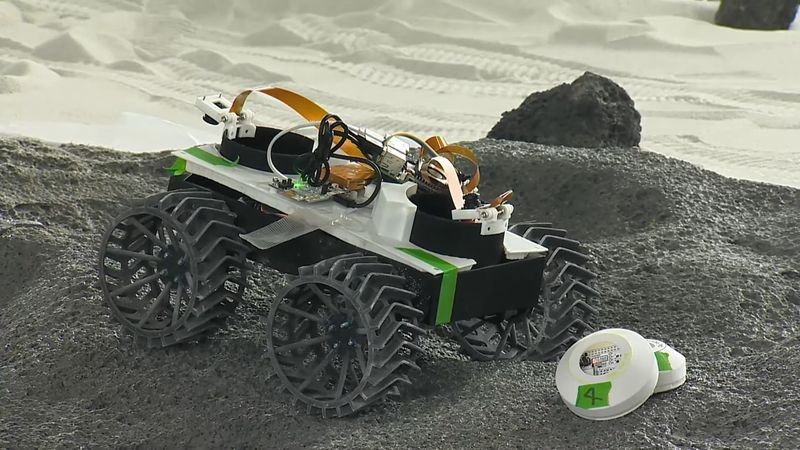
[Financial News] Students from Hansung University’s Department of Future Mobility won the Gyeongsangnam-do Governor’s Award at the first space rover competition held in Korea.
Hansung University said on the 27th that Arche_M1, a team of third-year students in the Department of Future Mobility, won the Mission Category Excellence Award at the 2026 Republic of Korea Space Rover Challenge, held on the 24th at the Sacheon Airshow venue in Sacheon, Gyeongsangnam-do.
The competition, hosted by the Korea AeroSpace Administration, was launched for the first time this year to identify next-generation space mobility technologies for use in lunar and Mars exploration. The Korea Atomic Energy Research Institute served as the lead organizer, with the Korea Advanced Institute of Science and Technology (KAIST) and the Unmanned Exploration Research Institute as co-organizers.
Twenty-three teams from across the country took part, and the eight teams that passed the technical proposal review advanced to the finals. The teams competed in the driving performance and exploration mission capabilities of small space rovers they had built themselves. The final judging selected one grand prize winner and three Excellence Award winners across the creativity, mission and technology categories.
Hansung University’s Arche_M1 team comprised five students: team leader Seo Hyemin, Kwon Daeun, Park Sihyeon, Oh Chanyeong and Lee Gyumin. Professors Kim Dongmin, Lee Gyeongbok and Noh Gwanghyeon jointly advised the team.
The rover they developed was designed to estimate its own position even on the lunar surface, where no external positioning system is available. It does so by directly deploying wireless devices (UWB anchors), which serve as reference points for positioning, as it drives.
The rover was designed to deploy its four onboard wireless anchors one after another along its route, and to combine distance measurements to the anchors with data from an inertial measurement unit (IMU) to estimate its 3D position in real time.
In the finals, the team carried out an exploration mission with a small rover weighing no more than 3 kg on a simulated lunar surface measuring 4 meters wide by 8 meters long. The team demonstrated its ability to carry out the mission by installing positioning reference points while traversing slopes and rocky terrain, then returning to the starting point.
Kim Dongmin, head of Hansung University’s Department of Future Mobility, said, “I find it meaningful that students achieved excellent results with technology they developed themselves at the first Space Rover Challenge held in Korea,” adding, “I will continue to actively support students so they can take on challenges and grow in the future space and aerospace field, drawing on their creative ideas and expertise in their disciplines.”
[email protected] Lee Bomi Reporter