[fn People] “We should be wary of assuming the semiconductor boom will continue ... Make services a new growth engine”
- Input
- 2026-10-27 14:27:40
- Updated
- 2026-10-27 14:27:40
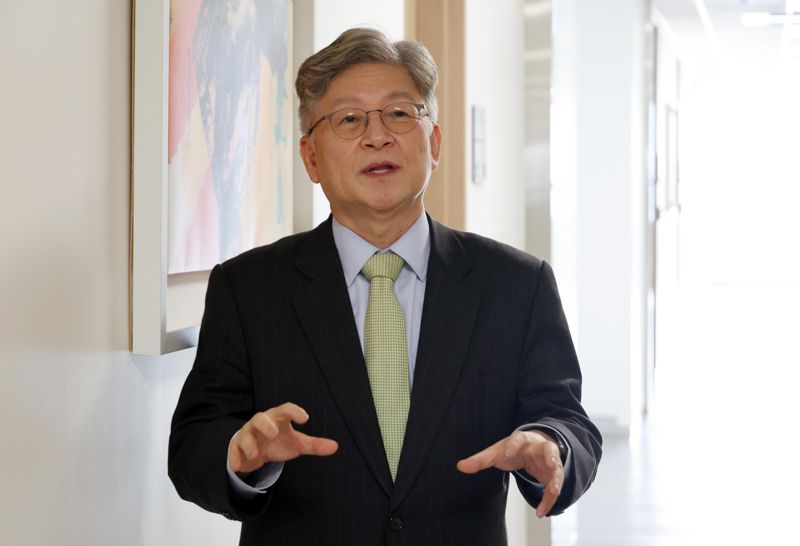
[Financial News] “We should be wary of formulating a growth strategy on the assumption that the current boom will continue.”
On the 27th, Kang Sung-jin, president of the Korean Economic Association, proposed fostering high-value-added service industries as a growth strategy to prepare for the period after the semiconductor boom. The idea is to raise the technological capabilities of manufacturing while building services such as finance, education, health care and tourism into new engines of growth.
Kang said South Korea’s growth strategy still relies heavily on an industrial structure centered on manufacturing that took shape in the 1970s. He noted that although leading industries have undergone restructuring and technological upgrading since the country’s heavy and chemical industrialization, policy support remains concentrated on major manufacturing industries.
He said the semiconductor boom is difficult to explain solely by South Korea’s technological competitiveness. Demand for high-performance semiconductors has grown with the spread of artificial intelligence (AI), while the global supply chain has been reconfigured amid the US-China competition for technological supremacy, benefiting South Korea’s semiconductor industry.
Kang cautioned, “We should not equate the gains brought by these changes in the external environment with long-term competitiveness,” adding, “Business conditions can change depending on demand and investment cycles, technological developments and trade policies.” His point was that, to turn growth driven by the semiconductor boom into a sustainable foundation for growth, South Korea needs an industrial structure that does not rely on the strong performance of any one industry.
He cited closer integration of manufacturing and services as a solution. With latecomers such as China catching up and expanding their capacity, he believes there are limits to further growth through increased production and investment alone. Kang said, “We need to strengthen service capabilities that increase manufacturing’s added value, including R&D, design, software, data analytics, finance and logistics.”
He also said the service sector is important for spreading the benefits of growth through domestic demand and employment. As people’s demand for services has become more diverse and sophisticated, domestic supply capabilities need to be strengthened. Kang stressed, “We need to establish institutional conditions that can promote investment and innovation while ensuring the public interest.” He added, “Supplying high-quality services domestically can redirect some of the consumption that would otherwise go overseas and also increase spending in South Korea by foreigners.”
Kang stressed that technological progress must be distinguished from its growth effects on the economy as a whole. He noted, “Even if AI adoption greatly boosts productivity in a particular industry, if those gains do not spread to other industries, synergies between industries and the growth effects across the economy will inevitably be limited.”
He identified labor market reform and improvements to the financial environment as measures needed to support this. The goal, he said, is to achieve “flexicurity” by increasing labor flexibility while strengthening employment safety nets and vocational training, and to expand venture capital to supplement funding centered on collateral and loans. He also stressed that high levels of R&D investment can drive productivity gains only if they lead to startups, commercialization and market entry.
He called on the government to eliminate unreasonable disparities in regulation and support between manufacturing and services. Kang said, “It is difficult to realize the growth potential of industries that combine manufacturing with software and transport services, such as drones and self-driving cars, if existing policy frameworks are applied unchanged.” He added, “We need to focus on reducing unreasonable regulations and arbitrary policy intervention, and on improving policy consistency and predictability.”
[email protected] Kim Chan-mi Reporter