“The moment the elevator doors opened, people rushed in” ... Only the stroller and wheelchair were left [What do you think?]
- Input
- 2026-10-27 15:38:23
- Updated
- 2026-10-27 15:38:23
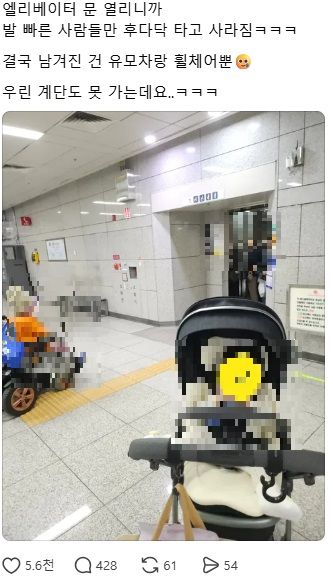
[Financial News] A story has emerged of wheelchair and stroller users being left out when ordinary passengers rushed onto an elevator as soon as its doors opened at a subway station, even though it was their only way to get around.
Unable to use the stairs, stroller and wheelchair users also struggle to get on elevators
According to the social media platform Thread on the 26th, a post was recently shared showing a stroller and an electric wheelchair left waiting outside a subway elevator after being unable to board. The post drew attention, garnering more than 200,000 views.
The poster, identified as A, wrote, “As soon as the elevator doors opened, only the people quick on their feet rushed in and disappeared,” adding, “In the end, all that was left in front of the doors was a stroller and a wheelchair. It was disheartening, since we can’t use the stairs either.” The elevator was full of ordinary passengers and left immediately. A helped a wheelchair user board the next elevator first and saw them off, then could barely get on when the third elevator arrived.
In media interviews and elsewhere, A lamented, “Wheelchair and stroller users take longer than ordinary pedestrians to get off a train and get around, so it’s not even easy for us to get in line first. It may be just a matter of ‘convenience’ for some, but for others it is their only means of ‘getting around to survive,’ so a more mature sense of civic responsibility and consideration are urgently needed.”
“Letting the next elevator go, then the next, leaves you stuck in the same place forever”: Personal accounts pour in
After the story spread, posts describing similar experiences began appearing in online communities. One user admitted, “I worry about what other people will think, and if I keep giving way, saying ‘I’ll take the next one, then the one after that,’ I end up standing in the same place forever.” Another woman in the final stages of pregnancy also shared her experience: “The elevator was packed, and when the warning alarm sounded, passengers who had boarded later gave me pointed looks, telling me to get off.”
Under the Act on Promotion of the Transportation Convenience of Mobility Disadvantaged Persons, people with disabilities, older adults, pregnant women, and people accompanying infants and young children are defined as people with mobility limitations who have the right to travel safely and conveniently. However, there are no provisions legally requiring priority boarding on elevators inside stations or imposing penalties for violations, so in practice their access depends entirely on passengers voluntarily giving way.
Experts agree that physical improvements are also needed, such as clearly marking designated waiting areas for people with limited mobility in front of elevators, as in major cities overseas, or separating the routes that guide passengers.
A civic group representative stressed, “Non-disabled passengers who can freely use stairs or escalators repeatedly block the only route available to people with limited mobility for a moment’s convenience,” adding, “The principle of prioritizing people with limited mobility must become firmly established across public transport facilities, through measures such as adding more wayfinding signs and improving queuing culture.”
[email protected] Mun Yeong-jin Reporter