Land Vice Minister Kim Yi-tak Reviews 20,000-Unit Public Procurement Target for Modular Homes: “Public Sector to Act as a Catalyst”
- Input
- 2026-10-27 14:12:03
- Updated
- 2026-10-27 14:12:03
[Financial News] The government has begun reviewing whether its plan to expand public procurement to grow the modular housing market is proceeding as intended. The review follows Korea’s Aug. 13 Housing Plan, which raised the public procurement target to 20,000 homes by 2030. The government plans to cover additional construction costs and address cost issues by enacting a special law.
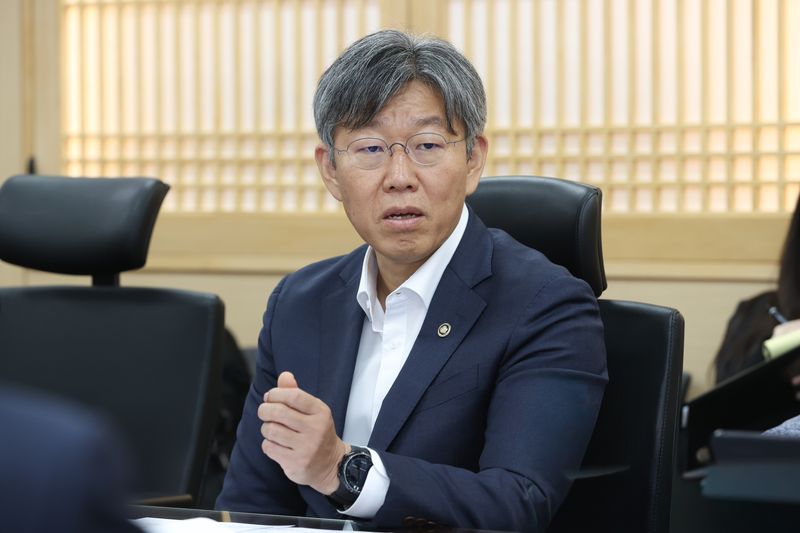
According to the Ministry of Land, Infrastructure and Transport on the 27th, First Vice Minister Kim Yi-tak held a consultative meeting that afternoon at the National Land Development Exhibition Hall with the Korea Land and Housing Corporation (LH), Gyeonggi Housing and Urban Corporation (GH), the Korea Institute of Civil Engineering and Building Technology (KICT), and related industry representatives to discuss ways to promote modular housing. Modular homes are built by first manufacturing the building’s main structural components and individual housing units in a factory, then transporting them to the site for installation and assembly.
The meeting was organized to check the progress of support measures for the modular housing ecosystem included in the “Aug. 13 Plan for Expedited Housing Supply” and review future plans. At the time, the government said it would raise the target procurement volume for modular public housing from 12,000 to 20,000 units for 2027–30 and launch pilot projects for high-rise housing of 20 stories or more. This would increase annual procurement from around 3,000 to 5,000 units.
A key advantage of modular construction is that factory production and on-site construction can proceed at the same time. It can shorten construction time by 20–30%, make quality control easier, and reduce the labor required as well as safety accidents. However, a clear limitation is that high construction costs make it difficult to ensure project viability.
Accordingly, the Ministry of Land, Infrastructure and Transport will subsidize the additional construction costs of public housing over conventional construction methods by 35 million won per household. Given that the additional costs per household cited when Korea’s Aug. 13 Housing Plan was announced were around 70 million won, public funds will cover roughly half the gap. The ministry also plans to enact a “Special Act on Modular Housing” and put tailored exemptions and incentives in place.
Under plans released earlier, LH is pursuing the Uiwang Chopyeong A4 block as a 22-story, 381-unit project, while GH is developing the Hanam Gyosan A1 block as a 25-story, 400-unit project. Uiwang Chopyeong is targeted for completion in November 2027, and construction at Hanam Gyosan is scheduled to begin in February 2027.
Deputy Minister Kim said, “Modular housing is a key to solving the difficult challenges facing the construction industry, including declining productivity, workforce structure, and safety management,” adding that the modular industry should be nurtured. He said, “The public sector should serve as a catalyst for revitalizing the modular housing market through the uninterrupted implementation of Korea’s Aug. 13 Housing Plan,” adding, “The government will also spare no necessary policy support to resolve difficulties through continued communication with the industry.”
[email protected] Jung Kyung-soo Reporter