Israel begins voting in first general election since the war ... Netanyahu's 'day of destiny'
- Input
- 2026-10-27 16:14:39
- Updated
- 2026-10-27 16:14:39
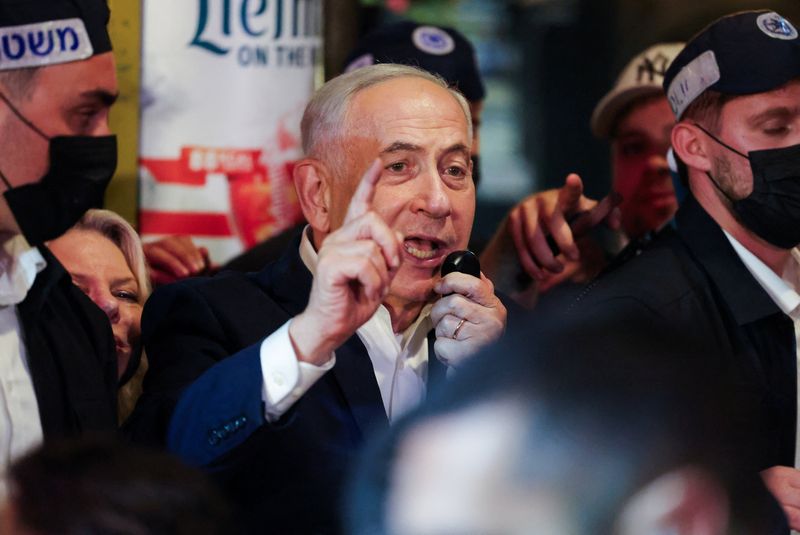
[Financial News] Voting has begun in Israel's general election to choose a new prime minister and government, as the country has been experiencing a two-front war for about three years. Israeli Prime Minister Benjamin Netanyahu, 77, who has held office for a cumulative 19 years, is seeking an eighth term by campaigning on security, but is expected to struggle to fend off an opposition closing in on him while calling for a reckoning with his government.
According to local media including The Times of Israel (ToI), Israel's Central Elections Committee announced on the 27th (local time) that voting in the election for the 26th Knesset had begun at 7 a.m. at 12,018 polling stations nationwide. Polls close at 10 p.m. (5 a.m. on the 28th Korea time), and broadcasters' exit polls, which can provide a read on the actual state of the race, will be released immediately afterward. The distribution of seats among the parties is expected to emerge over the following several hours to several days. Official results will be announced on the 4th of next month. On the 25th, The Wall Street Journal (WSJ) reported that Israel has no overseas absentee voting and estimated that more than 60,000 Israelis would return to their homeland solely to vote.
This is the first general election in 38 years to be held 'on schedule.' Given the country's highly unstable political landscape, this is the first Knesset since 1988 to have completed a full four-year term. Israel treats the entire country as a single constituency and elects all 120 members of the Knesset by proportional representation. About 7.3 million voters are eligible to vote, and parties that receive more than 3.25% of the vote are awarded at least four seats.
In Israel's parliamentary system, a prime ministerial candidate nominated by the president submits a proposed government to the Knesset, including their own appointment as prime minister and the other ministerial posts. The candidate can take office only if a majority of Knesset members (61) approves the proposal in a confidence vote. The president typically nominates as prime minister the leader of the party that receives the most recommendations from parties in the Knesset, giving them 28 days to form a government, with a possible 14-day extension. If both sides fail to form a government, an 'alternative government' outside the coalition could be formed. In the worst-case scenario, another election could be held next year, with Netanyahu remaining caretaker prime minister until then. According to the Israel Democracy Institute (IDI), a local think tank, forming a government has taken 20 to 100 days in the past.
Because of this electoral system, it is very difficult for a single party to form a government on its own in Israel, and coalition governments made up of several political forces are the norm. A composite of current polls estimates that the pro-Netanyahu right-wing bloc will win 50–51 seats, while four Jewish opposition parties opposed to Netanyahu are projected to secure 52–56 seats.
Foreign media have singled out former military chief Gadi Eisenkot as Netanyahu's strongest rival in this election. Now 66, Eisenkot is a military man who grew up in a family of Moroccan immigrants and served as chief of staff of the Israel Defense Forces from 2015 to 2019. He was elected to the Knesset in 2022 and served as a member of Benny Gantz's National Unity Party before founding the Yashar Party in 2025. On the Gaza war, Eisenkot has taken a more moderate stance than Netanyahu, advocating negotiations to secure the release of hostages. He has also stood in contrast to Netanyahu: Eisenkot's youngest son and two nieces or nephews were killed in the Gaza war, while Netanyahu's eldest son faces allegations of evading military service.
Meanwhile, US President Donald Trump, who started the Iran War with Netanyahu last February, referred to Netanyahu by his affectionate nickname, 'Bibi,' in a post on Truth Social on the 25th. Trump wrote, 'Let's elect Bibi Netanyahu as prime minister. We have to finish what we started.'
[email protected] Park Jong-won Reporter