[Kim Seong-gon's Journey Through Chinese Classical Poetry] 8: Shaoxing, an Art City Awash in Wine and Poetry
- Input
- 2026-10-29 08:00:00
- Updated
- 2026-10-29 08:00:00
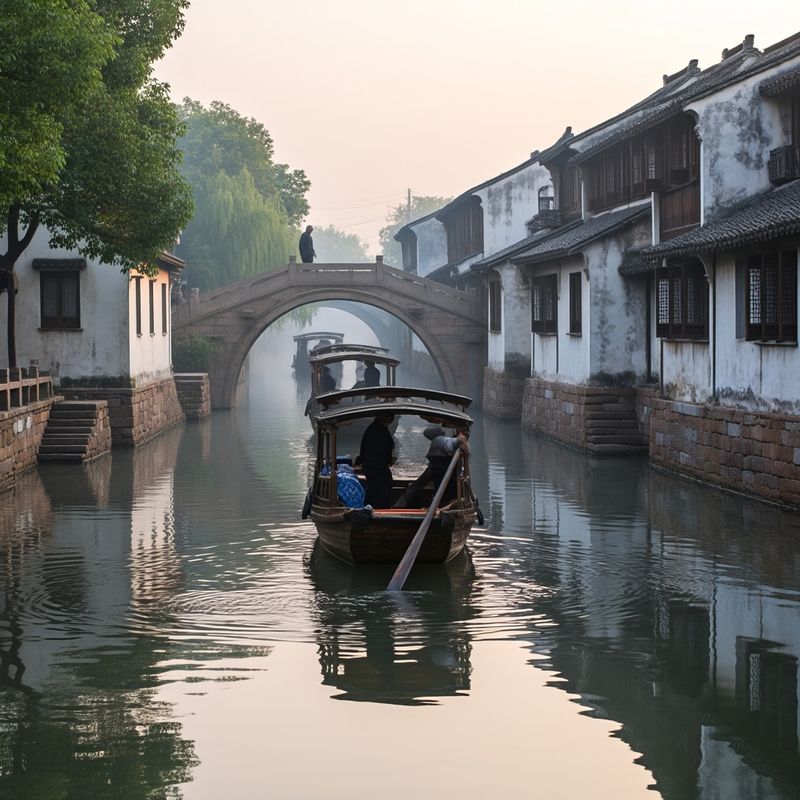
A drive of a little over an hour southeast from Hangzhou brings you to the historic city of Shaoxing. Set at the foot of Kuaiji Mountain, where the legendary flood-control hero Yu the Great is said to have gathered the feudal lords to reward them for their contributions, Shaoxing is an ancient city where traces of China’s long history remain throughout.
Shaoxing is a city steeped in the fragrances of literature and art as much as it is in history. Lu Xun, hailed as the father of modern Chinese literature, was born and raised here; the city holds the story of the tragic love of the great Southern Song poet Lu You; and it is also where He Zhizhang, the Tang dynasty’s most celebrated bon vivant, was born and spent his final years.
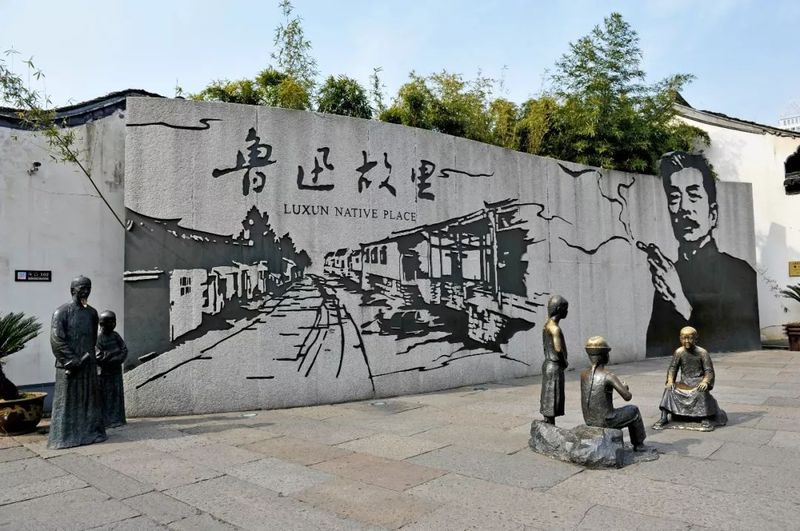
■ Meeting Kong Yiji in Lu Xun’s hometown
Lu Xun’s Native Place, in downtown Shaoxing, is the village where he was born and grew up through his youth. His former home, Baicao Garden—the vegetable plot tended by his family—and Sanwei Shuwu, where he studied as a boy, all retain their old appearance. Sanwei Shuwu, where Lu Xun studied from the age of 12 to 17, was a private school run by a scholar named Shou Jingwu. “Sanwei” means “three flavors,” referring to three pleasures of reading: reading Confucian classics is like eating plain rice, reading the books of the Hundred Schools of Thought is like tasting salty preserved fish, and reading history is like chewing meat. It is a charming name that compares the pleasure of reading to the taste of food.
One side of the desk where Lu Xun studied bears the character for “early.” It is said that Lu Xun carved it there after being scolded by his teacher for arriving late, as a promise to himself never to be late again. At the Lu Xun Memorial Hall across from Sanwei Shuwu, a famous line by Lu Xun catches the eye: “With knitted brows, I coolly face a thousand accusing fingers; bowing my head, I willingly become an ox for the children.”
The line comes from “Self-Mockery,” a seven-character regulated verse Lu Xun wrote in 1932. It embodies his literary spirit: refusing to submit to unjust power while willingly devoting himself to society’s powerless and vulnerable.
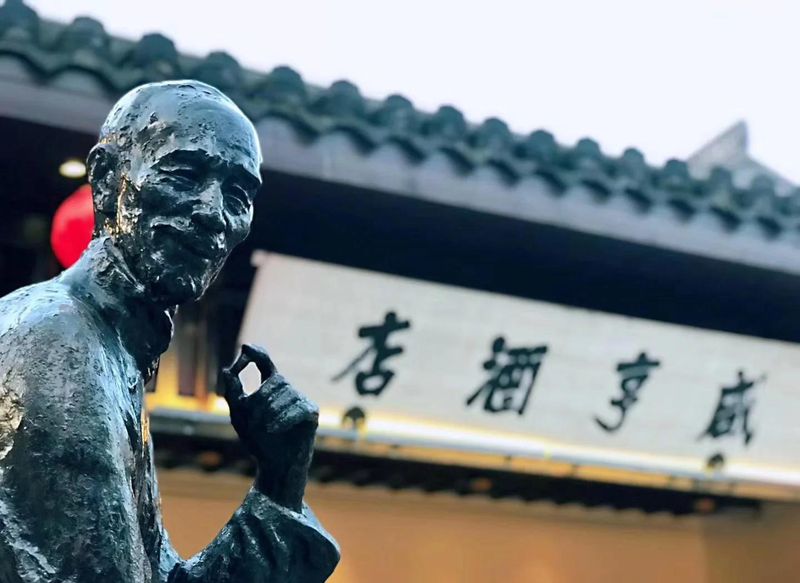
Leaving the Lu Xun Memorial Hall, visitors come to Xianheng Hotel, a symbol of his literary world. It is the setting of Lu Xun’s short story “Kong Yiji.” Kong Yiji is a fallen intellectual who failed to pass the imperial examinations. Wearing a shabby long gown, he comes to the tavern and orders wine, but, unable to afford a seat, he stands among the laborers and drinks. Whenever he appears, the customers tease him, accusing him of theft. Kong Yiji retorts with pedantic phrases, insisting that stealing books is what a scholar does.
The story depicts the failings of the feudal imperial examination system and the miserable fate of a fallen intellectual. But what drew Lu Xun’s attention was how people treated Kong Yiji. Those who mock him are also poor laborers, dressed in shabby clothes, standing as they drink wine by the cup. Though they too are socially vulnerable, they ridicule someone in an even more miserable situation instead of showing compassion.
Even when Kong Yiji, with broken legs after being caught stealing, appears at the tavern supporting himself with both hands, people’s attitude does not change. The owner presses him to pay his tab, and the customers laugh at him, asking if he has stolen again. Amid their laughter, Kong Yiji drains his last cup of wine and disappears.
A statue of Kong Yiji, still dressed in his long gown, stands in front of Xianheng Hotel. Tourists touch it and cheerfully pose for photos. Cross the street after leaving the hotel and you will find a wupeng boat landing. A wupeng boat is a small vessel with a black roof woven from bamboo. “Wu” means black, and “peng” refers to the boat’s canopy. The boatman rows the large oar with his feet and uses a smaller oar by hand to steer. Gliding through narrow waterways, the wupeng boat seems like the very spirit of Shaoxing’s water-town scenery.
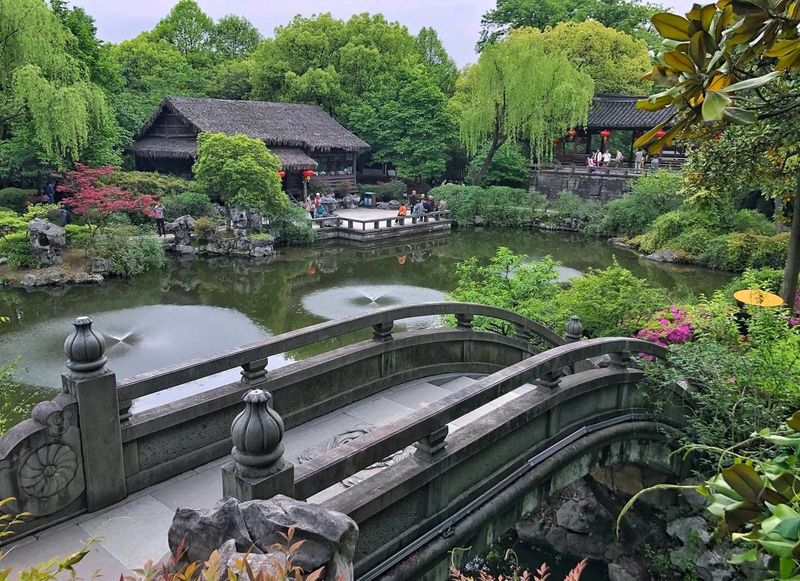
■ Shen Garden, where an enduring love lies at rest
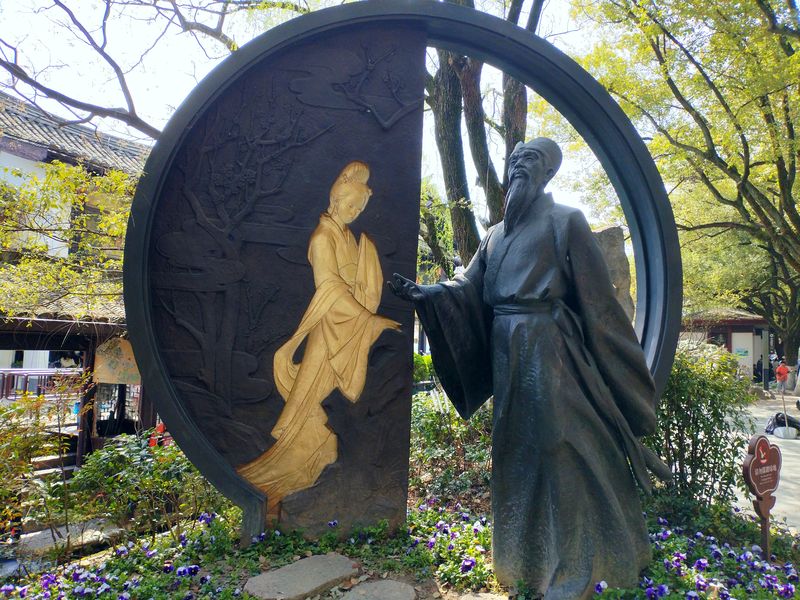
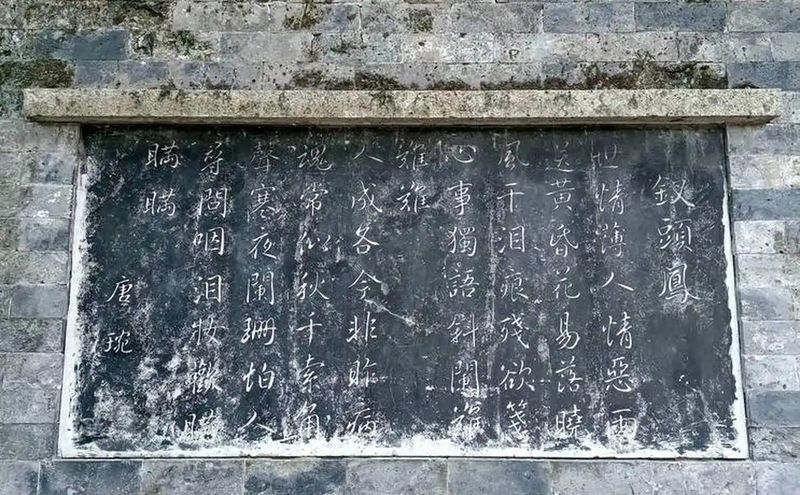
Not far from Lu Xun’s Native Place is the beautiful Shen Garden, a place imbued with the tragic love of the great Southern Song poet Lu You and Tang Wan. Lu You married Tang Wan, who was both beautiful and talented, and they lived happily, but his mother disapproved of her as a daughter-in-law, and the couple eventually separated. One spring day years later, Lu You happened to meet Tang Wan again at Shen Garden. She had come out to enjoy the spring with her second husband when she came across her former husband. With her husband’s permission, Tang Wan sat with Lu You and poured him wine. Unable to contain his powerful emotions, Lu You wrote a ci poem on the garden wall. It was the famous “Phoenix Hairpin.”
Fragrant wine poured by delicate hands
Spring has come to the whole city, and the willows are green
The fierce east wind has swept away the joys of love
How many years have I spent alone, my heart filled with longing?
Wrong, wrong, wrong—how wrong it all was!
Tang Wan, too, could not contain her grief and responded with “Phoenix Hairpin,” set to the same tune.
The world is harsh, and human feelings are cruel
At dusk, wind and rain easily scatter the petals
The traces of tears have dried in the morning breeze
I cannot convey these feelings even in a letter; alone, I lean on the railing and murmur to myself
Difficult, difficult, truly difficult!
Lu You laments the wrongs of the past with “Wrong, wrong, wrong,” while Tang Wan grieves over an inescapable reality with “Difficult, difficult, difficult.” Tang Wan died not long afterward. Years later, Lu You, now over 70, returned to Shen Garden and left a poem recalling his former love: “Beneath the heartbroken bridge, the spring waters run green; once they reflected your lovely form, like a startled wild goose.” The spring waters beneath Shen Garden’s bridge are as green now as they ever were, but the beautiful woman once reflected on their surface will never return. Standing in the garden and thinking of the tragic love of those who lived long ago, I suddenly look up to see evening petals fluttering down beside an old well. I find myself longing for a cup of Shaoxing wine.
■ He Zhizhang, the bon vivant born by Jianhu Lake
Southwest of Shaoxing, in the suburbs, lies Jianhu Lake, clear as a mirror. Once so vast it was called “the 800-li Jianhu,” the lake has shrunk considerably over the centuries, but it remains indispensable to any account of Shaoxing’s romantic spirit. Jianhu is the watery home of Shaoxing wine, regarded as China’s finest huangjiu, or yellow wine. Made primarily from rice and aged for a long time, Shaoxing wine is known for its amber color and rich aroma. In the past, people are said to have brewed wine when a daughter was born, buried it, and brought it out for the wedding feast when she married. This is the famous “Nü’er Hong.”

Jianhu gave rise to more than fine wine. He Zhizhang, the Tang dynasty’s most celebrated bon vivant, was born here too. A poet and calligrapher, he passed the imperial examination during the reign of Empress Wu Zetian and held a succession of high-ranking posts through the reign of Emperor Xuanzong. He was especially fond of wine and opens Du Fu’s “Song of the Eight Immortals of the Wine Cup,” about eight famous drinkers of the Tang dynasty: “When He Zhizhang rides a horse, he sways as if aboard a boat; dizzy, he falls into a well and sleeps beneath the water.” To get drunk, fall into a well, and still go to sleep—what a remarkable drinker. He Zhizhang was also the man who, on first meeting Li Bai and reading his poetry, exclaimed in admiration, “You must be an immortal banished from heaven to the human world!” At the age of 86, He Zhizhang retired from office and returned to his hometown by Jianhu Lake. After returning home for the first time in half a century, he wrote his famous poem “Written on Returning Home by Chance.”
I left home young and returned in old age
My dialect is unchanged, but my hair has turned white
The village children look at me but do not recognize me
They smile and ask, “Where have you come from, sir?”

Kim Seong-gon, professor in the Department of Chinese Language and Literature at Korea National Open University (KNOU)
[email protected] Sun-Min Jung Reporter