“Fired again despite winning a ruling that the dismissal was invalid” ... Workers at workplaces with fewer than five employees file constitutional complaint
- Input
- 2026-10-27 13:49:15
- Updated
- 2026-10-27 13:49:15
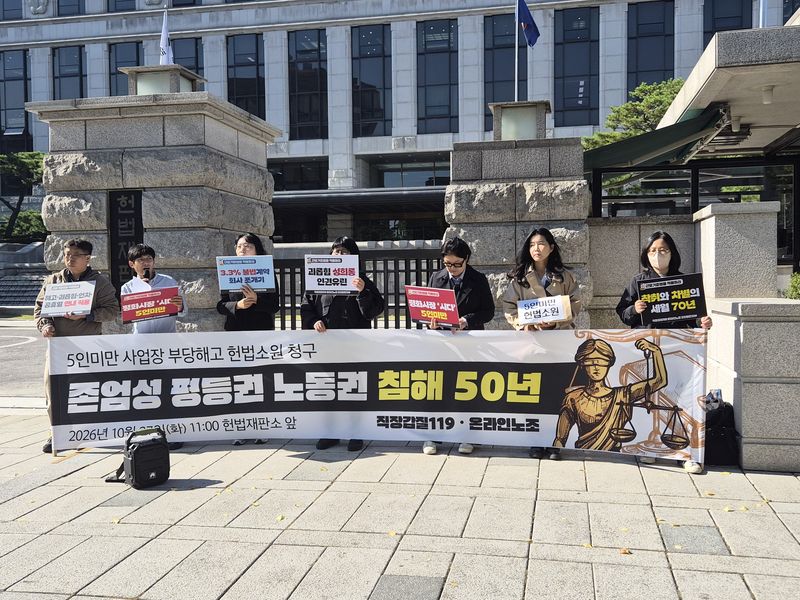
[Financial News] Workers at workplaces with fewer than five employees have filed a constitutional complaint challenging the current Labor Standards Act, which excludes them from provisions restricting unfair dismissal. They called for expanded legal protections, saying that they struggle to obtain redress because they cannot use Labor Relations Commission procedures due to their workplace size and must instead endure lengthy civil litigation.
On the 27th, the civic group Gabjil 119 held a press conference in front of the Constitutional Court of Korea in Jongno-gu, Seoul, and outlined the grounds for the constitutional complaint against Article 11, Paragraphs 1 and 2, of the Labor Standards Act and Article 7 of its Enforcement Decree. Under current rules, provisions restricting unfair dismissal and procedures for seeking redress through the Labor Relations Commission do not apply to workplaces with four or fewer regular employees. As a result, workers at those workplaces must rely on separate legal proceedings, such as civil lawsuits, rather than the Labor Relations Commission to challenge the legitimacy of their dismissal.
A petitioner who attended the press conference said they had been unfairly dismissed, but won a ruling invalidating the dismissal after years of civil litigation, only to be dismissed again after being reinstated. Yun Ji-young, representative and lawyer for Gabjil 119, explained, “The workplace had personnel rules setting out dismissal procedures, which enabled the claimant to win. But after the claimant was reinstated, the company abolished those rules and dismissed them again.” The case was cited as an example of how job insecurity remains unresolved even after workers win reinstatement following a lengthy legal battle.
Yun said, “Workers at workplaces with fewer than five employees have no choice but to endure unfair treatment for fear of being dismissed without just cause.”
Testimony about workplace harassment also continued. A worker employed at a human rights-related institution supported by a local government said that, after a conflict with the facility director, they endured ongoing emotional abuse but received no legal protection because the workplace was small. A migrant woman worker at the same institution also faced repeated reprimands and pressure to resign, and said she was told to leave because her contract had expired after she refused to resign.
Kim Du-na, a lawyer representing the petitioners, criticized the Constitutional Court for ruling in 2019 that the relevant provisions were constitutional without adequately considering workers’ employment insecurity and the possibility of their rights being violated in comparison with the burden on small-business owners. The argument is that differences in legal protection based on workplace size also restrict workers’ opportunities to seek redress for violations of their rights.
According to a survey conducted by Gabjil 119 last year, dismissal accounted for 30.8% of the reasons workers at workplaces with four or fewer employees lost their jobs—more than twice the overall average among workers of 14.1%. By contrast, voluntary resignations accounted for just 11.5%. These figures show that workers at small workplaces face a comparatively high risk of dismissal.
Lawyer Kim pointed out that the exclusion of small workplaces from provisions restricting unfair dismissal has continued since 1975. While the scope of some labor protections, including severance pay and maternity protection, has expanded, procedures for seeking redress for unfair dismissal still do not apply to workplaces with fewer than five employees. In other words, even as protections under labor laws have gradually expanded, legal remedies for dismissal remain unequal based on workplace size.
Yun emphasized, “We must change the reality that workers most in need of protection are excluded from procedures for seeking redress for unfair dismissal.”
[email protected] Lee Dong-hyuk Reporter