‘Catfish’ Toss puts online investment-linked finance industry on edge as it watches FSC review
- Input
- 2026-10-29 16:50:20
- Updated
- 2026-10-29 16:50:20
[Financial News] Toss’s entry into online investment-linked finance (OIF) is becoming a reality. After completing the establishment of a subsidiary, it is expected to launch operations as early as early next year. Tension is mounting across the OIF industry as Toss, with its large capital base and user base, enters the market. The review by financial authorities is also drawing attention amid concerns about conflicts of interest.
According to financial-sector sources on the 29th, it is expected to take at least 3–4 months for Toss’s OIF subsidiary, Toss Inclusive Preparatory Corporation, established on the 16th, to begin actual operations. However, with the OIF Association expected to issue a “certificate of prospective membership” this month, an FSC review of its OIF registration scheduled for early November, and technical procedures such as connecting to the Korea Federation of Savings Banks’ system still to be completed, a launch before the end of the year is considered unlikely.
The business segment has not been finalized, but personal credit loans for borrowers with mid-to-low credit ratings are expected to form its core. The most likely model is for Toss to use an alternative credit assessment model to identify people unable to obtain loans from mainstream financial institutions such as commercial banks, then connect them with savings-bank investment to provide loans at mid-range interest rates.
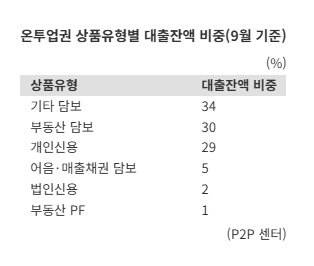
It is also possible that the company will offer real estate-backed loans and other collateral-backed loans, including loans secured by securities accounts. According to the OIF Central Record Management Institution, as of September, real estate-backed loans (30%) and other collateral-backed loans (34%) accounted for larger shares of the industry’s outstanding loan balance than personal credit loans (29%).
Toss says it will focus on expanding the market, but OIF companies are on edge. If Toss, with its large capital base and user base, enters, they will have to give up a significant portion of a market that is effectively limited in size.
OIF operators are currently limited to making linked investments with financial institutions of up to 40% of the amount raised, so they need to bring in at least three institutions (40·40·30%) to fund a loan. An OIF company official noted, “Even now, it’s difficult for mid- and lower-tier companies to bring in three institutions, and this will make that hurdle even higher,” adding, “This could also give financial holding companies and other big tech firms a reason to enter the market.”
Toss is also said to have already held preliminary talks with savings banks. SBI Savings Bank, OK Savings Bank and KB Savings Bank are among those mentioned as potential participating institutional investors. The industry is watching the FSC closely. The key question is what standards the FSC will use and how rigorously it will review Toss’s OIF registration. OIF is subject to registration rather than licensing, but both ruling and opposition parties raised concerns during this month’s parliamentary audit over conflicts of interest arising from platforms supplying financial products and large conglomerates entering the market, leaving room for a closer review.
A Toss representative said, “We will apply the same fee and exposure standards to our subsidiary as to other OIF companies,” adding, “Rather than take a share away from existing operators, we plan to pursue the business in a way that can increase the funds flowing into the market.”
[email protected] Kim Tae-il Reporter