Gwangju-area city bus routes to be overhauled on the 31st; total to rise from 103 to 115 for first time in 9 years
- Input
- 2026-10-27 13:17:28
- Updated
- 2026-10-27 13:17:28
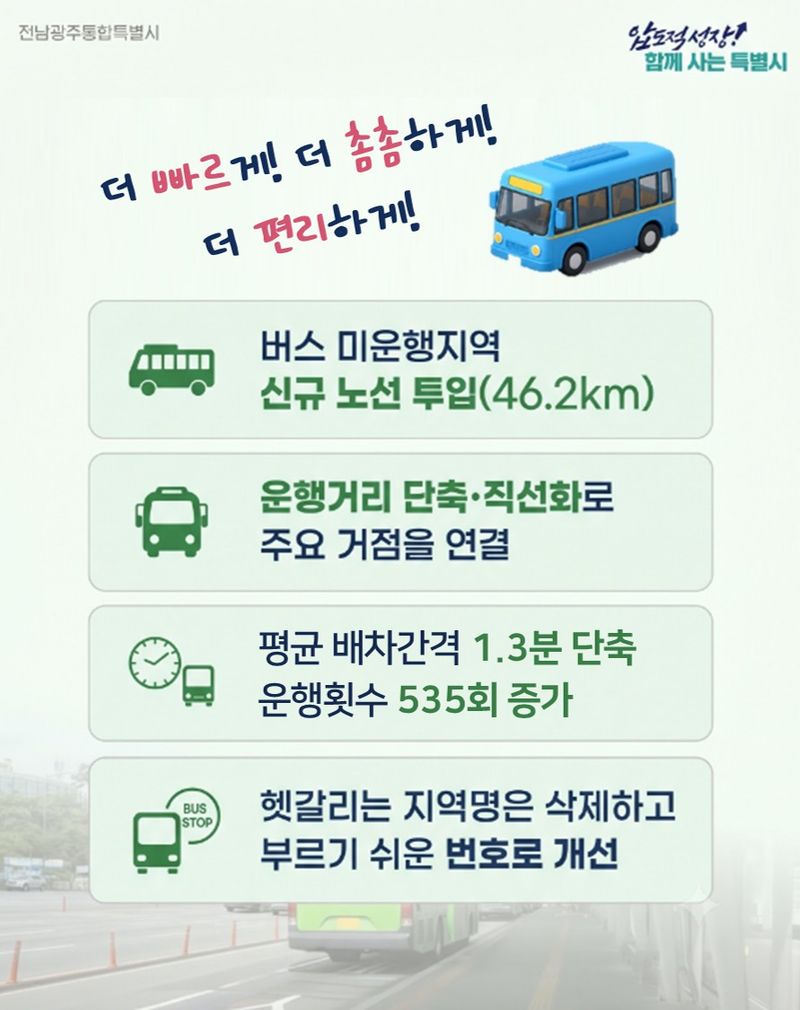
【Financial News, Jeonnam-Gwangju = Hwang Tae-jong, Staff Reporter】Jeonnam-Gwangju Integrated Special City (Gwangju Metropolitan City) will comprehensively overhaul city bus routes in the Gwangju area on the 31st, for the first time in 9 years.
Reflecting changes in the urban layout and residents’ travel needs, the key goals of building a “faster, denser, and more convenient city bus system” are to shorten travel times between major hubs, expand routes in underserved areas, add metropolitan and express routes, and simplify route numbers.
“Without adding buses, we will reorganize long-distance and overlapping routes and improve vehicle operating efficiency, increasing the number of city bus routes by 12, from 103 to 115, and adding 535 daily runs,” said Kim Yeong-seon, director of Gwangju Metropolitan City’s Integrated Transportation Bureau.
According to Gwangju Metropolitan City on the 27th, routes connecting major hubs such as universities and terminals have been straightened. Express service, with stops primarily at major hubs, has also been introduced on six long-distance and heavily used routes, making it possible to shorten travel times between major hubs.
Routes have also been extended by a total of 46.2 km across 19 underserved areas, including new residential complexes in places such as Sinyong and Yongdu-dong and Cheomdan 3 District, as well as areas where village bus services have been suspended. Metropolitan and express routes toward Naju Innovation City and Hwasun have increased from one to three, strengthening connections between neighboring areas.
Route numbers have also been revised to make them easier for residents to recognize: the existing numbers have been retained as much as possible, while the regional names previously prefixed to them have been removed.
“The revised routes can be checked from the launch date, the 31st, on the Gwangju Bus Operation Information System, NAVER Map, and KakaoMap,” said Kim Yeong-seon, director of the Integrated Transportation Bureau. “Real-time bus arrival information for each stop will also be provided.”
Kim Yeong-seon added, “Residents can look up the revised routes in advance using the QR codes on notices posted inside buses and at bus stops. Route maps are also being distributed at district offices and administrative welfare centers for residents who have difficulty accessing the internet.”
Meanwhile, Gwangju Metropolitan City plans to operate a “route-reorganization situation room” from the 31st through November 6 to minimize confusion during the initial rollout, closely monitor bus operations and issues affecting residents, and respond quickly to problems that arise on the ground.
The city also plans to comprehensively analyze actual operating conditions, transit card usage data, and residents’ opinions from November through December, and make further route adjustments, focusing on sections where transfers are inconvenient or congestion occurs.
[email protected] Hwang Tae-jong Reporter