IAEA Ministerial Conference on Nuclear Energy Held in Korea for First Time; “SMR Development and Demonstration to Accelerate”
- Input
- 2026-10-27 11:41:13
- Updated
- 2026-10-27 11:41:13
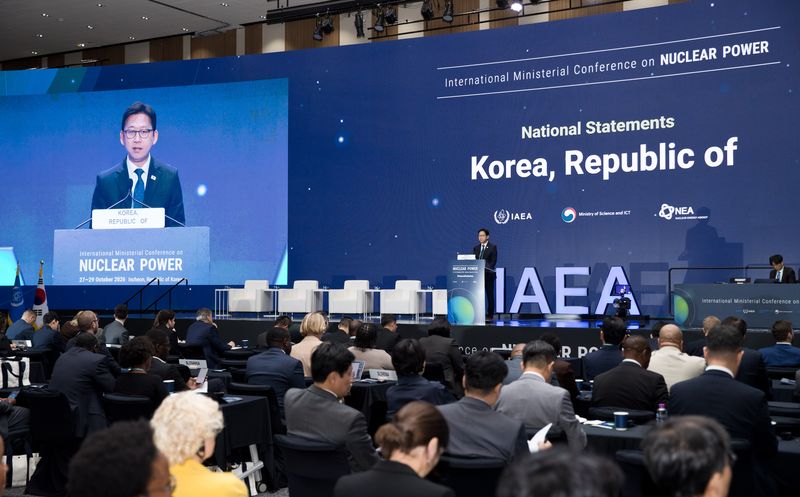
The Ministry of Science and ICT said the IAEA Ministerial Conference on Nuclear Energy opened on the 27th at Songdo Convensia in Incheon. The conference, the first of its kind to be held in Korea, runs through the 29th, with Deputy Prime Minister and Minister of Science and ICT Bae Kyung-hoon chairing and leading the discussions. About 800 people attended, including ministerial-level representatives of IAEA member states, as well as representatives from the governments of 60 member states, eight international organizations, and around 85 companies from Korea and abroad.
The IAEA Ministerial Conference on Nuclear Energy is a leading high-level policy meeting that discusses the peaceful uses of nuclear energy and future policy directions, and is generally held every four years. Launched in Paris, France, in 2005, the conference has since been held in China, Russia, the United Arab Emirates and the United States. This year’s sixth meeting is being held in Korea.
Since its first research reactor began operating in 1962, Korea has achieved technological self-reliance and exports of nuclear power plants and research reactors, growing from a country that adopted nuclear energy into one that shares its technology and experience. As nuclear energy’s role grows amid energy security and carbon neutrality goals, as well as rising electricity demand from artificial intelligence (AI) and advanced industries, Korea is leading discussions on the future of global nuclear energy and international cooperation through this conference.
In his opening remarks, Deputy Prime Minister Bae stressed that “we must bring together the technologies and experience of different countries under the principles of safety, nuclear security and nonproliferation, and cooperate so that the benefits of nuclear energy reach more countries and people.” He expressed his determination to use the conference, as host country, to expand practical cooperation among countries.
In his subsequent keynote address, he set out three key policy priorities for Korea: strengthening trust based on safety and transparency; the safe development and demonstration of small modular reactors (SMRs); and becoming a global production hub.
First, he emphasized that ensuring safety and communicating transparently are fundamental responsibilities in the use of nuclear energy. He expressed his determination to raise safety standards through scientific reviews and inspections under an independent regulatory system, guided by recommendations from IAEA international reviews, and to build trust among the public and the international community by disclosing operational and safety information and communicating transparently.
He explained that, building on this trust, Korea would pool public- and private-sector capabilities to accelerate SMR development and demonstration. While respecting the independence of regulatory bodies, it will strengthen the foundations for regulatory research and verification, and advance technology development to meet demand and operating conditions such as supplying power to AI data centers, providing industrial heat and powering ships. He added that Korea would update laws and regulations to support the commercialization of technologies whose safety has been sufficiently verified.
He also said Korea would work with nuclear design and development companies in various countries to become a global production hub. Its accumulated manufacturing and construction capabilities will support rigorous quality control and reliable supply, while AI and robotics will be used to strengthen on-site safety and quality management. He stressed that Korea would also expand cooperation across the entire lifecycle, including operations, decommissioning, waste management and next-generation nuclear fuels.
The conference covers a broad range of topics, from policy directions for the safe expansion and new uses of nuclear energy to specific implementation tasks. High-level sessions (panel sessions) discuss key policies and strategies to support energy security and carbon neutrality, including nuclear power plant deployment, regulation and SMRs. Expert sessions (In Focus) explore ways to develop talent, secure financing and build public trust—measures needed to turn policy into actual projects.
As part of the conference, Korea is leading the “A New Era of Nuclear Energy” session and setting out directions for technological innovation and international cooperation based on its digital and nuclear capabilities. The session focuses on ways to use AI to improve the safety and efficiency of nuclear energy and to expand cooperation on the use of SMRs and marine nuclear energy.
Ahead of the conference, on the 26th, the Ministry of Science and ICT held the Korea-U.S. Nuclear Industry Dialogue with the U.S. Embassy in Korea. A total of 150 people, including representatives of the two governments and 50 companies and organizations, took part and explored opportunities to connect demand in the U.S. nuclear market with Korea’s manufacturing, construction and supply-chain capabilities. Major U.S. companies attending included TerraPower, NuScale Power Corporation, Oklo, Kairos Power and Centrus Energy. Korean participants included Korea Hydro & Nuclear Power, Doosan Enerbility, Hyundai Engineering & Construction, Samsung C&T, SK Innovation and Samsung Heavy Industries.
[email protected] Yeon Ji-an Reporter