Splitting administrative districts left only fiscal strife... Incheon’s Seohae District seeks mediation over a 64.8 billion won settlement dispute
- Input
- 2026-10-27 11:33:11
- Updated
- 2026-10-27 11:33:11
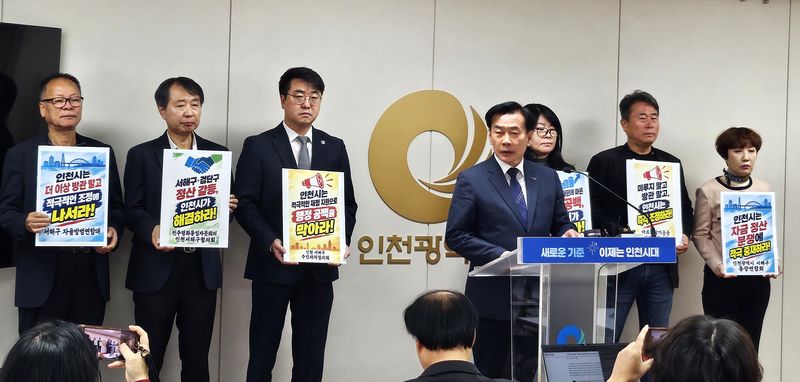
[Financial News, Incheon = Han Gap-su] The fiscal dispute between Incheon’s Seohae District and Geomdan District has been referred to Incheon Metropolitan City’s Dispute Mediation Committee. Although the two autonomous districts were launched following an administrative restructuring, they have failed to resolve their differences over financial settlements, the transfer of local debt, and public facility operating costs. Seohae District warns that its funds could run out from the middle of next month, while Geomdan District counters that the settlement amount was calculated incorrectly in the first place. There are concerns that a prolonged dispute could disrupt public services for residents.
Seohae District chief Gu Jae-yong said at a press conference at Incheon Metropolitan City Hall on the 27th that he would officially apply to Incheon Metropolitan City for dispute mediation over the financial settlement with Geomdan District. The move comes after months of talks between the two sides and mediation by the city failed to produce a solution.
The central issue is the 64.8 billion won in spending that exceeded revenue in the Geomdan area during the first half of this year. According to Seohae District, revenue in the area during that period was 38 billion won, while expenditure was about 102.9 billion won. Seohae District says it should be reimbursed for the excess spending because it initially covered the costs to ensure Geomdan District’s stable launch and administrative operations. It says the spending followed the principles for allocating launch budgets for autonomous districts set by Incheon Metropolitan City and the financial separation criteria agreed on by both sides.
Geomdan District chief Kim Jin-gyu, however, questioned the basis for the calculation at a press conference on the 26th, saying, “Seohae District initially demanded 58.1 billion won, but listed 64.8 billion won in the official letter it sent to Geomdan District.” He claimed that, as an omission of 10.8 billion won in non-tax revenue was corrected, revenue in the Geomdan area fell while expenditure rose by about 6 billion won. Geomdan District said it would be difficult to accept the settlement demand because there was insufficient detailed calculation information and supporting documentation for the revised amount.
The two sides are also at odds over what should be settled and which costs should be included. Seohae District argues that Geomdan District should cover spending incurred in the Geomdan area after the administrative boundary was divided. Geomdan District says the settlement criteria must first be clarified and the figures objectively verified.Seohae District: “Funds to run out in mid-November”... Payroll and waste-disposal costs in jeopardyGeomdan District also faces the cost of securing government offices and repaying debt... The fiscal dilemma facing newly established autonomous districtsThe dispute has also spread to local debt and public facility operating costs. Geomdan District says its fiscal burden has grown after it took on 26.3 billion won in local debt issued by the former Seo District. The debt includes costs related to the construction of the Majeon-dong Administrative Welfare Center and the Ara 1-dong Complex Government Building, as well as park development. Seohae District counters that, since Geomdan District took over the relevant facilities, it should also assume the associated debt.
Operating costs for facilities in the Geomdan area managed under contract by the Seohae District Facilities Management Corporation are another point of contention. Geomdan District pays personnel and project costs for libraries, sports facilities, and other sites, but objects that there is insufficient basis for Seohae District’s demand that it additionally contribute around 1.1 billion won toward the corporation’s head office operating costs. The two sides also continue to disagree over the transfer of employment for corporation staff.
The fiscal dispute could also affect residents’ daily lives. Seohae District said that if it does not receive the settlement funds, it could face difficulties paying essential expenses, including public employees’ salaries and waste-disposal costs, from mid-November. It also warned that securing funds through the final supplementary budget in December could prove difficult and asked Incheon Metropolitan City for emergency support. The district said the fiscal pressure was so severe that it was considering restructuring and selling assets it owns.
Geomdan District also has to establish its administrative infrastructure and secure government offices, while shouldering the burden of repaying local debt. It urged Incheon Metropolitan City, which led the administrative restructuring, to take responsibility for resolving the issue, saying the burden stemming from the former Seo District’s financial management should not be shifted onto a newly established district.
Seohae District proposed that Geomdan District pay part of the settlement amount first and resolve the rest through further talks. It asked Incheon Metropolitan City to finalize the settlement amount and repayment date before its funds run out in November, and to put emergency financial support measures in place even before the settlement is completed.
District chief Gu Jae-yong stressed, “Incheon Metropolitan City, which pushed for the administrative restructuring, must resolve the problems caused by inadequate preparation.” He said the city must clarify the financial principles and determine responsibility, rather than leaving the fallout from the administrative boundary changes to negotiations between the two autonomous districts alone.
The purpose of administrative restructuring is to provide residents with better public services, and there are calls for Incheon Metropolitan City to offer a practical solution so that disputes over fiscal responsibility do not become a burden on residents.
[email protected] Han Gap-su Reporter