A day when you show up for work but can’t get anything done: The reasons differ by age [Health Check]
- Input
- 2026-10-27 11:17:59
- Updated
- 2026-10-27 11:17:59
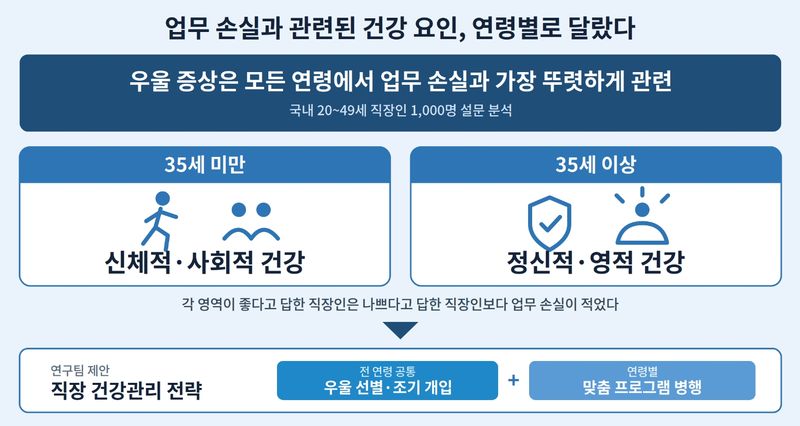
[Financial News] Depressed workers differed by age in how they experienced work loss. Among those under 35, absenteeism—not being able to come to work at all—was more pronounced, while among those aged 35 and older, “presenteeism”—showing up for work but being unable to get work done—stood out. Health factors associated with work loss also differed: physical health and relationships for younger workers, and mental health and meaning in life for middle-aged workers.
A research team led by Yun Yeong-ho, professor of family medicine at Seoul National University Hospital and director of its Gangnam Center, and Jeong Ju-yeon, professor in the Division of Tourism & Wellness at Hankuk University of Foreign Studies (HUFS), released its findings on the 27th. The team surveyed 1,000 workers aged 20–49 across various industries in January 2024, including 489 under 35 and 511 aged 35 or older. The findings were published in the latest issue of the international journal Journal of Occupational and Environmental Medicine (JOEM).
The research team considered a score of 10 or higher on the depression screening tool (PHQ-9) to indicate depressive symptoms. Work loss was measured in terms of absenteeism (the proportion of working hours lost because health problems prevented someone from working), presenteeism (the extent to which work efficiency declined due to health problems despite attending work), and total work loss, which combines the two.
Depression linked to 5.42 times the odds of absenteeism and 4.78 times the odds of presenteeism
In both age groups, depressive symptoms were the factor most strongly associated with work loss. The same pattern held after adjusting for sex, education, income and other factors.
Among workers under 35, those with depressive symptoms had 5.42 times the odds of absenteeism, 2.13 times the odds of presenteeism and 2.43 times the odds of overall work loss compared with those without depressive symptoms. Among those aged 35 and older, the odds were 2.89 times for absenteeism, 4.78 times for presenteeism and 4.84 times for overall work loss. In other words, work loss manifested as absenteeism among younger workers and as reduced efficiency after coming to work among middle-aged workers.
The areas of health associated with work loss also differed by age. Among those under 35, good physical health was associated with 0.52 times the likelihood of presenteeism and overall work loss, respectively. Good social health was associated with half the likelihood of overall work loss (0.50), while good mental health was associated with 0.59 times the likelihood of presenteeism.
Among those aged 35 and older, associations with mental and spiritual health were more pronounced. Good mental health was associated with 0.32 times the likelihood of presenteeism and overall work loss, respectively—about one-third the likelihood—while good spiritual health was associated with 0.41 times the likelihood of absenteeism. The research team interpreted the findings as suggesting that physical vitality and relationships within the organization may be factors associated with work loss among those under 35, while psychological resources and meaning in life may be associated factors among those aged 35 and older.
One in three workers under 35 has depressive symptoms ... absenteeism rate twice as high
The rate of depressive symptoms among those under 35 was 33.1%, higher than the 27.0% among those aged 35 and older. The average proportion of working time lost because of health problems was also 6.8%, about twice the 3.3% among those aged 35 and older. Presenteeism (36.3% versus 32.9%) and overall work loss (39.5% versus 34.4%) were also higher among those under 35.
The research team proposed promoting workplace depression screening and early intervention, and reducing stigma around mental health, across all age groups, while also running age-specific programs. Physical activity programs, team building and peer mentoring may suit those under 35, while stress management, mindfulness and programs focused on finding meaning in life may be appropriate for those aged 35 and older.
Professor Jeong said, “Because the health factors associated with work loss differ by age, wellness strategies need to be tailored to the characteristics of each age group rather than taking a one-size-fits-all approach.”
Professor Yun emphasized, “Depression is the factor most strongly associated with declining workplace productivity,” adding, “We need to change our thinking so that we do not view health solely as an individual issue or a matter of corporate benefits, but invest in the health of our employees to boost productivity and competitiveness.”
[email protected] Jung Myung-jin, Medical Correspondent Reporter