Inje County residents stage mass rally outside National Assembly; county governor and emergency committee chair shave their heads, demand withdrawal of Tier 2 designation
- Input
- 2026-10-27 10:50:16
- Updated
- 2026-10-27 10:50:16
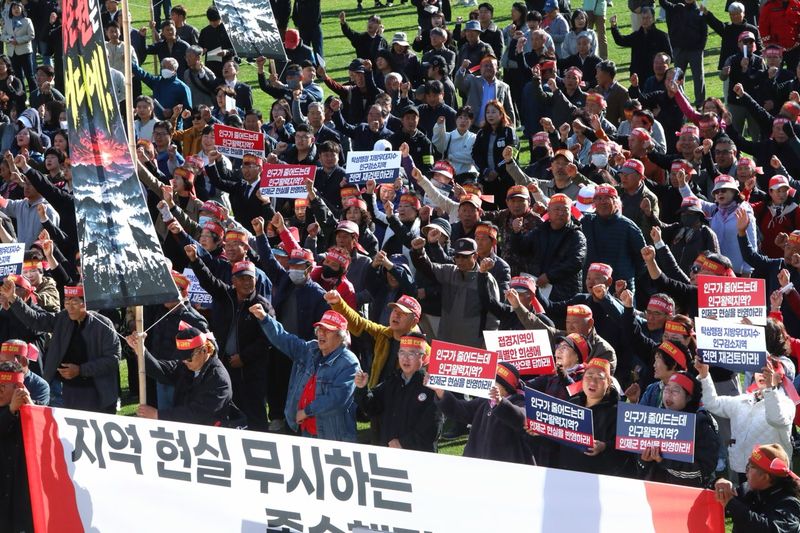
[Financial News, Inje — Kim Gi-seop, reporter] When Inje County, a border county with a population of 30,000, was placed in Tier 2 under the Local Preferential Treatment Index alongside cities such as Chuncheon, Wonju, Gangneung and Sokcho, around 600 residents converged outside the National Assembly, where the county governor and the emergency committee chair even shaved their heads as they demanded the government reconsider its decision.
The Emergency Committee Against Inje County’s Tier 2 Designation under the Local Preferential Treatment Index will hold protest rallies in front of the National Assembly in Seoul over two days, from the 27th through the 28th, the county said on the 27th. Participants included Inje County residents; National Assembly member Lee Yang-su (Sokcho, Inje, Goseong County, Gangwon Province, and Yangyang County); Inje County Governor Choi Sang-gi; Inje County Council Chair Kim Do-hyeong; Inje County Village Heads’ Association Chair Kim Geun-seong; and members of civic groups from six towns and townships. The committee plans to keep up its joint response until concrete support measures are introduced, gathering residents’ signatures and statements from civic groups and regularly conveying them to the government so the rally does not end as a one-off protest.
After holding the first rally at the Inje grass field at 9 a.m. with around 3,000 participants, around 600 residents traveled to Seoul and continued the protest from 12:30 p.m. in front of the National Assembly’s main gate. The program included a report on developments, protest speeches, the reading of a resolution and chants. County Governor Choi, Emergency Committee Chair Kim Do-hyeong and Association Chair Kim Geun-seong took part in a head-shaving ceremony, calling for the proposed Tier 2 classification to be corrected.
An additional rally will be held at 1 p.m. on the 28th on the steps of the National Assembly, with around 200 participants, including County Governor Choi, Council Chair Kim, residents and members of civic groups. Local civic group leaders will also join the head-shaving ceremony. After the rally, they plan to deliver a letter of protest to the chair of the National Assembly’s Special Committee on Budget and Accounts, calling for institutional improvements that reflect local conditions and the development of support measures.
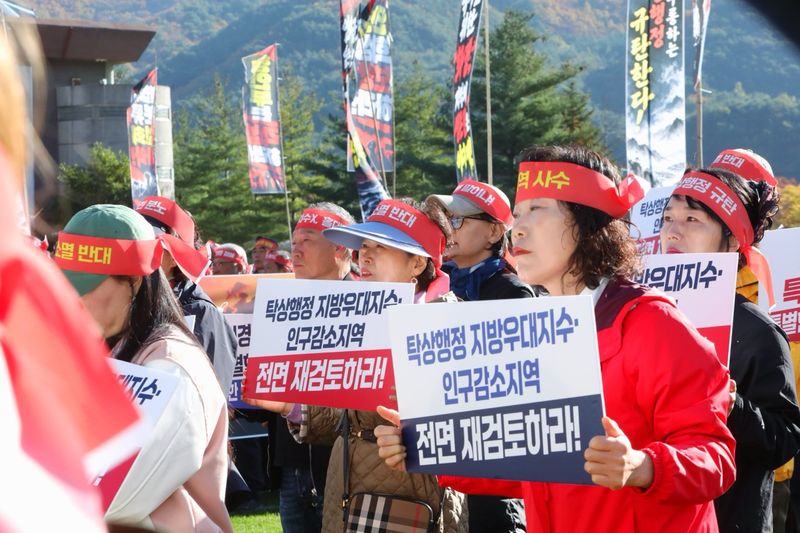
The collective action stems from a series of regional classification decisions by the Ministry of the Interior and Safety. In its redesignation of depopulation areas on the 7th, the ministry excluded Inje County and classified it as a Population Vitality+ region. In the Local Preferential Treatment Index announced on the 20th, it placed Inje County in Tier 2 along with Chuncheon, Wonju, Gangneung and Sokcho. Inje County is the only county-level area in the province included in Tier 2.
The county argues that the classification failed to reflect the realities of a border region whose development has long been constrained by military facility protection zones and various environmental regulations. The registered population fell by 1,529, from 32,165 at the end of 2021 to 30,636 this September, while the county ranks 151st in regional underdevelopment among 167 cities and counties nationwide. The county also maintains that, since the straight-line distance from Seoul used to calculate the index does not adequately reflect actual travel times or transportation conditions, access to everyday services such as healthcare and education, as well as the distinct circumstances of border and mountainous regions, should be assessed comprehensively.
The disparity in financial support is the community’s greatest concern. Once the Local Preferential Treatment Index is fully applied starting next year, government programs—including support for issuing Local Love Gift Certificates—will provide different levels of support by tier. There are also concerns that if child-welcome support grants are later tiered according to the index and Inje County receives a lower amount, conditions for childbirth and child-rearing could worsen further in a region experiencing population decline.
The county and the local community previously held an emergency response meeting on the 21st. On the 22nd, Inje County, the Inje County Council, the Inje County Village Heads’ Association and the Inje Junior Chamber, among others, held a press conference at the Gangwon Special Self-Governing Province Government Office and called for institutional improvements. They later formed a subcommittee of the emergency committee and have discussed response measures, including gathering residents’ signatures and submitting statements.
In his protest speech, Emergency Committee Chair Kim Do-hyeong criticized the government, saying, “The circumstances of Inje County, which has long put off development in order to defend the country and preserve nature, were not reflected in this government’s assessment.” He called for a complete review of the calculation method, disclosure of the grounds for evaluating each indicator, and adjustments to the tiers to reflect local conditions.
In a resolution, Inje County Village Heads’ Association Chair Kim Geun-seong said, “The Local Preferential Treatment Index groups Inje County—which has lost more than 1,500 people in five years and ranks among the most underdeveloped areas nationwide—with cities. It is preferential treatment in name only and a new form of discrimination against residents.” He urged the government to “withdraw the Tier 2 designation, improve the calculation criteria, disclose the grounds for the evaluation, and introduce concrete support measures.”
[email protected] Kim Gi-seop Reporter