“See clearly even when muddy water splashes on the lens”... See-through lens developed
- Input
- 2026-10-27 10:51:21
- Updated
- 2026-10-27 10:51:21
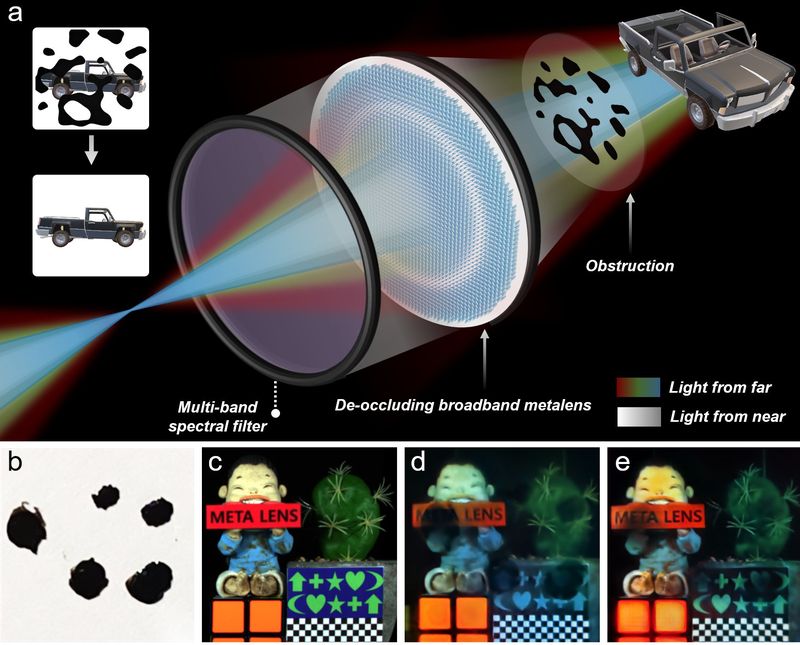
[Financial News] When it rains, even a single raindrop on a car’s rearview camera can make the screen look hazy. People can simply wipe it off by hand, but drones flying in the sky and endoscopic cameras moving through the body cannot. A paper-thin “see-through lens” has been developed that blurs dust or water droplets on a lens and captures only the scene behind them in sharp color.
On the 27th, Pohang University of Science and Technology (POSTECH) said that a team comprising Professor Baek Seung-hwan of POSTECH’s Department of Computer Science, Yoon Seung-woo, a student in the combined master’s and doctoral program, Professor Junsuk Rho of the departments of Mechanical Engineering, Chemical Engineering and Electrical and Electronic Engineering and the Graduate School of Convergence Science, and Kang Do-hyeon, a student in the combined program in the Department of Mechanical Engineering, developed a broadband metalens capable of clearly capturing in color scenes obscured by obstacles directly in front of the lens. The team worked with a research team led by Professor Su-ha Kwak of the Graduate School of Artificial Intelligence, Professor Arka Majumdar of the University of Washington in the United States, and a research team led by Professor Min-ho Choi of UNIST (Ulsan National Institute of Science and Technology). The study was published in the international journal Nature Communications.
The research team focused on metalenses, which control light by etching structures smaller than the wavelength of light onto a flat surface. They are extremely thin and ideal for small cameras, but it has been difficult to capture distant scenery sharply using multiple colors of light while keeping nearby obstacles blurred.
The team was the first to express this relationship mathematically: if distant scenery appears sharp in one color, a nearby obstacle appears sharp in another. Based on this, they divided each of the red, green and blue wavelengths into regions that let light pass through and regions that block it. Light from distant scenery is sharply focused in the pass-through regions, while light that would bring the obstacle into focus is directed to the blocking regions and filtered out. As a result, the obstacle becomes blurred like fog, leaving only the scene behind it clear. The remaining blur and distortion were corrected using AI image-restoration technology.
Experiments showed that the lens developed by the team not only improved image quality when obstacles were present, but also boosted AI performance in analyzing footage from autonomous vehicles, aerial photography and endoscopes. The team also built a small camera prototype, demonstrating that it could be used in drones, autonomous vehicles and robots, as well as in under-display cameras (UDCs) hidden beneath smartphone screens. The relationship between color and distance uncovered in the study could also be applied to holograms, 3D imaging and hyperspectral imaging, which analyzes subtle colors that are difficult to distinguish with the naked eye.
Professor Baek Seung-hwan said he expected that “full-color metalens technology that sees through obstacles will be useful for securing a camera’s field of view in extreme environments where accurate images are needed.” Professor Junsuk Rho added that “the optical see-through technique using metalenses will help small cameras, which are difficult to clean by directly wiping away obstacles, capture images reliably.”
[email protected] Yeon Ji-an Reporter