KICT to shorten semiconductor plant construction time with hollow PC columns
- Input
- 2026-10-27 10:35:13
- Updated
- 2026-10-27 10:35:13
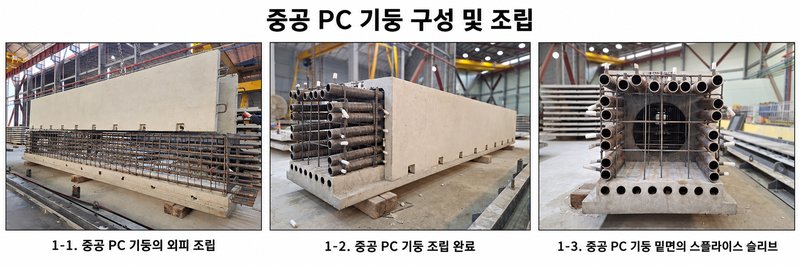
[Financial News] The Korea Institute of Civil Engineering and Building Technology (KICT) announced on the 27th that it had developed a “hollow precast concrete (PC) column construction method” for large industrial facilities such as semiconductor plants and data centers.
Hollow precast concrete is a factory-made component with reinforcement arranged around a hollow center. It is transported to the construction site and assembled, then concrete is poured to form an integrated structure.
According to KICT, facilities that house large equipment, such as semiconductor plants, require large columns because they have wide spans between columns and high ceilings. The cast-in-place reinforced-concrete method currently in use requires considerable time for formwork installation, rebar assembly and concrete curing. By contrast, when entire columns are manufactured at a factory, each component can weigh several tens of tons, requiring specialized equipment for transport and installation. Steel framing helps reduce weight, but its material costs are relatively high.
The research team at KICT’s Building and Urban Research Division adopted a method that leaves the center of the column hollow to reduce its weight, arranges reinforcement to ensure seismic performance, and prefabricates the column’s outer shell at a factory. The method leaves about 60% of the column’s cross-section hollow, substantially reducing the weight transported to the site. The columns can be installed using cranes commonly used at construction sites, and the design aims to cut construction time by up to 30% compared with conventional methods, depending on site conditions. The team also confirmed that, despite arranging the reinforcement in accordance with Korea’s structural design standards, the columns’ seismic performance is equal to or greater than that of conventional solid columns.
The research team produced a full-scale prototype and also confirmed that the columns could be manufactured in a factory. The team expects the technology to be applicable to a range of facilities requiring large columns, including semiconductor production facilities, logistics centers, large warehouses and parking towers.
KICT President Park Sun-kyu said, “The technology we have developed can ensure the safety of large columns while reducing both their weight and construction time, making it useful for building large industrial facilities such as semiconductor plants more quickly.” He added, “We will continue working to advance construction technology so that we can build the infrastructure underpinning the nation’s key industries safely and swiftly.”
This achievement was developed through a project supported by the Ministry of Science and ICT under KICT’s support program for SMEs and mid-sized enterprises, titled “Hollow PC Column Technology for Fast and Safe Construction of Large Industrial Facilities (2025–2026).” The technology is scheduled to be transferred to Camus E&C.
[email protected] Yeon Ji-an Reporter