“Enjoying ‘Forest Welfare’ in an Urban Forest” ... ‘Pop-up Forest Store’ to Open at Boramae Park in Daejeon
- Input
- 2026-10-27 10:17:17
- Updated
- 2026-10-27 10:17:17
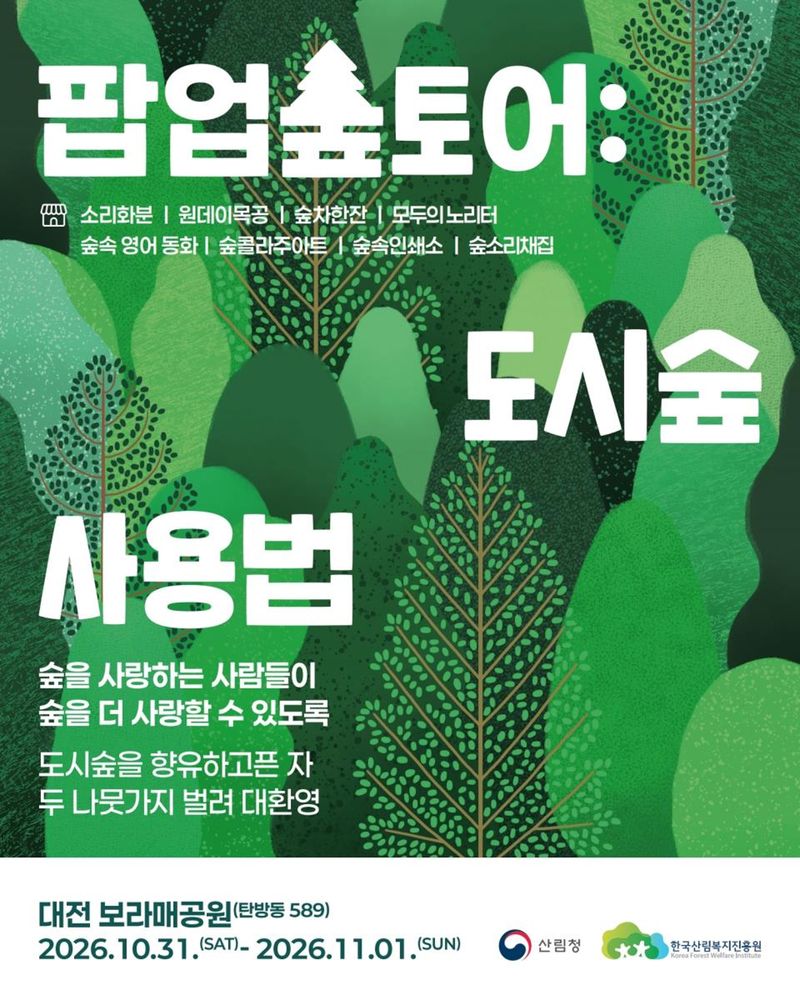
The Korea Forest Welfare Institute, an agency under the Korea Forest Service (KFS), announced on the 27th that it will hold a forest-welfare pop-up store, “Pop-up Forest Store: How to Use an Urban Forest,” at Boramae Park in Seo-gu, Daejeon, for three days from the 31st of this month through the 1st of next month. Anyone can attend free of charge.
The event was planned to give citizens the chance to experience forest-welfare services through urban forests, which are easily accessible in everyday life, and to showcase outstanding programs from private forest-welfare businesses. Its distinctive feature is the combination of the pop-up-store format—a trend that has recently taken hold, particularly among Millennials and Gen Z—with a youthful take on forest culture.
Boramae Park, the event venue, is located in the heart of Dunsan-dong, Seo-gu, Daejeon. Before development, the area was an Air Force airfield, and the park stretches for more than 1 km from the lawn plaza south of City Hall to a walking trail in the north. Daejeon has been developing the Dunsan green corridor, which extends for more than 3 km from City Hall through Boramae Park, Saemmeori Park, Government Complex Daejeon and Hanbat Arboretum to Daejeon Expo Park. The corridor also aligns with the event’s aim of letting people experience forest welfare in an everyday urban forest in the heart of the city.
Eight private companies and specialist businesses in the forest-welfare sector will take part, presenting eight hands-on programs that showcase their distinctive expertise. The main programs include Sound Flowerpot (Planco), One-Day Woodworking (Lunamu), Forest English Storytime (Supjigi Supichami), Forest Collage Art (COMS), Forest Sound Collection (Resound Company), Forest Print Shop (Greenideul), Everyone’s Play Space (Eco Namyangju Social Cooperative) and A Cup of Forest Tea (Forest Asan). Visitors can enjoy the urban forest in many ways, from recording forest sounds to creating works with natural materials.
There will also be ongoing activities and cultural events for the whole family. Group activities, including stacking wooden blocks and completing forest missions, will run throughout the event. On the evening of the first day, the 31st, an acoustic music performance and a prize-draw event are scheduled to add to the romance of an autumn night in the city.
A variety of on-site participation events are also planned. Visitors will receive themed souvenirs—such as a magnifying loupe, an urban-forest-tree picnic mat and a birdsong clock—depending on how many types (2, 3 or 5) of the “Urban Forest Tree” photo cards they collect by visiting activity booths. The “Find the Trees” mission, which invites visitors to identify 12 tree species in Boramae Park, will also offer a chance to learn naturally about the urban forest’s role in reducing fine dust and its ecological value.
The institute expects the event to broaden citizens’ access to forest-welfare services while giving private forest-welfare businesses a chance to connect with new prospective customers and test their market potential.
Kim Jong-nam, president of the Korea Forest Welfare Institute, said, “I hope citizens will discover new value in forests by experiencing forest-welfare services firsthand in an urban forest close to home.” He added, “I expect this event to be a meaningful occasion that offers citizens a special respite and forest-welfare businesses opportunities for growth and communication.”
[email protected] Kim Won-jun Reporter