Apple's 'Siri' adds Korean support, can understand screens and handle tasks in apps
- Input
- 2026-10-27 11:00:00
- Updated
- 2026-10-27 11:00:00
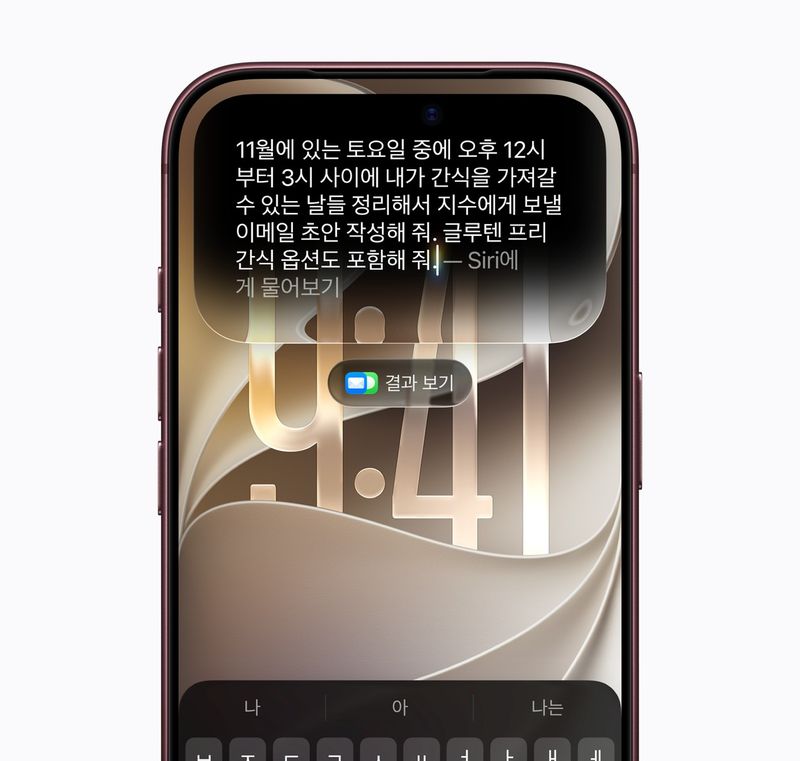
Find information in messages and emails, and carry out tasks in apps
Apple said it expanded Siri AI's supported languages to include Korean, French, Japanese, Portuguese and Spanish with the 27.2 software update it released on the 27th. The new Siri is built on Apple Intelligence and designed to understand users' personal context and answer questions on a wide range of topics.Siri AI finds information users need in their messages, emails, photos and other content. For example, if asked what they had planned to do with their mother over the weekend, it can find and report from their messages that they had agreed to make pumpkin porridge together. It can then pull up a recipe from an email sent by their grandmother or add ingredients to the shopping list in the Reminders app.
It can also recognize what is displayed on screen, answer related questions and carry out tasks. For instance, while viewing a wedding website, a user can ask Siri to add the weekend's event schedule to their calendar along with venue information. Users can also ask follow-up questions based on the earlier conversation.
Siri AI also works with apps made by other developers, including WhatsApp, Audible, Craft, Notability and Todoist. Users can ask it to draft a project overview, search study notes or add items to a to-do list. Apple said it supports Siri in carrying out a wider range of tasks across multiple apps.
Recognizes images and text in the camera view and on screen
Visual Intelligence has expanded beyond iPhone to iPad, Mac and Apple Vision Pro. On iPhone, users can connect the Camera app with Siri to ask about objects in front of them and request related tasks. For example, after pointing the camera at a music festival poster, users can ask about a favorite singer's performance schedule and add it to their calendar.On iPad, users can ask questions about an image captured from the screen; on Mac, they can select an image or text on screen using a keyboard shortcut and then ask a question. On Apple Vision Pro, users can look at content in an app window or nearby objects and ask for related information.
Siri AI can also draft and refine text in nearly any place where users can enter text. When users describe what they want to say, it creates a draft and revises the wording when asked for changes. In emails and messages, it reflects each recipient's communication style as well as the user's usual tone and punctuation. Apple Intelligence automatically corrects text across the operating system, including in most third-party apps.
Collaboration with Google's Gemini model ... Emphasis on privacy
Siri AI is powered by a next-generation Apple Foundation Model, custom-developed in collaboration with Google's Gemini model. The model runs either on the device itself or on Apple's Private Cloud Compute servers. Apple said it does not store personal data when processing requests in the cloud, and that no outside party, including Apple, can access the data.A dedicated Siri app is also available. Users can review previous conversations or start new ones in the app. Conversation history syncs via iCloud across iPhone, Mac, iPad, Apple Watch, Apple Vision Pro and other devices. On iPhone, users can summon Siri with the side button or Dynamic Island; on iPad and Mac, they can ask questions through Spotlight.
Apple said the new Siri protects privacy by using on-device processing and Private Cloud Compute. The availability of the new features may vary by device and operating system.
[email protected] Yoon Hong-jip Reporter