'Strengthening food security': Nonghyup Bank to provide POSCO International with 500 billion won in financing
- Input
- 2026-10-27 09:31:20
- Updated
- 2026-10-27 09:31:20
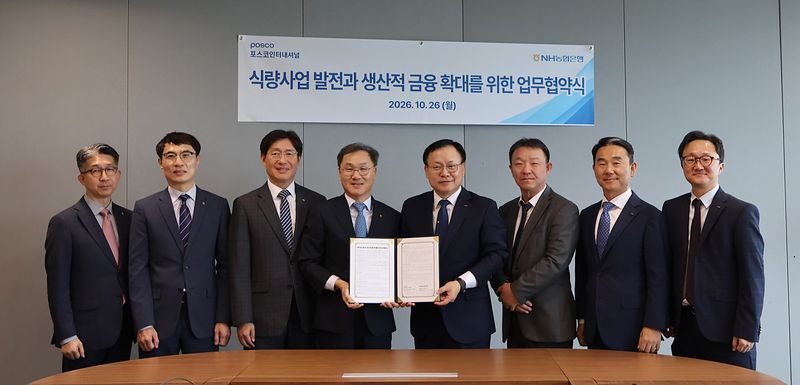
[Financial News] Nonghyup Bank will provide POSCO International with 500 billion won in financing over the next three years to strengthen food security.
According to financial industry sources on the 27th, Nonghyup Bank signed an MOU with POSCO International on the 26th at POSCO Tower in Songdo, Incheon, titled “Strengthening Food Security and Expanding Productive Finance.”
The two companies plan to establish a framework for financial cooperation aimed at strengthening food security and expanding productive finance. Their plan is to support the revitalization of the real economy by linking industry and finance.
Nonghyup Bank will provide a total of 500 billion won in productive finance over the next three years. Key areas of cooperation include support for integrated foreign exchange limits related to food businesses, preferential trade finance fees, and support for new foreign exchange (FX) transactions. Through these measures, Nonghyup Bank plans to support POSCO International’s global food business, while reducing its financial cost burden and making foreign exchange transactions more convenient.
Eom Eul-yong, vice president of Nonghyup Bank’s Corporate Banking Division, said, “By combining POSCO International’s capabilities in its global food business with Nonghyup Bank’s financial support capabilities, we will support efforts to strengthen food security and expand productive finance.” He added, “We will continue to expand tailored financial support that meets companies’ actual financial needs, contributing to stronger industrial competitiveness and the revitalization of the real economy.”
[email protected] Seo Ji-yoon Reporter