KICT shortens construction time for semiconductor plants with hollow PC columns
- Input
- 2026-10-27 09:07:28
- Updated
- 2026-10-27 09:07:28
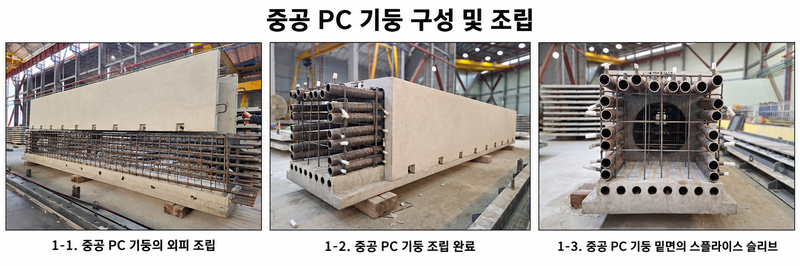
[Financial News] A prefabricated column construction method that reduces weight by leaving about 60% of the inside of concrete columns hollow has been developed.
According to the Korea Institute of Civil Engineering and Building Technology (KICT) on the 27th, a research team led by Lee Sang-seop, head of the Architecture and Urban Research Division, has developed a hollow precast concrete (PC) column method for large industrial facilities such as semiconductor plants and data centers. A hollow PC column is a component manufactured in a factory with reinforcing bars in place and a hollow center. It is transported to the construction site, assembled, and filled with concrete, which hardens into a single unit.
The research team opted to have the column shells made in advance at a factory. A horizontal-bar-shaped cover and a U-shaped jacket are assembled to make a column with a 1 m by 1 m cross-section. Although about 60% of the cross-section is left hollow, the reinforcing bars are arranged to fully comply with the reinforcement requirements set by the structural design standards for concrete columns. This significantly reduces the weight transported to the site while maintaining the column’s ability to withstand earthquakes. Tests confirmed that despite its hollow structure, the column’s seismic performance is equal to or even greater than that of conventional solid columns. Two patents have also been registered for the core technology behind this assembly method.
Such a method is needed because each of the existing approaches has clear limitations. Facilities with large equipment, such as semiconductor plants, require thick columns because they have wide column spacing and high ceilings. However, the cast-in-place reinforced concrete method commonly used today takes a long time: formwork must be assembled, reinforcing bars tied together, and the concrete left to harden. If an entire column is made in a factory, each component can weigh several tens of tons, making it difficult to transport or erect without specialized equipment. Steel columns are lightweight, but their material costs are high. The research team said the method is also competitive in material and construction costs compared with steel-based composite columns widely used in large-scale facilities.
The research team also confirmed that factory production is possible by building a full-scale prototype. The team believes the method could be used in a wider range of large-scale facilities requiring thick columns, including logistics centers, large warehouses, plants, parking towers and large mixed-use commercial facilities, in addition to semiconductor plants. The achievement was developed as part of a KICT project supporting small and medium-sized enterprises, funded by the Ministry of Science and ICT for 2025–2026. The technology is scheduled to be transferred to Camus E&C Co., Ltd.
KICT President Park Sun-kyu said, “The technology we have developed can ensure the safety of large columns while reducing both their weight and construction time, and can be used to build large industrial facilities such as semiconductor plants more quickly. We will continue working to advance construction technology so that infrastructure underpinning the country’s key industries can be built safely and swiftly.”
[email protected] Jeong Gyeong-su Reporter