International Convention Center Jeju’s Second Center: 88 Billion Won Invested, 277 kW of Solar Power, Green Building Grade 3
- Input
- 2026-10-27 08:58:35
- Updated
- 2026-10-27 08:58:35
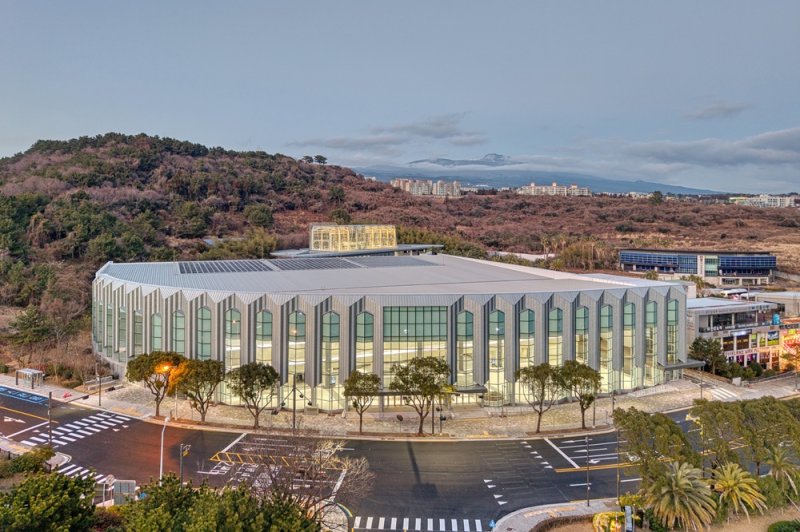
【Financial News, Jeju—Reporter Jeong Yong-bok】 The International Convention Center Jeju’s second center, built with an investment of 88 billion won, has received a Good rating under the national green building certification, with building-integrated solar power generation equipment among its features. Its solar power capacity is 277 kW, and it was designed to generate approximately 340,000 kWh of electricity annually.
According to the International Convention Center Jeju (ICC JEJU; CEO Kim Yong-beom) on the 27th, its second center in the Jungmun Tourist Complex in Seogwipo City received a Good rating under the Ministry of Land, Infrastructure and Transport’s Green Standard for Energy and Environmental Design (G-SEED), following an evaluation by the Korea Environmental Architecture Research Institute.
The green building certification is a national program that comprehensively evaluates buildings’ energy use, environmental pollution, use of materials and resources, water-cycle management, and ecological environment. It is based on the Act on the Support for the Creation of Green Buildings and has four rating levels: Outstanding, Excellent, Good, and General. The Good rating awarded to the second center corresponds to Green Grade 3.
A key element of the eco-friendly design is the building-integrated photovoltaic system (BIPV) installed on the roof. It integrates solar modules into a building’s roof or exterior walls, allowing them to serve both as building materials and as a means of generating electricity.
The second center’s solar power generation capacity is 277 kW. Based on the design, it is expected to generate approximately 340,000 kWh of electricity annually. Eco-friendly materials were used inside the building, and water-saving sanitary fixtures were also installed. Design features that take into account energy and water use, as well as the environmental characteristics of building materials, were reflected in the certification assessment.
The second center, which opened on February 24 this year, was built with a total investment of 88 billion won, including 28 billion won in central government funding, 44.7 billion won from Jeju Province, and 15.3 billion won in funding from ICC JEJU itself. It has a gross floor area of 15,110.53 square meters, with one basement level and two floors above ground. It was developed to expand the meeting and exhibition functions of the existing International Convention Center Jeju and operates as a multipurpose facility that can also host performances and sporting events.
The multipurpose hall, the facility’s centerpiece, covers 4,728 square meters and can accommodate 300 exhibition booths and 2,000 people for banquets. When used together with the existing Center 1, the facility is designed to accommodate meetings of up to 16,000 people.
Large exhibition and meeting facilities use considerable amounts of energy for heating and cooling, lighting, and various electrical systems during events. Introducing renewable energy generation facilities and water-saving equipment is one of the measures to reduce this operational burden.
Jeju Island is pursuing the expansion of renewable energy and improvements in energy efficiency in the building sector, with the goal of achieving carbon neutrality by 2035. Expanding green buildings is also a policy priority included in Jeju Island’s basic plan for carbon neutrality and green growth. The second center’s green building certification is also linked to these regional energy policies.
Kim Yong-beom, CEO of ICC JEJU, said, “We will continue to realize environmental value through eco-friendly facility operations and improved energy efficiency, and contribute to the sustainable development of Jeju’s MICE industry.”
MICE is an industry encompassing corporate meetings, incentive travel, international conferences, and exhibitions. Jeju Island is pursuing policies to broaden the tourism industry by attracting international conferences, exhibitions, and other events.
[email protected] Jeong Yong-bok Reporter