From memories held in the body to cinema without images... Four exhibitions open simultaneously at Art Sonje Center [fn Art Snap]
- Input
- 2026-10-27 07:00:00
- Updated
- 2026-10-27 07:00:00
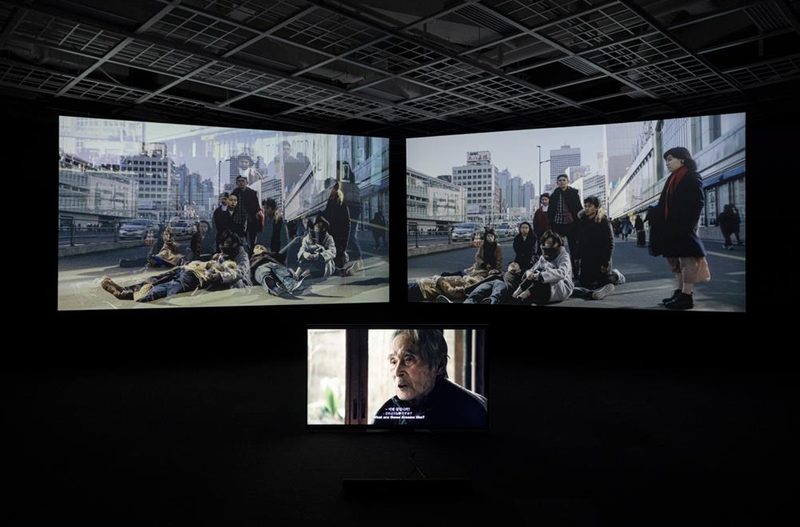
In the three-channel video “The Angels of Testimony” (2019), young performers read the testimony of a war veteran. A monitor between two screens plays an interview with Hajime Kondo, who was 99 at the time of filming. The elderly interviewee, unable to properly remember the violence they testified about, is shown alongside younger generations reading the testimony.
Drawings that render scenes of everyday life in Yasujiro Ozu’s films in charcoal and then partially erase them evoke traces of war obscured by postwar life.
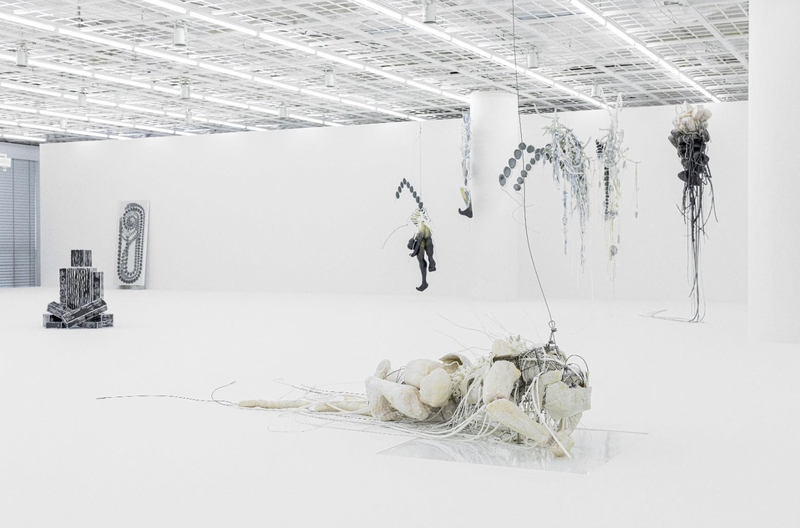
Choi Haneyl’s solo exhibition, on view in Space 1 on the second floor, explores the body beyond the control of consciousness through 12 sculptures, including a first kinetic work. Kinetic art uses movement as an element of the artwork. Sculptures in the “Dying” series are drawn upward by motors before falling, while another sculpture moves along a 20-meter track. They bring to mind the unsteady gait of a drunk, spasms just before falling asleep, and sleepwalking.
A huge fan-shaped plinth encourages visitors to walk around and view the sculptures. Exposed in the stark white space, visitors also become conscious of their own position and movements.
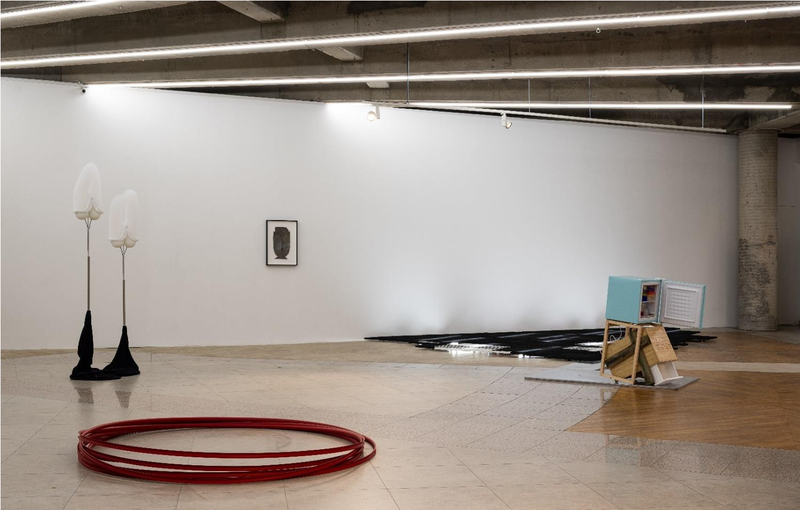
The museum building, designed by architect Kim Jong-sung, interprets its corner lot in the form of a quarter circle. Choi Goeun’s “Detective” (2026) is made from a 33.51-meter pipe—the same height as the building—bent into a spiral. Lee Rip’s “Upside-Down Atlas” (2026) recasts as a woman the god who carries the sky, depicting her leaning against a pillar. It shifts the focus from the strength of standing upright alone to relationships of leaning on one another.
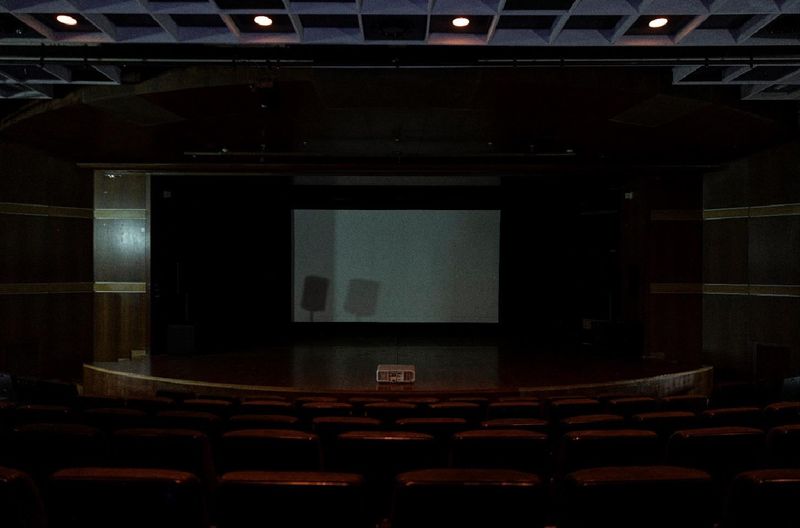
“Incident Volume 3” (2026), in the underground Art Hall, is a collaborative work by Kim Heecheon, Lee Haryeong, and Hong Seungtaek. Set in the fictional underground club “Waits,” its three episodes unfold over approximately 96 minutes. Dialogue, music, ambient noise, and sound effects invite audiences to imagine scenes in front of a blank screen.
Phone calls from the artists’ friends, family members, and colleagues interrupt the performance in real time. The calls overlap with the recorded performance or bring it to a halt, drawing the present moment into it. The audience does not make the calls themselves.
“Incident Volume 3” runs through December 6, and the other three exhibitions run through December 27. Visiting hours are from noon to 6 p.m.; the center is closed on Mondays. Admission to all four exhibitions is 10,000 won. The sound play is presented at 2 p.m. and 4 p.m.
[email protected] Jang In-seo Reporter