‘Rubber-Band Fines’ ... Cut in Half After Litigation
- Input
- 2026-10-26 18:35:27
- Updated
- 2026-10-26 18:35:27
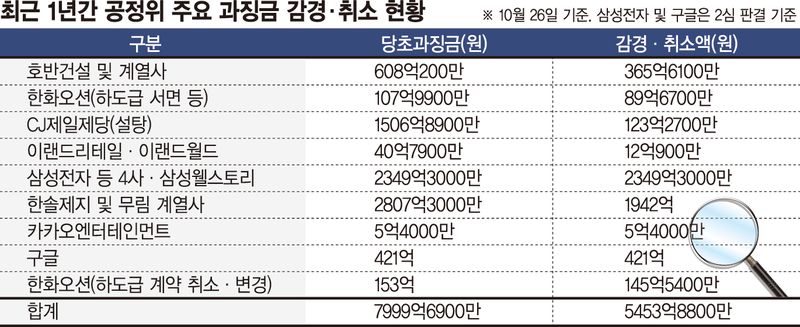
Large administrative fines imposed on companies are repeatedly being cut substantially after legal battles. With the penalties being contested in court alone totaling several hundred billion won, uncertainty for companies and the administrative burden on authorities are also growing as rulings are delayed.
According to legal sources and others on the 26th, over the past year, the amount of fines canceled or reduced by the judiciary, or recalculated downward and finalized by authorities, reached 268.358 billion won.
The initial fines in seven cases involving finalized sanctions—including five in which the Supreme Court issued final rulings and two that have reached the appeal stage—totaled 368.55 billion won. Even among major cases with final Supreme Court rulings, 67.6% (61.831 billion won) of the initial 91.52 billion won was canceled.
In the unfair assistance case involving Samsung Electronics Co., Ltd., three other companies and Samsung Welstory (234.93 billion won), and the case against Google Experience Center for abusing its market-dominant position (42.1 billion won), the Seoul High Court, acting as the second-instance court, ruled that the Korea Fair Trade Commission's measures should be canceled in full. Appeals are pending before the Supreme Court, and substantial reductions in these cases are also widely expected.
A Korea Fair Trade Commission official stressed, “Even when a court rules to cancel only part of a fine, we often cancel the entire amount and proceed with recalculation,” adding, “The cancellation of a fine after we lose a case does not mean that the Korea Fair Trade Commission’s entire measure was wrong.”
Two cases involving Hanwha Ocean Co., Ltd. (formerly Daewoo Shipbuilding & Marine Engineering Co., Ltd.) and alleged violations of the Subcontracting Act were also successively dealt setbacks by the Supreme Court. In a case involving, among other things, failure to issue written subcontracting documents, the fine was cut by 8.967 billion won, from 10.799 billion to 1.832 billion won. In a separate case concerning the cancellation and modification of subcontracting agreements, the fine was reduced by 14.554 billion won, from 15.3 billion to 746 million won, with at least 95% of the measure canceled. In the unfair assistance case involving ELANDRETAIL Ltd. and E-Land World, 1.209 billion won of the 4.079 billion won fine was canceled, leaving 2.87 billion won as the final amount. The Supreme Court also ruled to cancel in full the 540 million won fine imposed on Kakao Entertainment in connection with derivative works.
Neither authorities nor industry welcomes the way fines are finalized through litigation. Once an administrative measure is imposed, companies must record substantial litigation provisions in their financial statements until a final judgment is handed down. If the authorities lose, they must also pay statutory interest on top of the principal (the refund surcharge).
A Korea Fair Trade Commission official explained, “Even when we lose, the proportion of fines upheld exceeds 90%, and the KFTC’s win rate has also remained steady on average,” adding, “Various factors, including legal interpretation, the facts of the case and the calculation of sales, have an impact.”
The official added, “Changes to fines in some cartel cases are simply internal adjustments made when applying the leniency program or while preparing the final written decision, and are entirely different in nature from reductions resulting from administrative litigation.”
[email protected] Chang-hun Lee, Kim Chan-mi Reporter