Even as sales rise 2.5-fold, South Korea’s hydrogen cars face headwinds from cuts to government support [Chinese cars make inroads into the home market, Korean automakers face troubles at home and abroad (Part 2)]
- Input
- 2026-10-26 18:30:39
- Updated
- 2026-10-26 18:30:39
■ Budget and tax incentives cut on two fronts
According to the Korea Automobile & Mobility Association (KAMA) on the 26th, 3,175 hydrogen fuel cell vehicles were newly registered in the first half of this year, up 146.5% from 1,288 in the same period last year. The increase was driven by higher sales of Hyundai Motor Company’s second-generation Nexo. New registrations for the full year last year also rose 82%, to 6,902 from 3,787 the year before. According to market research firm SNE Research, Hyundai Motor Company accounted for about 70% of global hydrogen fuel cell vehicle sales in the first half of this year.
The domestic parts ecosystem is also robust. More than 90% of the Nexo’s core components are localized, and around 60 partner companies are part of its supply chain. According to the Korea Hydrogen Alliance, as of 2024 there were about 3,000 hydrogen-related companies in South Korea, employing 37,000 people. Unlike electric vehicles, where the share of Chinese-made products is growing rapidly, this is a sector where the domestic supply chain is holding firm.
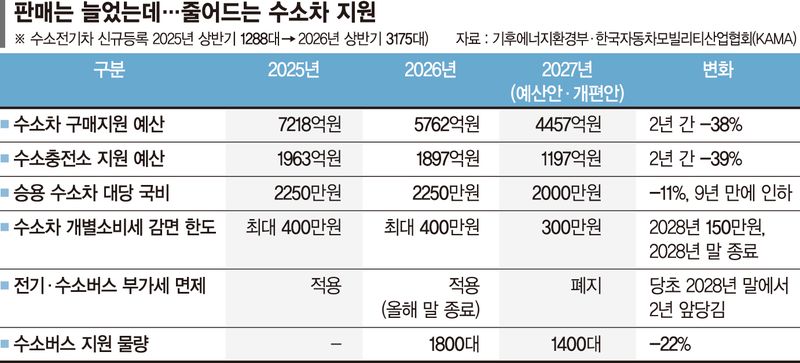
The problem is that government support is moving in the opposite direction. According to the Ministry of Climate, Energy and Environment’s budget proposal, next year’s budget for hydrogen vehicle purchase support is 445.7 billion won, 38% less than the 721.8 billion won allocated two years ago. Over the same period, support for hydrogen refueling stations will fall 39%, from 196.3 billion won to 119.7 billion won. The national subsidy per passenger hydrogen car will be cut from 22.5 million won to 20 million won, the first reduction in nine years since 2018, while the number of hydrogen buses eligible for support will drop from 1,800 to 1,400. This contrasts with next year’s electric vehicle purchase subsidy budget, which has been set at 2.1403 trillion won, up 32.8% from this year.
Tax benefits are also being reduced. Under the tax reform plan, the cap on the individual consumption tax reduction for hydrogen cars will fall from a maximum of 4 million won this year to 3 million won next year and 1.5 million won in 2028, before the reduction ends at the close of 2028. The value-added tax exemption for electric and hydrogen buses will end two years earlier than originally planned, at the end of this year instead of the end of 2028. In effect, both purchase subsidies and tax reductions are being cut at the same time.
■ Poor execution leads to cuts
Poor budget execution is behind the cuts. Hydrogen vehicle subsidies are paid jointly by the national and local governments, so if a local government cannot secure its share, the national funds cannot be used either.
Of the 6,000 passenger hydrogen cars eligible for national support this year, local funding had been secured for just 5,093 (84.9%) by the end of September. For commercial vehicles, including hydrogen buses, the figure was about 1,270 (70.6%) out of 1,800. The budget execution rate for last year’s hydrogen vehicle deployment program was just 67%, and stood at 47% as of the end of July this year. The government reflected this in next year’s budget cuts.
The refueling infrastructure is also struggling to become self-sustaining. As of August, there were 309 hydrogen refueling stations nationwide. According to the office of Kim Wi-sang, a member of the National Assembly’s Climate, Energy, Environment and Labor Committee, 208 (80.6%) of the 258 hydrogen refueling stations with commercial operations in the first half of this year received subsidies for fuel purchases. With eight out of every 10 stations relying on subsidies to stay afloat, the budget for station support is being cut as well.
Kim Pil-su, a professor in the Department of Future Automotive Engineering at Daelim University College, said, “Hyundai Motor Company is investing in hydrogen not to sell a lot of Nexo vehicles, but to build the hydrogen value chain—it is preparing for 20 years from now.” He added, “There is a serious problem with the government’s view of hydrogen,” and criticized the government, saying, “The budget needs to be used properly to foster the industry, but even the funds already secured are not being spent.”
Other countries are moving in the opposite direction. China plans to select up to five city clusters this year and provide each with up to 1.6 billion yuan over four years. It has also set a goal of doubling the number of hydrogen vehicles to 100,000 by 2030. The aim is to grow the market by putting government support behind the hydrogen industry, as it has with electric vehicles.
Japan will spend 3 trillion yen to cover the price difference between low-carbon hydrogen and conventional fossil fuels for up to 15 years. The plan is for the government to bridge the price gap starting at the hydrogen production stage and thereby expand the supply chain.
[email protected] Kim Dong-chan Reporter