Brazil’s Lula stages a ‘stunning comeback,’ halting the ‘right-wing wave’ and winning a fourth term
- Input
- 2026-10-26 18:28:29
- Updated
- 2026-10-26 18:28:29
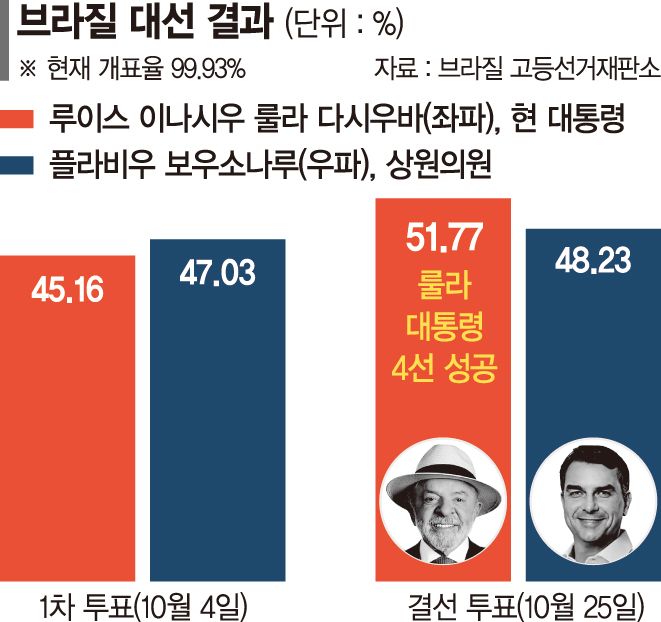
With 99.93% of the votes counted that day, Brazil’s Superior Electoral Court declared incumbent President Lula the winner with 51.77% of the vote, defeating Senator Flávio Bolsonaro, who received 48.23%. The margin was 3.54 percentage points.
Senator Bolsonaro immediately said he would not accept the result, raising the prospect of turmoil and repercussions in Brazil’s political landscape. Bolsonaro said, “(The court) changed the rules in the middle of the game,” and added, “I cannot accept the election result. I will ask for it to be annulled.” He cited the Supreme Federal Court’s decision to extend voting hours by two hours, from 5 p.m. to 7 p.m., because of severe weather as grounds for his refusal to accept the result. The court had granted a request from Lula’s camp and extended voting hours that day. Bolsonaro argued that the decision undermined the election’s fairness, pointing out that Supreme Court Justice Cristiano Zanin, who made the decision, had previously been President Lula’s lawyer.
By contrast, President Lula took aim at the United States in his victory speech, declaring, “Brazil is nobody’s backyard.” He has pursued a policy of strengthening ties with developing countries in Asia, Africa and elsewhere, moving away from a U.S.-centered international order.
The Trump administration’s security strategy—including the ‘Donroe Doctrine,’ which seeks to curb China’s expanding influence in South America, including its deepening ties with Brazil, and maximize U.S. hegemony by tightening control over the Western Hemisphere—is now facing a setback. The United States had also secured pledges from the conservative candidate to shift the center of gravity of his foreign and economic policies from China to the United States and to join the ‘Shield of the Americas,’ a U.S.-led regional anti-crime alliance.
Lula, who began working in a factory as a boy, was elected in 2002 as the first president from the working class in Brazil’s history and was reelected in 2006. He then defeated Jair Bolsonaro, who was president at the time, in 2022 to win a third term, and secured a fourth by defeating Flávio, the candidate and son of former President Bolsonaro, in this election.
[email protected] Lee Seok-woo, International Affairs Specialist Reporter