Tariff backlash amid high prices ... Could the economy Trump was so confident about now trip him up? [America’s choice in the Nov. 3 midterms]
- Input
- 2026-10-26 18:28:25
- Updated
- 2026-10-26 18:28:25
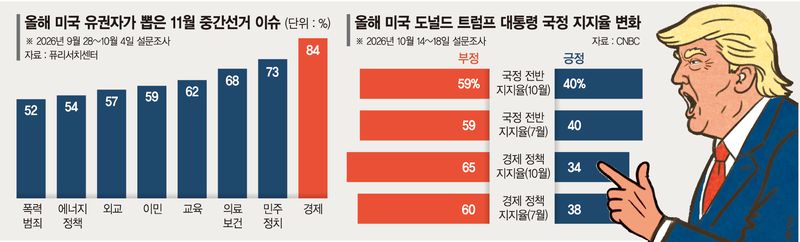
■ Trump rose on the economy, and now he is faltering over it
During the 2024 presidential election, U.S. President Donald Trump pointed to rising prices during former President Joseph Robinette Biden Jr.’s time in office and promised to lower prices through tariffs and deregulation. But the rate of increase in the U.S. personal consumption expenditures (PCE) price index rose from 2.6% when Trump’s second administration took office in January last year to 3.4% as of last August. According to the American Automobile Association (AAA), average U.S. retail prices for gasoline and diesel were $3.06 and $3.58 per gallon (3.78 liters), respectively, on January 2 last year; as of the 24th, they stood at $4.27 and $6.31. That represents increases of 39.5% and 76.3%, respectively, in about 22 months. Among the 5,062 people who took part in Pew Research Center’s survey, 74% selected energy costs when asked to choose all the economic issues they were concerned about. They were followed by groceries and consumer goods (73%), housing costs (66%) and job opportunities (48%).
Former Democratic President Barack Obama said at a campaign rally on the 24th in support of candidates in the midterm elections, “Everything is more expensive now,” and pointed out, “Mortgage costs, medical expenses and utility bills have all gone up, and interest rates have risen too.” He said, “To be fair, as a former president, sometimes plans go awry because of factors a president cannot control,” but stressed, “That is not the case this time. The actions of this (Trump) administration are directly responsible for rising prices.”
On the campaign trail for this election, President Trump has touted investments secured from countries including South Korea and stressed that things are improving. At a rally in Kentucky on the 17th, he emphasized that if the Iran war ends soon, gasoline prices will fall below their previous levels. At a rally in Tennessee on the 10th, he also threatened, “If the Democrats win, you will face a Great Depression like the one in 1929.”
■ Trump’s support erodes ... tariff backlash
Disappointment with President Trump is showing in his approval ratings. According to a poll released by U.S. broadcaster CNBC on the 22nd, 65% said they did not support the Trump administration’s economic policies—the highest share across Trump’s first and second terms. Pew Research Center’s survey found that Trump’s approval rating among voters who chose him in the 2024 presidential election fell by 25 percentage points, from 95% in January 2025 to 67% at the end of last month. In the same survey, 56% of respondents expected Trump’s tariff policies to harm the economy going forward, while 20% expected them to have a positive effect.
The Trump administration initially announced that it would impose additional tariffs on imports, use the resulting revenue to pay down government debt and boost the economy by increasing spending at the same time. President Trump stressed that companies in the U.S. and abroad would willingly cut their product costs by an amount equivalent to the tariffs in order to do business in the world’s largest consumer market, and that consumers would not face higher costs.
In a report on the 6th, the Federal Reserve Bank of New York, part of the U.S. Federal Reserve System (Fed), said its analysis of 67 consumer goods categories as of last February found that their prices were 2.9% higher than they would have been without tariffs. It also found that about 26% of the additional tariffs imposed over roughly the year through last February had been passed on to final consumer prices.
[email protected] Park Jong-won Reporter