Yun Ho-jung: “Fire-service finances can’t cope as cigarette tax revenues fall ... fundamental reform of the funding structure is needed”
- Input
- 2026-10-26 16:36:30
- Updated
- 2026-10-26 16:36:30
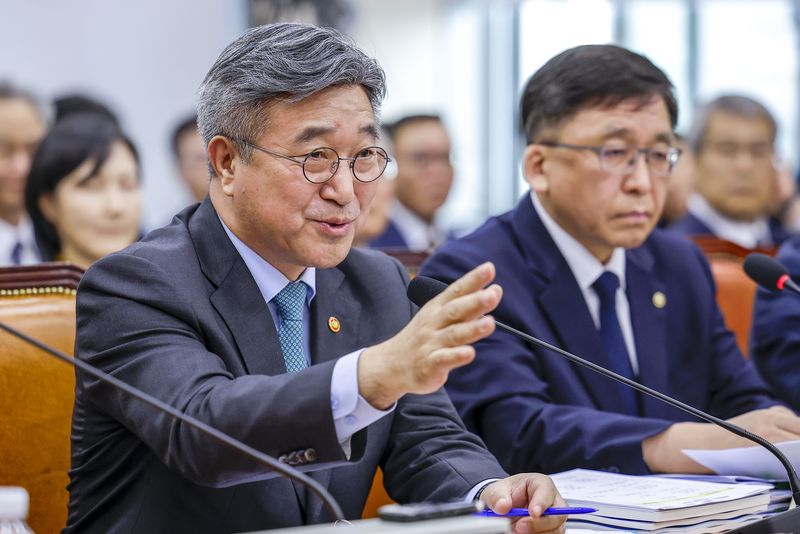
[Financial News] Minister of the Interior and Safety Yun Ho-jung said on the 26th that fundamental improvements were needed to the current fire-service funding structure, which relies on cigarette taxes, saying, “This structure can’t cope.” Even after firefighters became national civil servants, central government funding remained stagnant while personnel costs continued to rise, and falling tobacco tax revenues were also reducing the Fire Safety Grant Tax.
Minister Yun gave that response during a comprehensive audit by the National Assembly’s Security and Public Administration Committee that day, after People Power Party lawmaker Kwon Young-jin pointed out that regional disparities in fire-service personnel, equipment and working conditions remained unresolved even after firefighters became national civil servants.
Kwon said that although six years had passed since firefighters became national civil servants, regional disparities in aging fire stations, equipment and firefighters’ working conditions persisted.
According to Kwon, 13 fire stations that are at least 30 years old have a safety rating of Grade C. The budget for counseling, screening, medical care and treatment costs to support firefighters’ mental health also remained at the same level—from 560 million won in 2020 through 2025.
The central government’s share of the total fire-service budget also declined. Kwon explained that its share rose to 14.9% in 2021, after firefighters became national civil servants, but fell to 10.7% this year as central government funding did not increase thereafter.
In response, Minister Yun said, “Although firefighters were transferred from local to national civil-service status, fire service itself remains a local government responsibility,” adding, “Local and central governments have no choice but to jointly fund fire services.” He continued, “Rather than adjusting the budget up and down as needed, it is tied to tax revenues and legally fixed according to them.” He said, “That has ultimately imposed certain limits on the national government’s ability to bear fire-service costs, and I think the time has come for fundamental reform.”
When Kwon asked, “Isn’t 45% of cigarette tax revenue simply not enough?”, Minister Yun replied, “As cigarette tax revenues continue to fall, this structure can’t cope.”
The government’s proposed 2027 budget allocates 760.5 billion won to the Fire Safety Grant Tax, down 289.8 billion won (27.6%) from this year’s 1.0503 trillion won.
The Fire Safety Grant Tax is funded by 45% of the total individual consumption tax levied on tobacco. When tobacco sales fall and individual consumption tax revenues decline, the grant tax also decreases.
According to the Ministry of the Interior and Safety (MOIS), next year’s grant-tax budget reflects the forecast for individual consumption tax revenues based on declining tobacco sales, as well as the results of the settlement of actual tax revenues for 2025. MOIS said the amount was calculated in accordance with relevant laws, rather than reflecting a discretionary cut by the government.
Minister Yun said, “We realized around August that the fire-service budget would be reduced by about 300 billion won, making it difficult to reflect this in the government’s budget proposal and the relevant tax laws.” He added, “It was difficult both to reflect this in the government budget and to immediately submit changes to the tax laws, which are budget-related bills submitted alongside the budget.” He stressed, “I hope we can discuss together ways to secure sufficient funding for the fire-service budget during this budget review and the review of the tax laws.”
Kwon also proposed establishing a fire safety fund within the Future Response Fund to secure the funding needed to replace aging fire stations and equipment.
Meanwhile, the on-scene commander’s decision about entering the site also became controversial after a firefighter was killed in the line of duty in a factory fire in Bucheon, Gyeonggi Province, on the 16th.
When Democratic Party of Korea lawmaker Chae Hyun-il pointed out, “The risk of an explosion had been confirmed, and there was no one inside, yet firefighters were sent in anyway,” NFA Commissioner Choi Yong-cheol replied, “It is true that there are many question marks about that.” Choi said, “The joint investigation is not yet complete, and it is being conducted professionally and objectively,” adding, “Radio transcripts confirmed that the control room had communicated in advance that hazardous materials were present.” He continued, “The on-scene commander has to decide on the strategy, such as whether to use an offensive tactic alongside firefighters,” and said, “It is true that there are many question marks about those matters.” He added, “We will investigate thoroughly and objectively and, if we find problems, develop adequate measures for reform.”
Chae pointed out that the Standard Operating Procedures (SOP) for disaster scenes had been revised after two firefighters were killed in the Mungyeong fire in North Gyeongsang Province, but were still not being properly applied at the scene.
Chae said, “There may also be fear of complaints over property damage after the fact and of being held accountable when firefighters take a defensive approach,” and stressed the need for special provisions granting civil and criminal immunity to firefighters who choose defensive firefighting.
[email protected] Lee Bomi Reporter