27,873 cases involving corporations delinquent on the four major insurance programs over five years... “Small fines alone have limited power to prevent wage arrears”
- Input
- 2026-10-27 07:00:00
- Updated
- 2026-10-27 07:00:00

[Financial News] The problem of delinquent payments continues to recur each year: over the past five years, 27,873 cases involving corporations were newly added to the list for large, habitual arrears on contributions to the four major social insurance programs. The government has tightened sanctions against employers with habitual wage arrears, including public disclosure of their names, credit sanctions and travel bans, but workers’ losses remain difficult to remedy. Experts say that stronger punishment alone has limited power to prevent arrears, and that institutional measures are needed to encourage employers to pay voluntarily and make victims whole.
Thousands added to the list every year
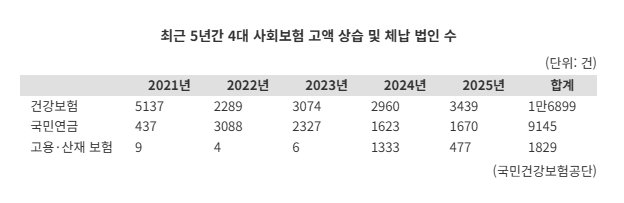
On the 27th, according to the National Health Insurance Service’s public disclosure data on large, habitual delinquents, a total of 27,873 cases involving corporations were newly added to the list for unpaid contributions to the four major social insurance programs over the past five years (2021–2025).By type of insurance, corporations delinquent on health insurance contributions accounted for the largest number, at 16,899 cases. By year, the figures were 5,137 in 2021, 2,289 in 2022, 3,074 in 2023, 2,960 in 2024 and 3,439 in 2025, with at least 3,300 cases newly disclosed on average each year. The number newly disclosed last year increased 16.2% from the previous year.
Over the same period, 9,145 cases involved corporations delinquent on National Pension contributions. The annual figures were 437 in 2021, 3,088 in 2022, 2,327 in 2023, 1,623 in 2024 and 1,670 in 2025.
Another 1,829 cases involving corporations delinquent on Employment Insurance and Workers’ Compensation Insurance contributions were newly disclosed over the five-year period. The cumulative number of large, habitual delinquent corporations disclosed over the past five years reached 27,873.
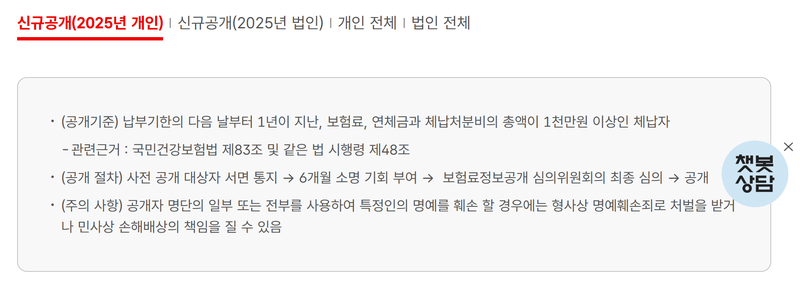
For health insurance and the National Pension, those subject to public disclosure include cases in which the total amount of contributions, late fees and delinquency collection costs is at least 10 million won and a year or more has passed since the payment deadline. Because disclosure requires arrears at least a certain amount to persist for an extended period, the actual amount of arrears may be greater than the published figures suggest.
Strengthen relief for workers, not just punishment
Wage arrears are also a problem that recurs year after year. According to the Ministry of Employment and Labor, 187 employers were named this year on the list of those with large, habitual wage arrears, about 3.7 times the 50 listed last year. Including 119 in 2023 and 277 in 2024, a total of 633 employers have been added to the list over the past four years.Employers are subject to public disclosure if they have received final convictions at least twice for wage arrears within the three years preceding the reference date and had unpaid wages of at least 30 million won in the past year. In addition to the 187 employers named this year, the Ministry of Employment and Labor also imposed credit sanctions on 298 others.
The problem is that sanctions against employers do not lead to meaningful recovery for workers. If an employer deducts National Pension contributions from workers’ wages but fails to pay them, that period is not counted toward their contribution period, potentially reducing the pension they receive in the future. There is a remedy through which workers can pay the contributions themselves and have the period recognized, but this leaves workers bearing the burden of their employer’s failure to pay.
Critics say that oversight is inadequate to determine whether the government’s tougher sanctions against employers with habitual wage arrears are leading to meaningful recovery for workers. The argument is that, rather than relying solely on punishment after the fact, measures are needed to prevent unpaid wages and insurance contributions in advance and support recovery for those affected.
Yang Seung-yeop, an associate research fellow at the Korea Labor Institute, said, “In many cases, the current system results only in small fines that are lower than the amount owed, so punishment alone has limited power to prevent arrears. We should examine whether incentives to encourage employers’ voluntary efforts to prevent wage arrears are lacking or inadequate.”
[email protected] Lee Dong-hyuk Reporter