'23,000 Works of Art and 1 Trillion Won in Medical Donations'—Hong Ra-hee Honored with the Order of Civil Merit for 40 Years of Giving
- Input
- 2026-10-26 15:59:28
- Updated
- 2026-10-26 15:59:28
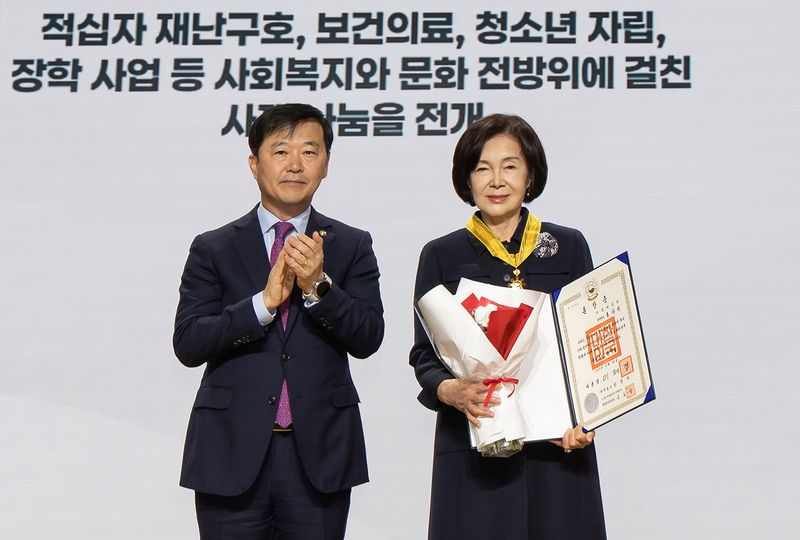
[Financial News] Hong Ra-hee, honorary director of the Leeum Museum of Art, received the Order of Civil Merit, Dongbaek Medal, for more than 40 years of giving in the fields of culture, medicine and welfare.
Her wide-ranging social contributions—from supporting villages for people with Hansen’s disease and treatment for children with cancer and rare diseases to donating cultural heritage to the state and expanding medical infrastructure to respond to infectious diseases—have been recognized. Her longstanding efforts to care for marginalized neighbors while expanding public access to culture and strengthening the nation’s medical infrastructure are now being reassessed.
■ Social Contributions Expanded Through Cultural Heritage
Hong received the Order of Civil Merit, Dongbaek Medal, at the Korean Red Cross’s 121st anniversary ceremony, held on the 26th at Woori Bank headquarters in Jung-gu, Seoul. This honor follows the Gold Medal of the Red Cross Humanitarian Award in 2024. The Order of Civil Merit is awarded by the government to people who have made notable contributions to improving public welfare and advancing national development.
Hong’s social contributions can be summed up in the sustained and public-minded nature of her giving. She is credited with personally looking after marginalized neighbors over many years while helping expand the cultural and medical resources available to society as a whole.
A notable example is the 2021 donation of artworks from the collection of the late former Samsung chairman Lee Kun-hee, carried out with his family, including Samsung Electronics Chairman Lee Jae-yong. More than 23,000 works, including Jeong Seon’s Inwangjesaekdo, were donated to the state jointly by the family. The donation transformed cultural heritage that had been privately owned into a public asset that anyone can view and study.
The impact of the donation was also reflected in visitor numbers. The KH Collection traveling exhibition, organized by the National Museum of Korea and the National Museum of Modern and Contemporary Art, Korea, has been held 35 times since 2021, drawing a cumulative total of 3.5 million visitors. An overseas special touring exhibition that began last November has also been introducing Korean art, traveling from Washington, D.C., and Chicago to the United Kingdom. About 80,000 people visited the Washington exhibition and about 115,000 visited the Chicago exhibition.
From the planning stages of the overseas exhibitions, Hong exchanged views with people in the art world and helped secure loans of key works from the Leeum Museum of Art and Ho-Am Art Museum. She also attended gala receptions in the United States and the United Kingdom with her family, introducing Korean art and supporting cultural exchange following the donations.
■ Giving Greater Meaning Through More Than 40 Years of Hands-On Service
In the medical field, she and the other family members returned 1 trillion won from the former chairman’s estate to society.
Of this amount, 300 billion won was allocated to treatment and research for children with cancer and rare diseases. Through a support program established on that basis, about 28,000 young patients had received assistance by this year. The remaining 700 billion won is being used to build the Central Infectious Disease Hospital and expand research facilities for treatments and vaccines, among other efforts to establish a national infectious disease response system.
Behind this giving is more than 40 years of hands-on volunteer work. After learning about the circumstances of people with Hansen’s disease in 1980, Hong began visiting St. Lazarus Village in Uiwang-si, Gyeonggi Province, the following year, bringing sugar and household goods. She later supported residents by providing food and medicine and helping renovate toilets.
Since 1990, she has continued her donations and volunteer work while serving as a special adviser to the Korean Red Cross’s women’s volunteer service committee.
For more than 10 years, through last year, she took part as a one-day sales assistant at the Red Cross bazaar. She also donated 500 million won toward making mobile shower trucks for disaster victims and relief workers at disaster sites. In 2016, she joined the Red Cross Honors Club as its third founding member, and last year she was inducted into its 1 Billion Won Honors Club.
The 1 billion won she donated to the Youth Happiness Foundation supported protection, counseling, vocational training and self-reliance for at-risk young people, while the 355 million won given to the Yongsan Welfare Foundation helped stabilize the livelihoods of vulnerable groups.
Hong’s social contributions are seen as having advanced the social safety net and taken the culture of giving in Korea to a new level, putting her at the forefront of practicing “noblesse oblige.” Her receipt of the medal is likewise understood as recognition of her long-standing contributions, from sharing cultural heritage and strengthening the nation’s medical infrastructure to volunteering to care for neighbors in their everyday lives.
[email protected] Kim Hak-jae, Lim Su-bin Reporter