ETF Listings Are Effectively Being “Allocated” ... Exchange Adds One Staffer for First Time in 4 Years, 7 Months
- Input
- 2026-10-28 15:42:05
- Updated
- 2026-10-28 15:42:05

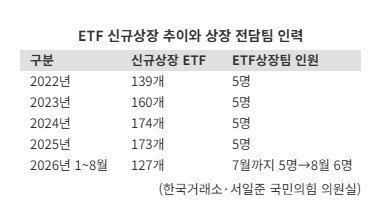
[Financial News] After years of calls from the asset management industry to expand staffing for reviews of exchange-traded funds (ETFs), the Korea Exchange has added one staff member responsible for the work. However, some say that applications to list ETFs are even being accepted on a limited basis, and that staffing still falls short of demand.
On the 28th, the Korea Exchange told the office of Seo Il-jun, a People Power Party lawmaker, that its ETF Listing Team had added one deputy-level employee in August this year, increasing its headcount from five to six. The team, which had consisted of one team leader and four members, added one staff member responsible for day-to-day work. This is the first staffing increase in the four years and seven months since the dedicated team was launched. The exchange cited “increased listing demand” as the reason for the increase.
As the ETF market has grown and competition to launch new products has intensified, the asset management industry has continued to call for more staff to review listings. An official at one asset manager said, “We started asking for more staff three years ago,” adding, “There had long been calls to increase staffing even when single-stock leverage was not at issue.”
The ETF market and the number of new listings have grown rapidly. The net assets of domestic ETFs rose about fourfold, from 74 trillion won at the end of 2021 to 297.2 trillion won at the end of last year, while the number of listed products nearly doubled, from 533 to 1,058. Annual new ETF listings increased from 139 in 2022 to 174 in 2024, and stood at 173 last year.
Listings have also outpaced the same period last year so far this year. Based on a tally of submitted materials, 127 new ETFs were listed from January through August this year, including 16 single-stock ETFs tied to Samsung Electronics and SK hynix. That was 19 (17.6%) more than the 108 listed in the same period a year earlier. For the first half of the year, listings rose 28.6%, from 77 to 99.
Limited review capacity is also affecting how many new products each asset manager can launch. According to the industry, new ETF listings are being coordinated at effectively one per month for smaller firms and around two to three per month for larger firms. Some asset managers see this, in effect, as a company-by-company “quota.”
An exchange official said, “We can’t process everything if every asset manager submits 10 products each,” adding that the exchange could coordinate launch timing with asset managers during periods when applications surge.
The asset management industry is concerned that even when firms prepare products targeting areas of strong market interest, delays in launching them can mean missing out on investor demand. An official at another asset manager said, “The market changes quickly, so it’s important to get the timing of a product launch right,” adding, “You have to set sail when the tide comes in, but the situation keeps repeating where, by the time we’re ready to launch, the ETF has become something nobody is interested in.”
Industry players believe this staffing increase alone is not enough, given the need to diversify products and allow new asset managers to enter the market. An industry official said, “We wholeheartedly welcome an increase in staffing,” but added, “There is a need to increase staffing aggressively.”
[email protected] Lee Jeong-hwa Reporter