Kang Shin-chul: “Closely consulting with U.S. and South Korean authorities on setting the year for OPCON transfer”
- Input
- 2026-10-26 15:40:36
- Updated
- 2026-10-26 15:40:36
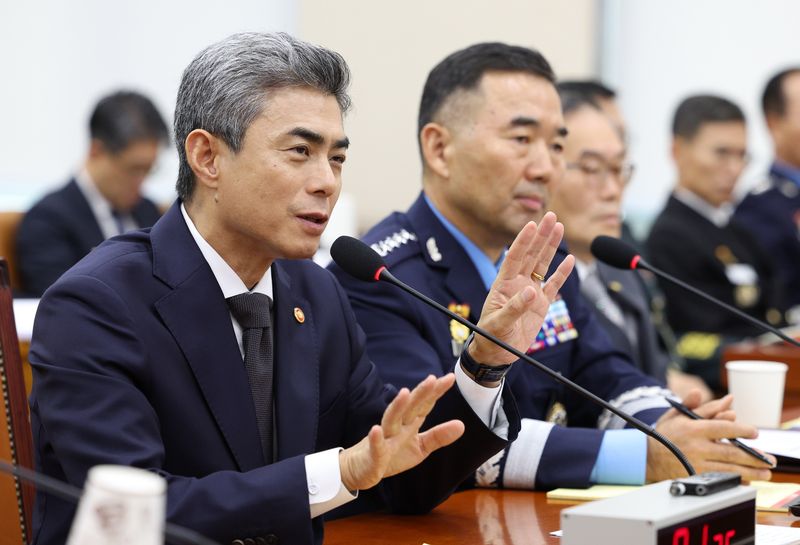
[Financial News] Defense Minister Kang Shin-chul said on the 26th that South Korean and U.S. authorities were “closely consulting on completing Full Operational Capability (FOC) verification and deciding ‘Year X’ (the year of OPCON transfer)” in connection with the transfer of Wartime Operational Control (OPCON). Regarding consultations with the United States on relocating Gwangju Military Airport, he said, “This is an issue that needs to be resolved top-down, so I am handling it personally.”
Minister Kang made the remarks that day during a comprehensive audit by the National Defense Committee of the National Assembly of the Republic of Korea of the Ministry of National Defense and other agencies.
At the National Defense Committee hearing that day, lawmakers also asked how South Korea would respond if the U.S. side would not agree to consultations that set a firm date for the transfer of OPCON. In response to the question from Democratic Party of Korea lawmaker Kim Byung-joo, Minister Kang avoided giving a direct answer, saying, “We can consider various options, but so far we are working closely with the U.S. side.”
However, responding to Kim Byung-joo’s call to “declare that we will exercise OPCON independently,” Minister Kang made clear that the principle was that “the transfer of OPCON must take place with trust assured.”
FOC verification is the second stage of the process for determining whether the future Combined Forces Command, which will be led by a four-star general from the Republic of Korea Armed Forces after the transfer of OPCON, has the capability to carry out its missions. The government’s goal is to complete the verification at the Security Consultative Meeting (SCM) between the South Korean and U.S. defense ministers, which is being planned for the United States around December this year, and to decide “Year X,” the year of OPCON transfer.
Minister Kang also said that, in response to remarks by Eighth United States Army (EUSA) commander Joseph Hilbert in an interview with foreign media to the effect that EUSA troops could be deployed not only on the Korean Peninsula but also against other threats in the region, “we expressed strong concerns and discussed the matter at the working level.”
He also addressed the relocation of Gwangju Military Airport, which the government selected as an investment site for developing a semiconductor cluster in the Honam region. Gwangju Military Airport is a combined operating base (COB) used jointly by the South Korean and U.S. air forces. In a contingency, it serves as an aerial port of debarkation for U.S. reinforcements, equipment and military supplies. Consultations with the U.S. side must be completed before the relocation.
Asked whether a reserve airport had been selected, Minister Kang said, “We are discussing it,” adding that no decision had yet been made. The government is pursuing a plan to relocate Gwangju Military Airport to Muan to secure a site for developing a semiconductor cluster in the Honam region. However, there has reportedly been no concrete progress yet in consultations with the U.S. side on relocating the base.
[email protected] Lee Jong-yoon Reporter