Debate over MBK’s responsibility for the “Homeplus crisis” intensifies as ruling bloc launches push to regulate private equity funds
- Input
- 2026-10-26 15:23:36
- Updated
- 2026-10-26 15:23:36
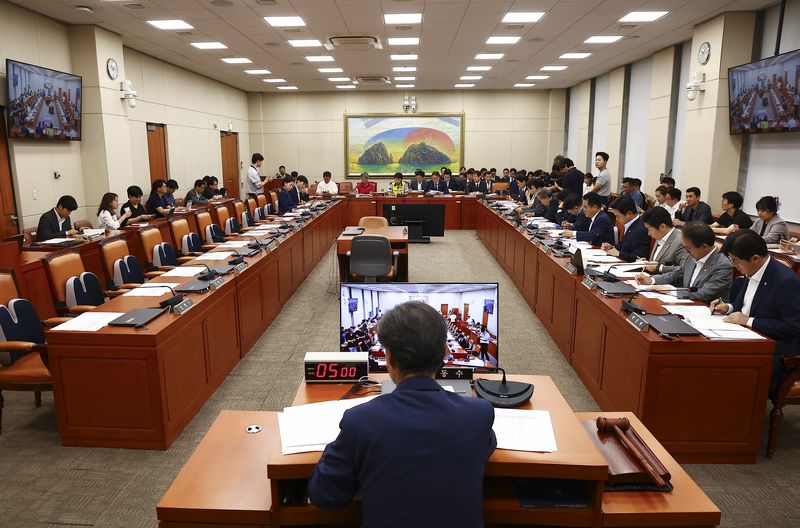
On the 26th, Rep. Heo Seong-mu of the Democratic Party of Korea and Rep. Jeong Hye-gyeong of the Progressive Party held a press conference at the National Assembly Communication Center with the Mart Industry Union’s Homeplus branch, the Korean Public Service and Transport Workers’ Union, the Korean Metal Workers’ Union’s OSSTEM IMPLANT chapter, and others, calling for tighter regulation of private equity funds and stronger controls on speculative capital.
Rep. Heo said, “It is essential to expand investment to strengthen and promote the foundations of domestic industry,” but added, “If such investment serves to maximize investors’ short-term gains at the expense of strengthening the industrial base—instead damaging it and weakening companies’ competitiveness—it is speculation in all but name, not investment.”
He said, “In particular, practices such as leveraged buyouts (LBOs), in which a company is acquired with excessive debt on the basis of little equity and that debt is shifted onto the acquired company, bring out the speculative nature of private equity funds.” He went on to criticize private equity funds for selling off core assets and pursuing excessive restructuring, saying they had “shown the very face of ‘hit-and-run’ capital.”
Rep. Jeong also pointed to regulatory gaps as the reason speculative practices by private equity funds had not been curbed, and stressed that related bills should be passed during this regular session of the National Assembly.
He said, “Even though funds amounting to 170 trillion won are in circulation, there are not enough regulations to prevent speculative practices and hold corporate acquirers accountable,” adding, “Companies are not objects of speculation; they are workers’ livelihoods and the foundation that sustains people’s lives. We must now change a system in which speculative capital treats workers’ workplaces like cash machines.”
They singled out MBK Partners’ acquisition and management of Homeplus as a prime example of the problem, citing practices such as selling off key real estate assets after acquiring Homeplus through an LBO. During this year’s parliamentary audit, the National Assembly also named MBK Partners Chairman Kim Byung-joo as a witness to question him about responsibility for Homeplus’s worsening business performance, but he ultimately did not appear.
The ruling bloc plans to turn the issues raised during the parliamentary audit into legislation. Currently, 14 amendments to the Financial Investment Services and Capital Markets Act that directly regulate private equity funds are pending in the 22nd National Assembly.
The bills include measures to reduce borrowing limits and expand reporting requirements to the Financial Services Commission to regulate corporate acquisitions financed through excessive borrowing, such as LBOs. Other key provisions include establishing eligibility requirements for controlling shareholders of asset management firms, including social credibility; requiring companies to inform workers’ representatives of the purpose of an acquisition and its impact on employment; mandating internal control standards and the appointment of compliance officers; and expanding the management information provided to limited partners (LPs), including the National Pension Service.
However, there are concerns that excessively tight regulation of private equity funds could also stifle legitimate mergers and acquisitions (M&A) and restructuring. Lowering borrowing limits and uniformly restricting the recovery of investment could reduce investment and funding for companies in financial distress, potentially hindering their recovery. Another point to consider is that the added costs of expanded reporting, disclosure and internal control requirements could fall disproportionately on smaller asset management firms.
Regulatory parity between domestic asset managers and foreign funds is also at issue. If regulation is concentrated on managers registered in Korea while some offshore funds are excluded, more transactions could shift to foreign funds or take forms that circumvent the rules. The Financial Services Commission has also proposed, in light of regulatory arbitrage with other countries, maintaining borrowing limits while tightening reporting requirements when a certain ratio is exceeded.
[email protected] Kim Hyeong-gu Reporter