Vietnamese Ramen Surges, Shaking Up South Korea’s Japan- and China-Dominated Imported Ramen Market
- Input
- 2026-10-26 15:25:58
- Updated
- 2026-10-26 15:25:58
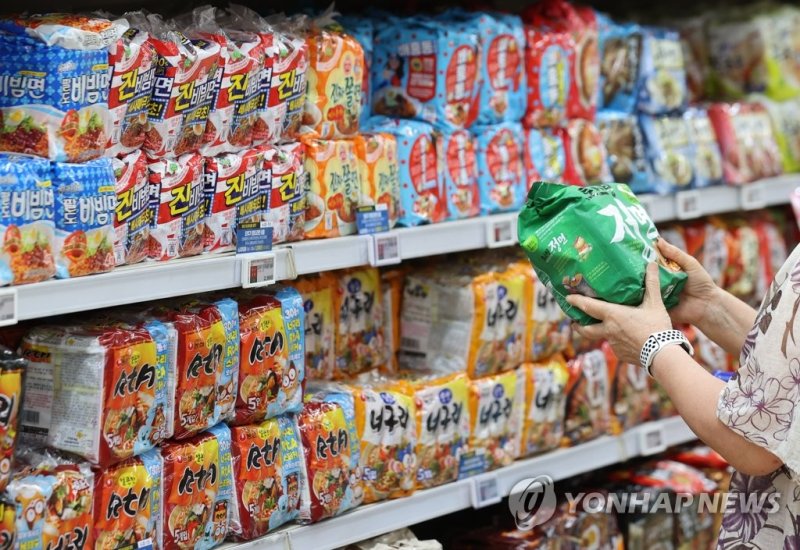
[Financial News] The landscape of South Korea’s imported ramen market is shifting. As Japanese and Chinese ramen, which have long led the market, lose ground, Vietnamese ramen is growing rapidly and emerging as a major source of imports. This is believed to reflect the sharp increase in the number of Vietnamese residents in South Korea and the expansion of the consumer base for food from Vietnam.
According to the Korea Agro-Fisheries & Food Trade Corporation (aT)’s 2026 processed food status survey, South Korea’s imported ramen market has recently been undergoing an adjustment. The value of ramen imports into South Korea, which stood at around $10.24 million in 2021, set a new record each year, reaching $14.98 million in 2022, $18.96 million in 2023 and $24.69 million in 2024. However, it eased to $17.39 million last year. An industry official said, “The decline in imports of overseas ramen appears to have been caused by a combination of factors, including higher raw material and logistics costs, exchange-rate fluctuations, changes in domestic consumption trends, and the strong competitiveness of Korean ramen.”
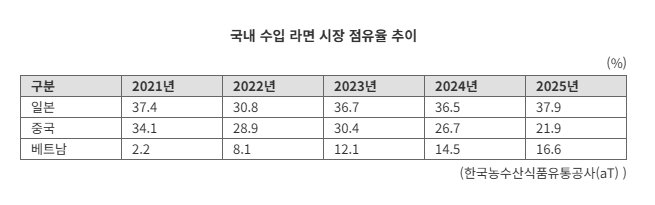
The mix of countries supplying imported ramen is also showing signs of change. Based on the value of South Korea’s ramen imports last year, Japan ranked first with $6.58 million (37.9%). It was followed by China with $3.8 million (21.9%), Vietnam with $2.87 million (16.6%), Thailand with $2.02 million (11.6%) and Indonesia with $1.3 million (7.5%).
The most striking change is the rapid rise of Vietnamese ramen. Its share of total ramen imports, which was just 2.2% in 2021, surged to 16.6% last year—four years later—moving Vietnam from fifth to third among import sources.
By contrast, Japanese ramen, which has long held the top spot in the market, was effectively flat, with its share edging from 37.4% in 2021 to 37.9% last year. The share of Chinese ramen fell more sharply, from 34.1% in 2021 to 21.9% last year. Vietnamese products are rapidly expanding their position in South Korea’s imported ramen market, once dominated by Japan and China. The changing national composition of foreign residents in South Korea is cited as a factor behind this shift.
According to the Ministry of Justice’s statistics on foreign residents, the number of Vietnamese nationals residing in South Korea (as of December 2025) surged from 209,000 in 2021 to 337,000 last year, marking one of the highest growth rates among major nationalities.
The increase in the number of Vietnamese residents in South Korea is believed to have boosted demand for foods they are accustomed to eating in their home country and expanded both distribution channels carrying Vietnamese food products and the consumer base for them. Demand for ramen has also grown among consumers who prefer the flavors and product characteristics familiar to them from Vietnam.
An aT official said, “The increase in the number of Vietnamese residents in South Korea, along with the expansion of the consumer base for Vietnamese food culture and products, is likely to have contributed to some extent to the recent rise in imports of Vietnamese ramen.”
South Korea’s ramen industry is watching to see whether the shift in the countries supplying imported ramen reflects domestic consumers’ demand for a wider variety of food cultures. An industry official said, “The impact of changes in the imported ramen market on domestic ramen companies will be minimal,” adding, “Still, we need to keep an eye on market trends.”
[email protected] Kim Seo-yeon Reporter