Acting police chief says improvements will follow study findings after rural policing disparities are flagged
- Input
- 2026-10-26 13:30:15
- Updated
- 2026-10-26 13:30:15
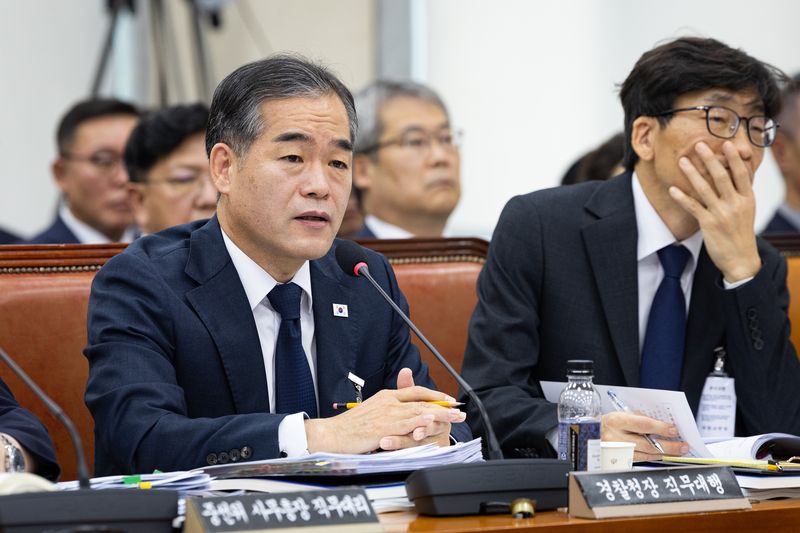
[Financial News] Acting Korean National Police Agency chief Kim Jong-cheol said he had commissioned a study to determine appropriate staffing levels for policing in rural and fishing communities and would develop reasonable improvements based on its findings. Responding to concerns about policing gaps under the central-area police station system, he said public safety should take precedence over the efficiency of police work.
At the comprehensive audit of the National Assembly’s Security and Public Administration Committee on the 26th, Acting Commissioner Kim told Park Deok-heum of the People Power Party, who had raised concerns about a shortage of police personnel in rural and fishing communities, “We have commissioned a study on how many police personnel should be maintained at an appropriate level in those areas,” adding, “Once the results are available, we will seek reasonable ways to improve the situation.”
Rep. Park questioned the effectiveness of the system, saying that since the central-area police station system was introduced, response times to emergency calls in Seoul had fallen, while the national average had actually risen. Under the system, two or three neighboring police precincts or substations are grouped together; the one serving an area with greater policing demand is designated the central station, while the others operate as community stations. Only minimum staffing is kept at community stations, with the rest assigned to the central station to respond to 112 calls and conduct preventive patrols.
According to data presented by Rep. Park, the time taken to reach emergency calls in Seoul fell by 25 seconds, from 286 seconds to 261 seconds, while the national average rose by 30 seconds, from 314 seconds to 344 seconds. Over the same period, the number of regional police officers nationwide fell by 1,992, from 50,897 to 48,905.
Rep. Park asked, “Do you think the efficiency of police operations is more important than public safety?” Acting Commissioner Kim stressed, “Efficiency in police work is important too, but the issue that must take top priority is public safety.”
Rep. Park said, “We need to bring back differentiated operations for urban and rural areas, ongoing evaluations based on response times and resident satisfaction, and adjustments based on those evaluations,” and criticized the system, asking, “Is it acceptable to treat people unfairly just because they live in rural and fishing communities?” He also raised concerns about fairness between regions, noting that a plan to consolidate police substations in urban areas had been withdrawn after residents objected, while community stations continued to operate in rural and fishing communities. Acting Commissioner Kim said, “We will look for ways to ensure resident satisfaction is adequately taken into account in how police personnel are deployed.”
At that day’s audit, questions were also raised about the adequacy of the previous police investigation into allegations that independent lawmaker Han Dong-hoon’s daughter had fabricated her credentials. When Democratic Party of Korea lawmaker Yoon Geon-yeong asked whether he had received the official records supporting the award given to Han’s daughter, Acting Commissioner Kim replied, “I did.”
When Rep. Yoon asked whether a high school freshman could have donated 50 laptops, National Office of Investigation chief Hong Seok-gi said, “I don’t think that is in line with common sense.”
Rep. Yoon raised allegations that the police investigation at the time had been inadequate. Chief Hong explained, “I was told that investigators had interviewed as a witness the organization that verified the volunteer work, and had also looked into how the relevant materials were submitted to that organization.”
Rep. Yoon criticized the police for sending cooperation requests to 14 institutions in South Korea and abroad but not to the U.S.-based Massachusetts Institute of Technology (MIT) to verify allegations concerning the former minister Han’s daughter and her admission. In response, Acting Commissioner Kim said, “I understand that a complaint has been filed in connection with what you mentioned,” and promised, “We will examine every aspect of the case carefully, one by one, so that not the slightest doubt remains.” Chief Hong added, “We will investigate thoroughly in accordance with the law and principles.”
[email protected] Kim Ye-ji Reporter