Park Chan-dae: “Incheon will achieve 5% economic growth and create quality jobs” ... Steps up push to develop future industries
- Input
- 2026-10-26 13:18:42
- Updated
- 2026-10-26 13:18:42
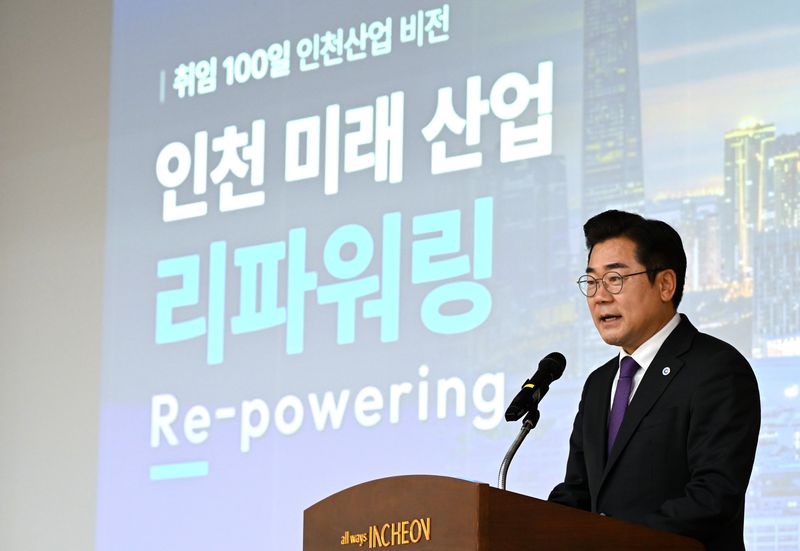
【Financial News, Incheon = Han Gap-su】 Incheon Mayor Park Chan-dae is setting out to develop future industries, targeting 5% economic growth and the creation of 6,000 additional high-value-added jobs. The plan is to secure new growth engines by adding research and development (R&D) capabilities to its world-class bio-manufacturing base and growing the artificial intelligence (AI), future vehicle, logistics and clean-energy industries.
Mayor Park announced “Incheon Future Industry Re-powering” on the 26th, saying, “We will lead Korea’s global competitiveness by building on the irreplaceable strengths unique to Incheon.” Re-powering means injecting new momentum into existing industries to revive Incheon’s growth.
The core of the initiative is the “ABC+E” strategy, which reorganizes the industrial structure around AI, bio, culture and energy—the election pledges—and links them with related industries such as logistics and future vehicles.
The target average economic growth rate during the ninth popularly elected administration is 5%, 1.1 percentage points higher than the 3.9% average growth rate during the eighth administration. Since Incheon’s growth rate, which ranked first nationwide in 2022, fell to minus 0.5% last year, the city plans to focus its administrative efforts on restoring growth.
The city has designated 2028 as a turning point for an industrial leap forward and plans to draw up sector-specific master plans by 2027. It will then seek to host international events and expos in the bio, future vehicle and logistics sectors, as well as the 2028 Group of Twenty (G20) summit.
In the bio sector, the city plans to pursue legislation to establish the Incheon Institute of Bio Science and Technology and seek to upgrade the Yeongjong Bio Specialized Complex to a national industrial complex. It aims to prepare the bill by the first half of next year. In the future vehicle sector, it plans to attract an R&D project worth up to 900 billion won and cluster related companies and cybersecurity firms around Cheongna.
The city will incorporate AI transformation into the logistics industry. It will pursue technology development and demonstration through the Logistics AX Alliance, which includes 37 organizations and companies, and begin securing a site for a Logistics AX Convergence Institute, aiming to open it in 2029. It also presented a proposal for an East-West Peace Logistics Expressway linking Incheon with northern Gyeonggi Province and Gangwon Province.
In the energy sector, the city plans to transition from coal-fired power to solar, wind and hydrogen, among other sources, and develop AI data centers and the offshore wind industry. It aims to expand offshore wind capacity to a total of 4.4 GW, including 1 GW led by the public sector. It has also proposed to the government increasing the cut in industrial electricity rates to 8–14 won per kWh, but no further reduction has been confirmed. The introduction of a small modular reactor (SMR) on Yeongheung Island remains under review.
The city has set a target of creating 6,000 additional high-value-added jobs annually through its restructuring of future industries. It plans to develop a comprehensive package of measures analyzing the employment impact by industry and pursue projects under its own plans rather than relying solely on government open-call programs.
Mayor Park said, “Even goals that are difficult to achieve must be pursued step by step; we must adjust our strategy based on the results and try again,” adding, “Together with our citizens, we will open a new future for Incheon.”
[email protected] Han Gap-su Reporter