Mountain Villages Facing an Extinction Crisis Build Foundations for Self-Reliance with Local Resources
- Input
- 2026-10-26 10:22:29
- Updated
- 2026-10-26 10:22:29
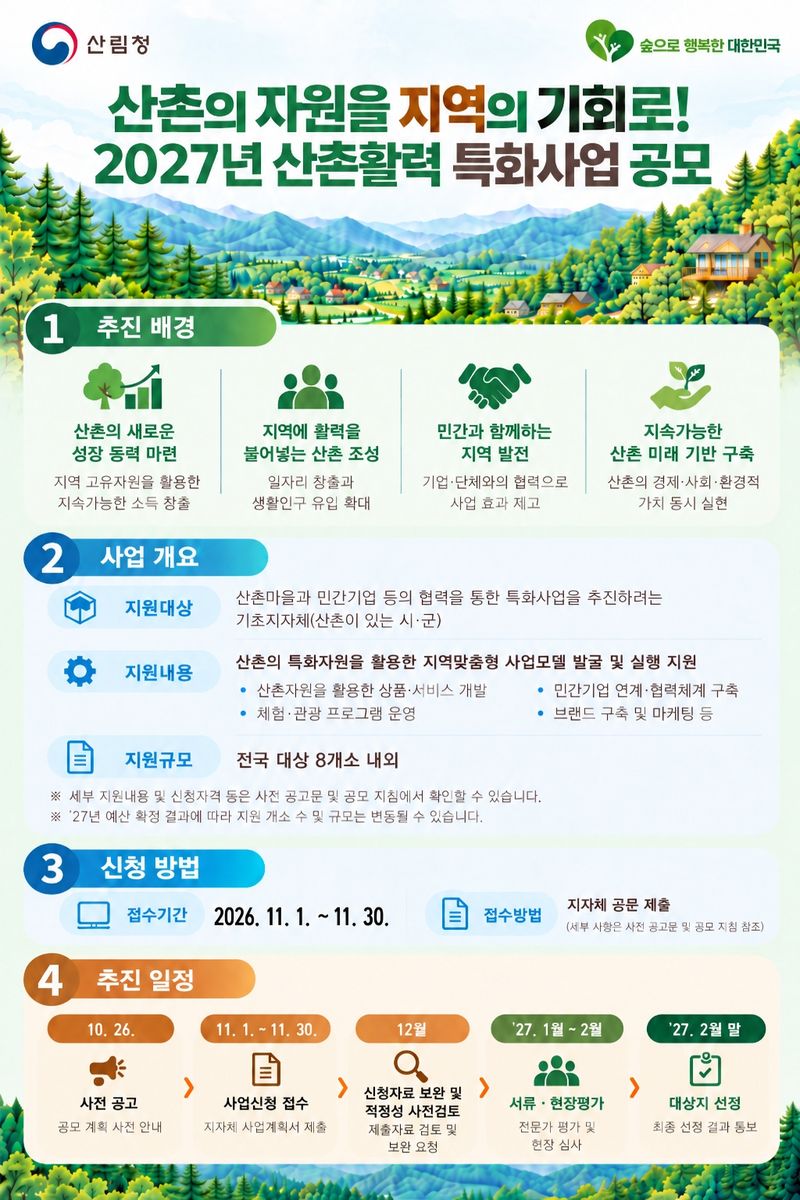
The KFS said on the 26th that it had announced its plan to select sites for the 2027 Mountain Village Vitality Specialized Project and would invite local governments with mountain villages to apply from the 1st to the 30th of next month.
According to the Mountain Village Basic Survey conducted by the KFS in 2024 as part of its survey held every 10 years, South Korea currently has 468 eup and myeon administrative districts classified as mountain village areas. In particular, at least 90% of them face a “very high risk of extinction,” making it urgent to develop measures to sustainably revitalize mountain villages at the local level.
Launched in 2024, the Mountain Village Vitality Specialized Project is an initiative to identify and support tailored business models by drawing on the abundant forest, landscape and cultural resources of struggling mountain villages.
The KFS plans to select a final eight regions by the end of February next year, following a rigorous application process that includes expert reviews of written submissions and on-site assessments. Each selected region will be paired with a professional consulting firm, which will provide close, on-the-ground support to identify income-generating models suited to local characteristics and establish systems for implementing the projects.
Cho Young-hee, director general of the Forest Welfare Bureau at the KFS, said, “We will pursue specialized projects that highlight the unique character and appeal of mountain villages, creating an opportunity to revitalize these communities and promote regional development.”
Meanwhile, the Mountain Village Vitality Specialized Project is expected to expand beyond support for growing forest products, which focuses simply on the primary industry, by combining it with rapidly growing demand for wellness tourism and forest therapy and recreation infrastructure. The plan is to transform resources such as mountain villages’ pristine natural environments, forest recreation activities and forest experiences into tourism products centered on overnight stays, drawing in young people and others with ties to the area. This is expected to go beyond one-off support, increasing the number of people visiting mountain villages and directly bringing vitality to local economies.
[email protected] Kim Won-jun Reporter