“I thought the warship was going to sink”...The 91-year-old U.S. Navy veteran who guarded Korean waters after the armistice <1950, Memories of the Living (7)>
- Input
- 2026-10-27 06:00:00
- Updated
- 2026-10-27 06:00:00
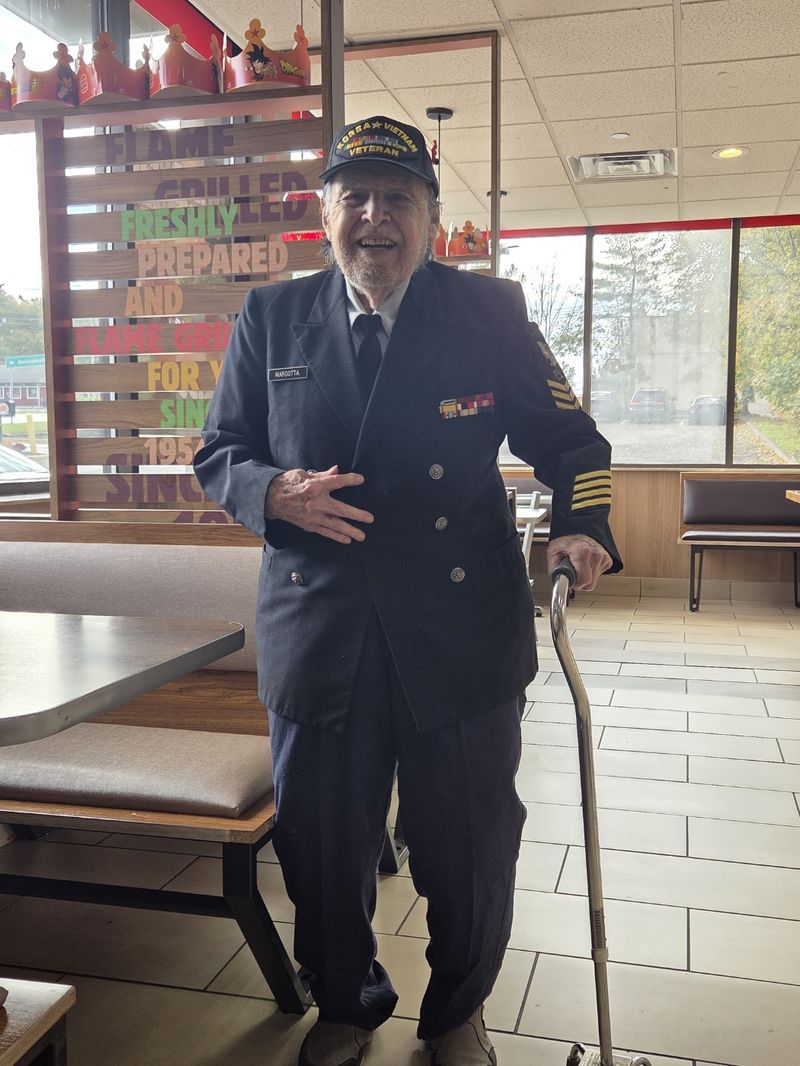
“We ran into a typhoon, and seawater came pouring into the warship. I thought the ship was going to sink. I’m lucky to still be alive.”
For Raymond Allen Magota, 91, who says he joined the U.S. Navy shortly after the Korean War armistice and served in waters around the Korean Peninsula, memories from more than 70 years ago are still vivid. The guns of war had fallen silent, but peace had not come to the Korean Peninsula. He recalls that, at 18, he monitored the movements of nearby ships and aircraft while keeping watch on the warship’s radar screen.
In an interview with The Financial News on the 7th, Magota said, “We tracked ships and planes on radar,” adding, “When we were ordered to prepare to fire the ship’s guns, all the crew members went to their assigned positions.”
After the interview, he checked the relevant records and said that the warship he had served aboard was the U.S. Navy heavy cruiser USS Baltimore (CA-68). Magota remembers carrying out missions off the coast of Korea in 1954. The official U.S. Navy service record (DD214) he provided contains details of his military service from his enlistment in 1953 through the early 1980s, radar training, and major medals and commendations.
18-year-old with no money for college joined the Navy 72 days after the armistice
Born on January 9, 1935, in Sleepy Hollow, New York, Magota considered his options after graduating from high school. He wanted to attend college, but his family was not well off.
“My parents didn’t have the money to send me to college. I didn’t have the money for tuition either. So I joined the Navy.”
He enlisted in the U.S. Navy in New York on October 7, 1953. The Korean Armistice Agreement had been signed 72 days earlier. The official service record he provided also lists October 7, 1953, as the date he first entered active duty.
Asked why he had joined the military, he replied, “I wanted to serve my country.” When asked why he had chosen the Navy rather than the Army or Air Force, he laughed and said, “I liked the water.”
Friends around him were also joining the military at the time. Some went into the Army, while another friend joined the Air Force. Magota chose the sea. That choice marked the beginning of a military career that lasted about 30 years.
After completing recruit training, he received training in radar operation and maintenance. A 1956 service record issued by the U.S. Navy states that he underwent radar operation and maintenance training from January to July 1954. He later served as a radarman, and his rate in 1956 was Radarman Second Class (RD2). Radarmen were responsible for detecting aircraft and ships approaching a warship, and determining their position and direction of movement.
“The radar spins around and picks up nearby ships and planes. I watched the screen to check whether any ships or aircraft were approaching.”
Tensions still gripped the Korean Peninsula after the armistice...Radar watch aboard a heavy cruiser
The USS Baltimore, which Magota says he served aboard, was a heavy cruiser that operated in the Pacific theater during World War II.
Commissioned in 1943, the Baltimore took part in operations in the Marshall Islands, Iwo Jima and Okinawa, among others. The ship was about 205 meters long and carried nine 8-inch guns and 12 5-inch guns. It was decommissioned once after the war, then recommissioned in November 1951, during the Korean War.
Magota recalled first boarding a warship in January 1954. He said it departed from the U.S. East Coast, passed through the Panama Canal, and headed for Japan via the West Coast and Hawaii. He said he later traveled between Japan, the Philippines, Okinawa and Taiwan on missions.
He recalled, “We would serve overseas for about six months, return to the United States, and then go out again.”
The USS Rochester (CA-124) is the only warship in his service history confirmed by official documents. A service record prepared in 1956 lists the Rochester as the last ship on which he served. The Rochester was also a U.S. Navy heavy cruiser equipped with large guns and operated in waters around the Korean Peninsula during the Korean War.
Asked which waters off Korea he had served in, Magota replied, “The West Sea. The waters on the Chinese side.”
Fighting had stopped on the Korean Peninsula, but no peace system had been established. The signing of the armistice agreement on July 27, 1953, brought an end to large-scale fighting that had continued for more than three years. The Military Demarcation Line and the Demilitarized Zone (DMZ) were established on land. But the armistice was only a military agreement to halt hostilities, not a peace treaty that would formally end the war politically.
The West Sea in particular remained an area of military tension after the armistice. The armistice agreement placed the five West Sea island groups, including Baengnyeongdo, Daecheongdo, Socheongdo, Yeonpyeongdo and Udo, under the military control of the United Nations Command (UNC). But unlike the land-based Military Demarcation Line, the armistice did not specify a maritime military boundary running across the entire West Sea.
Military mistrust also persisted. The UNC and the South Korean government were concerned about possible violations of the armistice agreement, including whether North Korea was complying with it and bringing in military equipment. Disputes also continued over the activities of the Neutral Nations Supervisory Commission, which monitored implementation of the armistice.
The U.S. Navy continued surveillance operations in waters around Korea after the armistice. According to the U.S. Navy’s official ship history, the destroyer USS Monssen (DD-798) patrolled waters off Korea and the Taiwan Strait for about four months from June 1954. The U.S. Navy continued its maritime surveillance missions around the Korean Peninsula after the armistice.
“Eight-hour radar watches...battle stations when the ship’s guns were to be fired”
Magota’s day began with keeping watch over the radar screen.
“We stood watch in eight-hour shifts. When someone else came on, I would eat or rest. Then, when it was time, I would go back to the radar.”
Warship crews maintained round-the-clock surveillance through shift work. They identified the positions of aircraft and ships appearing on radar and tracked their movements.
The tense moments came when the order to go to battle stations was given.
“When we had to fire the ship’s guns, the order called ‘General Quarters’ was given. Everyone went to their assigned positions. Mine was the radar room.”
He explained that he had not fired the ship’s guns himself.
“Once we found a target, the fire-control personnel fired the guns. I didn’t fire them myself.”
Magota also recalled that the ship’s guns had been fired toward the North Korean coast while he was serving in waters off Korea.
“We weren’t attacking an aircraft or a ship. We fired toward the shore.”
However, he could not remember the exact date or location of the shelling. Whether the North Korean coast was actually shelled after the armistice needs to be confirmed through operational records from the time.
Magota said he spent most of his time aboard the warship while serving in waters off Korea, because the radar room was his workplace.
“I was inside the ship. I couldn’t see outside. I just watched the radar, as if I were looking at a television screen.”
He said he did not remember seeing South Korean or North Korean soldiers in person, as he carried out surveillance duties at sea, away from the coast, and spent long periods inside the warship.
The only visit to Korea he remembers was a brief shore leave in Busan.
“I went to Busan. I think I had shore leave for three or four days. Korean people were really kind. They were warm and welcoming to visitors.”
Asked what had impressed him most about Korea, he also singled out the kindness of its people.
Life aboard a warship was grueling. The crew had to stay at sea for months at a time, and sleeping quarters were cramped. The food was monotonous, too.
“The beds were small. The food wasn’t very good either. It was always much the same.”
When the ship was operating far out at sea, supply ships would come alongside to deliver food and other supplies. He said he also had photos of such an at-sea resupply.
“I thought the warship was going to sink”...A typhoon more vivid than the sound of gunfire
Asked about the most dangerous moment, Magota thought first of a typhoon rather than combat.
“We ran into a typhoon. Seawater came into the ship. I thought it was going to sink.”
He could not remember exactly where or when he encountered the typhoon. But the moment when he feared for his life remains vivid.
“I’m lucky to still be alive today.”
Even a warship armed with massive guns was not safe from the power of nature. His life at sea remained in his memory not only as a duty to watch the enemy’s movements, but also as a struggle against rough waves.
Magota’s service records also include medals and commendations that attest to his long career in the Navy.
The 1956 service record lists the Good Conduct Medal, the China Service Medal, the National Defense Service Medal and the Commanding Officer’s Letter of Commendation.
The China Service Medal was awarded to service members, including U.S. Navy personnel, who served for a specified period in China and designated nearby waters. It is a noteworthy record alongside Magota’s account in the interview of serving in East Asia, including Japan and Taiwan.
Later records of his Naval Reserve service also list the Naval Reserve Meritorious Service Medal, Armed Forces Reserve Medal, Navy Expeditionary Medal and Sea Service Ribbon, among others.
In particular, records from the early 1980s list experience as an Operations Specialist and an Instructor in the Navy. After beginning his military career as a radar watchstander, he went on to teach other service members related technical skills and operational experience.
Magota completed his first period of active duty on September 19, 1957, and transferred to the Naval Reserve. His separation at the time was recorded as an Honorable Discharge.
He later attended college using the GI Bill, a veterans’ education benefit program. The young man who had joined the Navy because he could not afford tuition gained the opportunity to pursue a college education through his military service.
After college, he worked in quality control at Mallory Battery Company, a battery manufacturer. But he lost his job around the time he got married. With a family to support, he returned to the Navy.
“I got married, but I didn’t have a job. Three children were born within three years. When I joined the Navy, I could get various benefits, including health insurance. I had to do it for my family.”
He said he served in the military for about 30 years in total, combining active-duty and reserve service.
His official records also show a long military career. In 1977, after serving at the Naval Air Technical Training Center in Norfolk, Virginia, he was transferred to a Naval Reserve facility in Middletown, New York. Another discharge document, prepared in 1982, records that he served as an Operations Specialist and Instructor at the Fleet Combat Training Center in Virginia Beach.
The 18-year-old who joined the Navy shortly after the Korean War armistice is now 91. Memories of keeping watch over the radar screen aboard a warship more than 70 years ago remain with him. The exact dates and locations of the operations have grown hazy, but he has not forgotten the rough seas, the tense life aboard the warship, or the kindness of the people he met in Korea.
[email protected] Correspondent Lee Byung-chul Reporter