Takaichi’s approval rating at 62% ... Takaichi ranks first in preference for next prime minister
- Input
- 2026-10-26 08:38:55
- Updated
- 2026-10-26 08:38:55
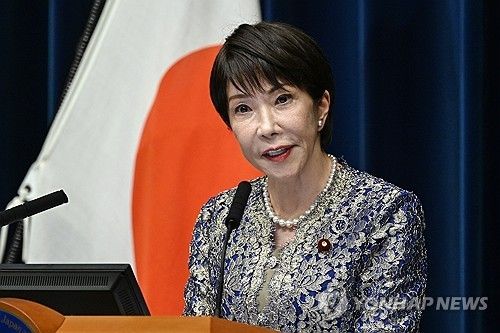
【Financial News, Tokyo—Correspondent Seo Hyejin】Japanese Prime Minister Sanae Takaichi, marking one year in office, has maintained cabinet approval in the 60% range. She also ranked first among politicians in a survey of preferences for the next prime minister. However, more than half called for expanded dialogue with China, and views were divided on the government’s response to high prices and the weak yen.
According to the Nihon Keizai Shimbun on the 26th, a public opinion poll conducted with TV Tokyo from the 23rd to the 25th found that approval of the Takaichi Cabinet stood at 62%, unchanged from the previous month. The share of respondents who disapproved fell by 2 percentage points (p) to 31%.
Since taking office in October last year, the Takaichi Cabinet has consistently recorded approval ratings above 50%. The Nikkei reported, “Since the survey began in 1987, this is only the second case of a cabinet maintaining an approval rating above 50% during its first year in office, after the Second Abe Cabinet.”
Support among younger people remains solid ... Takaichi also leads as choice for next prime minister
In the Nikkei poll, approval of the cabinet among those aged 39 and under rose 4 percentage points to 73% from the previous month. It fell 4 points to 65% among people in their 40s and 50s, while remaining unchanged at 56% among those aged 60 and older. Approval among independents rose 8 points to 46%.
In a public opinion poll conducted by the Mainichi Shimbun on the 24th and 25th, 27% said Prime Minister Takaichi was the most suitable choice for the next prime minister, the highest share among politicians. Defense Minister Shinjirō Koizumi followed at 12%, and former Internal Affairs and Communications Minister Yoshimasa Hayashi at 10%. Foreign Minister Motegi Toshimitsu received 3%, while LDP Policy Research Council Chairman Takayuki Kobayashi received 2%.
However, “don’t know” was the most common response overall, at 38%. While 55% of LDP supporters chose Prime Minister Takaichi, 53% of independents withheld judgment. Among independents, 17% named Takaichi.
Regarding her time in office, the most common response, at 32%, was that she should continue for as long as possible. 23% said she should resign soon, while 17% wanted her to stay until the end of the LDP president’s term in September 2027. In the Mainichi poll, cabinet approval stood at 45% and disapproval at 41%.
Calls for expanded dialogue with China ... views divided on response to prices
Despite the cabinet’s high approval rating, many also called for the government to change course on individual issues.
In the Nikkei poll, 55% said there should be more opportunities for dialogue with China, exceeding the 39% who said the current approach was sufficient. Even among LDP supporters, 50% favored expanding dialogue, compared with 46% who wanted to maintain the current approach.
The question was asked after respondents were given an explanation that relations between China and Japan had deteriorated following Prime Minister Takaichi’s remarks last November about a contingency involving Taiwan. At the time, Takaichi said that an armed conflict in a Taiwan contingency could qualify as a “survival-threatening situation,” one of the conditions for Japan to exercise its right to collective self-defense.
On the prime minister’s handling of former Agriculture, Forestry and Fisheries Minister Kazuo Yana’s resignation, 48% said there had been “a problem,” compared with 43% who said there had been “no problem.” Yana caused controversy with remarks including that he had cut road budgets in areas whose local government heads had not supported him. Takaichi initially defended him, saying, “Do your job and repay with results.”
As a measure against high prices, respondents preferred cutting the consumption tax on food over cash payments. 54% said a consumption tax cut by the government and ruling party would be more effective, compared with 33% who favored the opposition’s cash payments. 57% also supported a bill to lower the consumption tax rate on food to 1%, exceeding the 36% opposed.
By contrast, views of Prime Minister Takaichi’s response to high prices and the weak yen were nearly evenly split, with 45% positive and 47% negative. In other words, although respondents supported tax cuts, they did not give the government’s overall response to prices high marks.
The Nikkei–TV Tokyo poll was conducted nationwide among men and women aged 18 and older, using random telephone surveys via landlines and mobile phones. There were 945 valid responses, and the response rate was 40.3%.
[email protected] Seo Hyejin Reporter