“KOSPI could fall to 5,200... Stop fixating on Samsung Electronics and SK Hynix”
- Input
- 2026-10-26 08:31:32
- Updated
- 2026-10-26 08:31:32
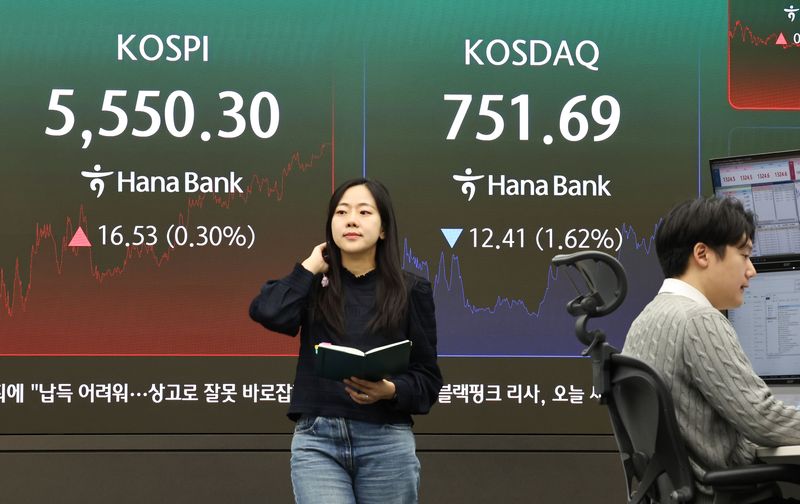
[Financial News] It was noted that the KOSPI could fall to 5,200. They advised that rather than aggressively increasing KOSPI holdings, investors should selectively buy stocks such as oil refiners and shipping companies that are expected to be defensive amid high oil prices and benefit from geopolitical developments. In a report on the 26th, Daejun Kim, a researcher at Korea Investment & Securities Co., Ltd., said the market was in a phase in which “the KOSPI will have difficulty recovering quickly because of external uncertainties.” The KOSPI has fallen for four consecutive weeks this month. Last week, it dropped another 2.1% to close at 5,550.3. Average weekly trading value, an indicator of market activity, peaked at 59.9 trillion won in June before declining to 17.6 trillion won last week.
Kim said, “SK Hynix’s share buyback has ended, removing a factor that had been supporting the market floor. On top of that, Meta’s free cash flow turned negative, spreading concerns about investment in artificial intelligence (AI).” He added, “Sentiment is strongly tilted toward waiting for this week’s earnings from major domestic and global tech companies and various events, so the wait-and-see trend is likely to continue for some time.”
He cited France’s fiscal risks as a source of adverse news from Europe, explaining that the issue was fueling risk aversion. On the 23rd (local time), the yield on French 10-year government bonds rose to 5.02%, widening the gap with German yields to 1.67 percentage points. In an unusual development, it also rose above U.S. Treasury yields.
Monetary policy meetings by the central banks of major economies scheduled for this week are also a concern. The central banks of the United States, the eurozone and Japan are all expected to hold policy rates steady, but analysts say they are likely to maintain a hawkish, or tightening-oriented, stance. This could increase pressure from discount rates and weigh on the stock market’s upside.
The conflict in the Middle East is another factor to watch. Kim said, “Amid the offensives by Iran and the Houthis, West Texas Intermediate crude oil (WTI) climbed to $103.3 a barrel.” He added, “The U.S. Strategic Petroleum Reserve has also fallen to 280 million barrels, a historically low level.”
He continued, “In this environment, high oil prices are very disadvantageous for President Donald Trump and the Republican Party, whose approval ratings are falling. The problem is that this trend could continue until the election.”
Kim believes investors should respond with selective investments rather than aggressively increasing their holdings. He said, “I set 5,200 points—the level corresponding to a 12-month forward price-to-book ratio (PBR) of 1 for the KOSPI—as the floor. But rather than aggressively increasing holdings, investors need a strategy of selectively investing in high-oil-price defensive stocks, such as oil refiners and shipping companies, and stocks that stand to benefit from geopolitical developments.”
[email protected] Han Young-jun Reporter