Housing price gap nears 300-fold; residential asset gap between top and bottom 20% hits record
- Input
- 2026-10-26 09:30:21
- Updated
- 2026-10-26 09:30:21
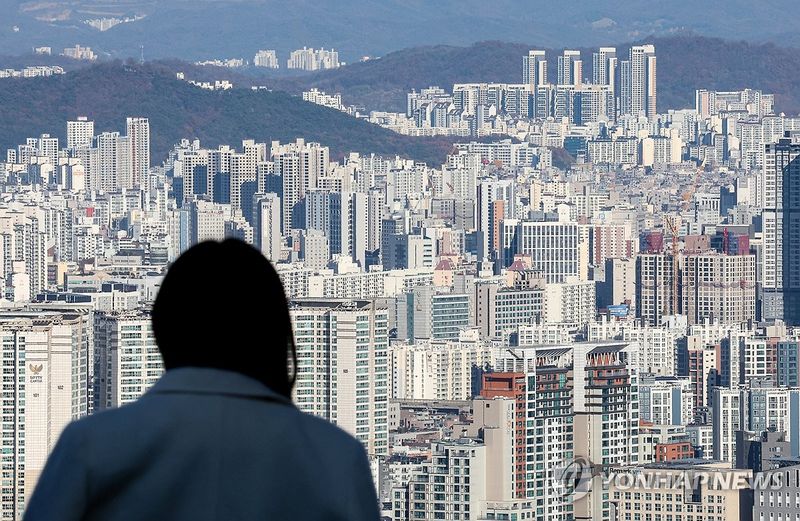
[Financial News] The price of homes owned and occupied by households in the top 20% by assets is nearly 300 times that of homes in the bottom 20%, widening to its largest gap since statistics began being compiled in 2017. The asset gap, including real estate, between the top and bottom 20% also widened to a record 68.6 times, further deepening asset polarization.
Home prices for the bottom 20% by assets fall ... Decline in owner-occupation cited as cause
According to reports on the 26th by Yonhap News Agency and the Ministry of Data and Statistics' Korean Statistical Information Service (KOSIS), among others, last year the average price of owner-occupied homes among households in the bottom asset quintile was 2.39 million won, down 9.1% in a year. This was the lowest level since 2017, when statistics began to be compiled under the current criteria. The statistics record a value of zero for households living in jeonse or monthly rentals, as well as those who own a home but do not live in it; for households with multiple homes, only the price of the home they actually live in is counted.
The decline appears to be mainly due to a drop in owner-occupation. Among households in the first asset quintile, the share owning the home they lived in was 6.6%, down 0.8 percentage points from the previous year and a record low.
By contrast, last year the average price of homes occupied by households in the top asset quintile was 693.41 million won, up 7.7%. This was the second-highest level since 2017, after 746.35 million won in 2022.
The owner-occupation rate for the fifth quintile fell 1.2 percentage points from a year earlier to 82.5%, but rising home prices pushed up the average. The median home price among fifth-quintile households that owned the home they lived in also rose 2.9% to 720 million won.
As a result, the price of homes occupied by households in the fifth asset quintile was 290.1 times that of the first quintile. From 2017 onward, this ratio increased each year, rising from around 146 times in 2018 to 245.5 times in 2022. It briefly narrowed to 215.1 times in 2023, then rose to 244.9 times in 2024 before jumping sharply again last year.
The housing gap translated into an asset gap. Assets in the first quintile, including the home they lived in, totaled 25.88 million won, down 2.9% from a year earlier, while assets in the fifth quintile rose 7.5% to 1.77615 billion won. Assets in the fifth quintile were 68.6 times those in the first, surpassing the previous record of 64.0 times in 2022 and reaching an all-time high.
Asset gap widens more than income gap
The asset gap was even more pronounced than the income gap. Last year (hereafter, years refer to survey years; the actual statistics are based on the preceding year), current income in the fifth income quintile was 11.2 times that in the first, while the gap in disposable income was 9.8 times. The current-income gap had actually narrowed from 12–13 times in 2017–2019. The disposable-income gap also contracted from 11–12 times.
Given the recent sharp rise in prices of high-end apartments in Seoul, the gaps in home prices and assets among upper-tier households are likely to have widened further. If the investment and rental properties they own are also included, the actual real estate gap is likely to be even larger.
Kim Gwang-seok, head of the Economic Research Division at the Korea Economic and Industrial Research Institute, said the government was also paying considerable attention to addressing polarization in real estate, but that it had not achieved results because asset prices, including housing, are ultimately determined by the market.
He added that focusing on stabilizing home prices might not help ensure housing stability. He stressed that greater focus should be placed on housing-stability measures for vulnerable groups, such as expanding rental housing for households renting on jeonse or a monthly basis and increasing public sales of apartments for young people and newlyweds.
Lee Seon-hwa, a senior research fellow at the National Assembly Futures Institute, noted in a recent report, “Asset Inequality and Mid- to Long-Term Reform Tasks for Property Holding Taxes,” that “in Korea, about 70% of household assets are concentrated in real estate, which could amplify the effects of widening asset gaps between regions and generations.”
She said that “over the medium to long term, property holding taxes need to be reformed in stages, reducing tax differences based on the number of homes owned and shifting to taxation based on asset value.” She also proposed that “gaps in housing prices and assets should be addressed comprehensively by coordinating related policies—not only other asset-related tax systems, but also the macro-financial environment, household asset allocation, housing welfare and housing supply.”
[email protected] Kim Su-yeon Reporter