Hyundai Rolls Out a ‘20 Million Won EV’ in a China Gamble as It Teeters on the Brink
- Input
- 2026-10-26 07:23:10
- Updated
- 2026-10-26 07:23:10
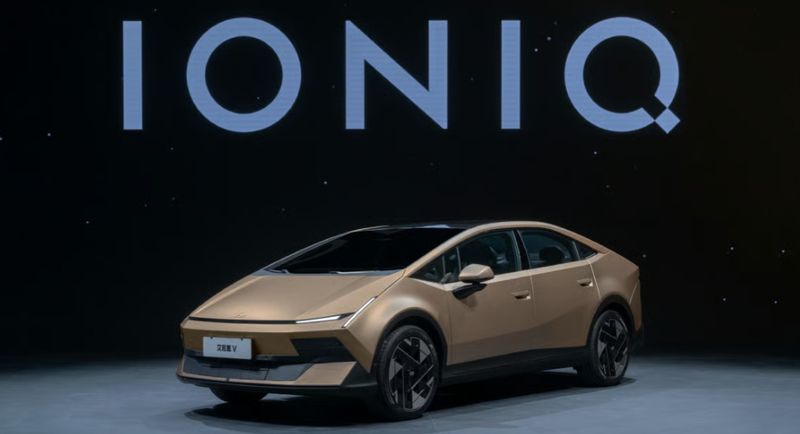
[Financial News] Hyundai Motor Group is losing ground in Europe and China, the two major battlegrounds in the global EV market. In Europe, EV sales hit a record high, but the group was pushed out of the top five in market share by competitors’ aggressive advances. In China, the combined market share of Hyundai Motor Company and Kia fell to 0.6%. Hyundai is mounting a market-specific counteroffensive with the IONIQ 3, a small EV for Europe, and the IONIQ V, a model tailored for China.
■ Falling out of Europe’s top five amid EV market growth
According to market research firm Counterpoint Research on the 26th, EV sales in Europe topped 1.2 million in the second quarter of this year, up 20% from the same period a year earlier. The figure includes not only battery electric vehicles (BEVs), but also plug-in hybrid electric vehicles (PHEVs) and extended-range electric vehicles (EREVs).The Volkswagen Group ranked first among automakers with a 15.07% share, followed by the Renault–Nissan Alliance (9.63%), BMW Group (9.14%), Stellantis (8.56%) and Tesla (8.56%). Hyundai Motor Group, which ranked fifth in the same period last year, fell out of the top five.
Hyundai Motor Company and Kia Corporation sold 131,032 BEVs in Europe in the first half of this year, a record for a six-month period. The increase was driven by higher sales of the Kia EV3 and EV4, and the Hyundai Inster (known domestically as the Casper Electric), among others. But their ranking in the market fell as competitors such as Renault and Tesla rapidly expanded sales with new models. Renault’s EV sales in the second quarter, in particular, surged 153% year on year.
Hyundai Motor Company is counting on the IONIQ 3, which began sales in major European countries last month, to turn its fortunes around. Developed as a B-segment EV targeting demand for small cars in Europe, it has a starting price of €28,950 in Germany.
Hyundai Motor Company also chose Turkey as a production hub to improve price competitiveness. It invested €250 million in its Izmit plant to install EV production facilities and began mass-producing the IONIQ 3 last August. Turkey has a customs union with the European Union (EU), allowing vehicles made there to be supplied to the EU market tariff-free. This gives Hyundai a way to strengthen its price competitiveness while Chinese EV makers face additional tariffs.
■ China market share at 0.6%...EV priced in the 100,000-yuan range enters market
Hyundai Motor Company and Kia’s sales slump is even more pronounced in China. An analysis by Hana Securities of data from the China Passenger Car Association (CPCA) found that their retail sales in China in September were about 4,000 and 5,000 vehicles, respectively. Combined sales totaled 9,000, down 39% from the same month a year earlier. It was the first time this year that their monthly sales had fallen below 10,000.The two companies’ combined market share was just 0.6%. Their share, which exceeded 10% in the mid-2010s, has effectively become entrenched below 1%. Their combined sales from January to September this year also fell 22% from the same period last year, to 115,000 vehicles.
On the 29th of last month, Hyundai Motor Company launched the IONIQ V, an electric sedan tailored for China, as it sought to re-enter the market. The model draws on a partnership with China’s Beijing Automotive Group and local supply chains, and features a lithium iron phosphate (LFP) battery from Chinese battery maker CATL and advanced driver-assistance technology from Momenta.
The IONIQ V’s official starting price was set at 109,900 yuan. A limited-time discount at launch brought the price down to 99,900 yuan. The strategy is to compete head-on with local Chinese automakers on price. Sales last month totaled 558 vehicles, and the model remains at an early stage.
Hyundai Motor Company plans to expand its lineup of new models in China, starting with the IONIQ V. It aims to launch 20 new models over the next five years and increase annual sales to 500,000 vehicles by 2030, including exports from its China subsidiary.
In Europe, the strategy centers on small EVs and local production; in China, it emphasizes local technology and parts sourcing, along with price competitiveness. But competition has intensified in both markets, so it remains to be seen whether the new models will translate into higher sales and a recovery in market share. In China in particular, competition with local automakers that are leveraging low-cost EVs and advanced driver-assistance technology is expected to be key to a future rebound in performance.
[email protected] Kim Dong-ho Reporter