WSJ: Kim Jong Un’s ‘bridge diplomacy’ aims to counter North Korea-Russia rapprochement... China seeks to safeguard its influence over North Korea
- Input
- 2026-10-26 01:03:55
- Updated
- 2026-10-26 01:03:55
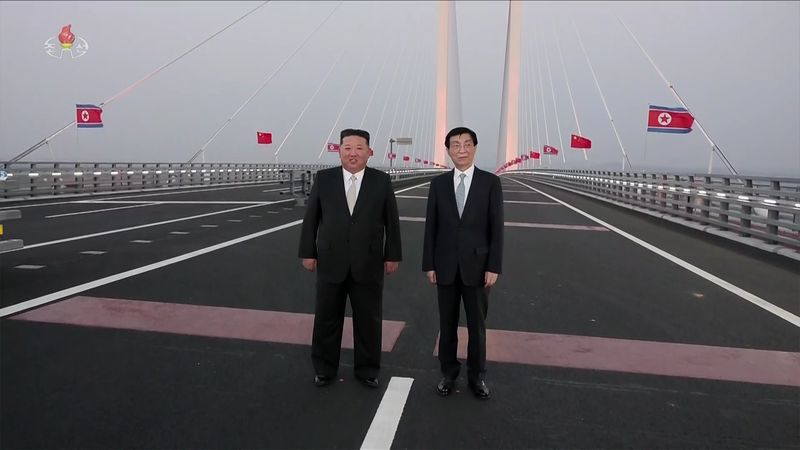
[Financial News] As domestic media outlets successively reported North Korean leader Kim Jong Un’s surprise visit to Dandong, China, and his use of the New Yalu River Bridge, major foreign media outlets offered an in-depth analysis of the move as ‘geopolitical bridge diplomacy’ that went beyond simply resuming exchanges between North Korea and China. Rather than focusing on the surface-level fact that Kim visited a bus factory in Dandong, they examined the calculation behind his crossing a bridge that had been left unused for 12 years after its completion and only recently opened: ‘Why now?’
On the 25th (local time), The Wall Street Journal (WSJ) identified Russia as the most important hidden motive behind the closer ties between North Korea and China. The paper noted, ‘There were times in the past when North Korea’s drive to advance its nuclear capabilities put China in an awkward position and strained relations between the two countries.’ It added, ‘But as ties between North Korea and Russia have strengthened recently, China has gained a powerful “additional motive” to maintain its existing influence over Kim Jong Un’s regime.’ The interpretation is that, as military cooperation between North Korea and Russia accelerates, China has stepped up efforts to manage North Korea so as not to lose its geopolitical influence on the Korean Peninsula.
In this context, Xi Jinping’s decision not to appear in person while Wang Huning, the Chinese Communist Party’s fourth-ranking official and chairman of the Chinese People’s Political Consultative Conference (CPPCC), led the reception is also seen as careful calibration of the diplomatic tone. Meeting Kim, Wang responded, ‘Let us use the shared cause of socialism as a bond, implement the consensus reached by the top leaders of our two countries, and take North Korea-China relations to a higher level.’
WSJ also considered the visit to China significant as a message of pressure on the United States. The paper noted, ‘This “bridge diplomacy” unfolded at a time when the U.S. government was putting its allies to the test over issues including trade, security and defense spending.’ It said that, taking advantage of the strain on the United States’ global network caused by disputes with allies over who pays the bill, major rivals were coming together and flaunting their ‘unbreakable friendship forged in blood.’
WSJ also described the New Yalu River Bridge, a four-lane crossing that China invested $300 million in (about 420 billion won) but that went unused for 12 years because North Korea lacked the necessary infrastructure and has finally begun functioning as intended, as a powerful signal that full-scale trade normalization between the two countries—now fully restored to pre-pandemic levels—was underway, alongside their political and military alignment.
According to North Korean state media, Kim emphasized during the visit that the relationship between the two countries was an ‘unbreakable friendship forged in blood.’ Wang, who led the Chinese delegation, also reaffirmed their strong solidarity, saying, ‘Let us use the shared cause of socialism as a bond, implement the consensus reached by the top leaders of our two countries, and take North Korea-China relations to a higher level.’
[email protected] Park Ji-hyun Reporter