From waiting for a rebound to worrying about delisting... KOSDAQ investors are suffering [Why Is the Stock Market...]
- Input
- 2026-10-26 06:00:00
- Updated
- 2026-10-26 06:00:00
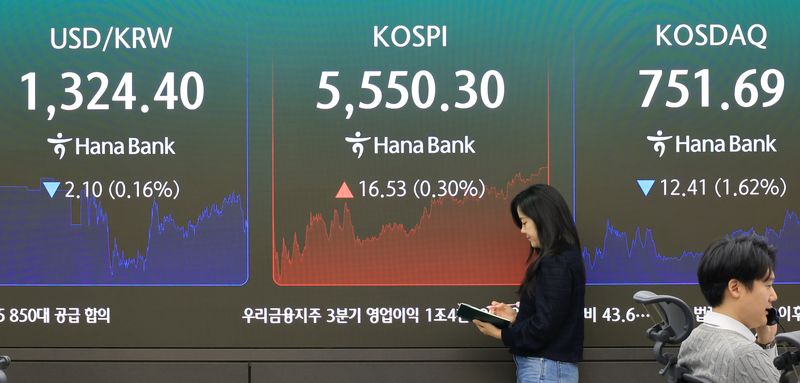
[Financial News] The KOSDAQ index fell more than 5% in a week, putting a damper on hopes for a rebound. Investors are finding little to cheer about despite forecasts that funds concentrated in large-cap stocks could shift to small- and mid-cap stocks. The market downturn has increased the number of companies falling short of market-cap requirements, while concerns have also grown that the KOSDAQ tier system could concentrate investment in a few blue-chip stocks.
Gave back rebound gains in just a week... A shift in fund flows is key to recovery
According to the financial investment industry on the 26th, the KOSDAQ index closed at 751.69 on the 23rd, down 5.42% from 794.78 on the 16th. The KOSPI fell 2.08% over the same period, meaning the KOSDAQ's decline was more than twice as steep. On the 23rd, the KOSPI rose 0.30%, while the KOSDAQ fell 1.62%.The KOSDAQ rose 4.46% in a single day on the 16th, but gave back all of those gains within a week. It is 18.78% below 925.47 at the end of last year and 34.60% below 1,149.44 at the end of January this year. To regain its 52-week high of 1,229.42, it would have to rise 63.55% from its current level.
During the Global Financial Crisis (GFC), the KOSDAQ fell 52.85% in 2008 and then rose 54.67% in 2009. However, the index stood at 513.57 at the end of 2009, 27.07% below its 704.23 level at the end of 2007, just before the crisis. More recently, it rebounded 27.57% in 2023 after falling 34.30% in 2022, but failed to recover its level at the end of 2021 and fell another 21.74% in 2024.
A shift of funds away from large-cap stocks, where they have been concentrated, is seen as a potential catalyst for a rebound. Kang Hyun-gi, an analyst at DB Securities Co., Ltd., explained, “In general, the KOSDAQ tends to outperform when the concentration of fund flows in large-cap stocks eases.”
Kang said, “As competition among artificial intelligence (AI) companies intensifies, service fees are falling, while interest expenses are rising as infrastructure investment expands.” He forecast, “If rising interest rates add to the pressure and AI-related stocks enter a period of consolidation, small- and mid-cap stocks, including those on the KOSDAQ, could emerge as alternative investment destinations.”
Sharp rise in companies with market caps below 30 billion won... Reforming the system and protecting growth companies are also challenges
According to the Korea Exchange, the number of KOSDAQ-listed companies with market capitalizations below 30 billion won rose about 89%, from 182 on February 12, when a delisting reform proposal was announced, to 344 on the 20th of this month. Over the same period, the KOSDAQ index fell 30.55%, from 1,125.99 to 781.97.Strengthening delisting rules is intended to remove financially distressed companies and bolster confidence in the market. However, when the market as a whole declines, the number of companies falling short of market-cap requirements may grow, regardless of the efforts individual companies make to manage their businesses. Companies are not delisted immediately just because their market capitalization is below 30 billion won, but the longer a bear market lasts, the greater the burden of maintaining a listing may become.
An industry official said, “Companies need time for their research and development to produce results, but if they become preoccupied with meeting market-cap requirements right away, they will inevitably prioritize short-term stock-price management over long-term investment.” The official added, “Companies with growth potential should also be given time to prove it.”
The KOSDAQ tier system also carries both promise and risks. Separating high-quality companies into a premium group could boost confidence and help attract institutional and foreign investment. On the other hand, if investment becomes concentrated in premium stocks and related exchange-traded funds (ETFs), other small- and mid-cap stocks could face reduced trading and greater difficulty raising funds.
Eom Su-jin, an analyst at Hanwha Investment & Securities Co., Ltd., said, “I expect the positive effects of introducing the system to outweigh its side effects,” while noting that “biotech and technology companies that currently lack sufficient sales and profits could be disadvantaged by short-term performance criteria.”
A securities industry official emphasized, “If earnings estimates continue to be revised upward, net buying persists, and rising trading value spreads across multiple sectors, that could provide a basis for assessing the sustainability of the rally.” The official added, “We should also watch whether the burden from margin loans and forced selling eases.”
[email protected] Choi Doo-seon Reporter