Was Kim Jong Un’s China Visit Meant to Lay the Groundwork for a North Korea-U.S. Summit? Most Assessments Are Skeptical
- Input
- 2026-10-26 06:00:00
- Updated
- 2026-10-26 06:00:00
Negative assessments are prevailing for now, given that Kim did not meet with Chinese President Xi Jinping. However, some believe the possibility of coordination on the North Korea-U.S. summit cannot be ruled out, since the foreign ministers of North Korea and China were in attendance.
According to diplomatic sources on the 26th, the failure to hold a meeting with Chinese President Xi Jinping is cited as the most decisive reason why Kim’s visit to China is difficult to view as preparation for a North Korea-U.S. summit.
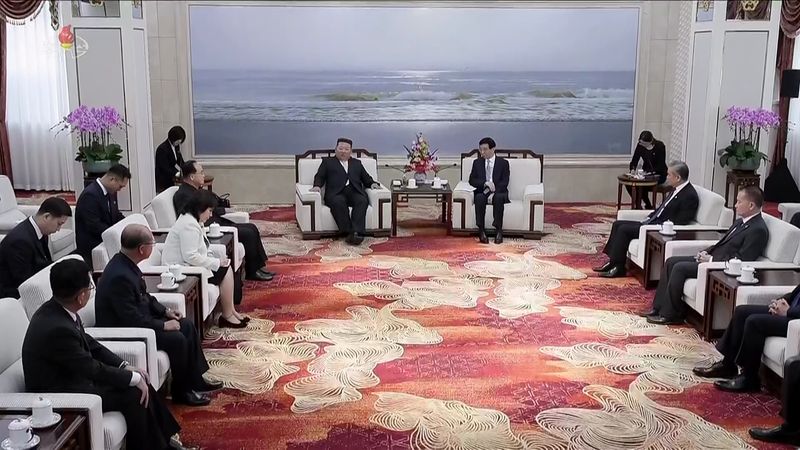
In the past, when North Korea sought to coordinate in advance with China ahead of major diplomatic events such as North Korea-U.S. talks, it visited Beijing and held meetings at the highest level. This time, however, Kim met only with Wang Huning, China’s fourth-ranking official and chairman of the Chinese People’s Political Consultative Conference (CPPCC), and did not meet with Xi. This has lent weight to the view that the visit was not an occasion for formal, full-fledged coordination on North Korea-U.S. talks.
Some assessments have nevertheless emerged that the possibility of discussions on North Korea-U.S. affairs was not entirely ruled out, given that Foreign Minister Choe Son-hui and China’s Foreign Minister Wang Yi were in attendance. However, it has been pointed out that Kim’s day-trip schedule to China left too little time for the North Korean and Chinese foreign ministers to hold a separate follow-up meeting.
A senior ruling-party official drew a distinction, saying, “This visit was an extremely short trip centered on Dandong, and was more strongly characterized as an economic cooperation event focused on border areas, such as the opening of the New Yalu River Bridge, rather than high-level coordination on the situation for a North Korea-U.S. summit.”
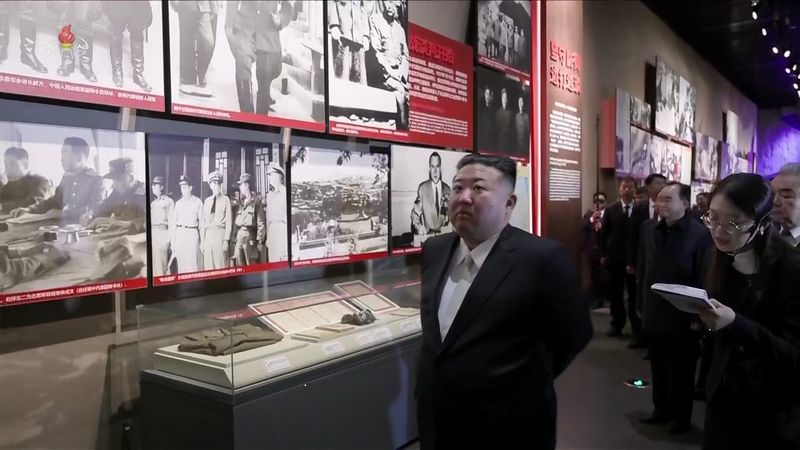
The fact that the first place Kim visited upon arriving in Dandong was the Memorial Hall of the War to Resist U.S. Aggression and Aid Korea also undermines the theory that the trip was preparation for North Korea-U.S. talks. The term refers to China’s entry into the Korean War and its support for North Korea against the United States, and the memorial is regarded as a symbol of resistance to the U.S.
The analysis is that the aim was not to send a conciliatory signal to the United States, but to demonstrate North Korea’s role as a key pillar of anti-U.S. solidarity on a “new Cold War front” underpinned by closer ties between China and Russia.
U.S. President Donald Trump’s top diplomatic priority is currently focused on ending the war in Ukraine swiftly, not on the Korean Peninsula. On the sidelines of next month’s Asia-Pacific Economic Cooperation (APEC) summit, Trump plans to focus on trilateral talks among the United States, China and Russia to discuss ending the war in Ukraine. As a result, four-party talks among South Korea, North Korea, the United States and China to resolve issues on the Korean Peninsula have been pushed to the back burner.
Asked recently by reporters about the possibility of a meeting with Kim, Trump shifted back to a cautious and noncommittal stance, saying, “I don’t know who is asking for a meeting.” Major think tanks, including the Carnegie Endowment for International Peace in the United States, are also putting the odds of a surprise North Korea-U.S. summit on the sidelines of next month’s Asia-Pacific Economic Cooperation (APEC) summit at an extremely low level—below 10%.
[email protected] Kim Kyung-soo Reporter