[Editorial] Move beyond stopgaps for high oil prices and plan for stable energy supplies
- Input
- 2026-10-25 19:35:14
- Updated
- 2026-10-25 19:35:14
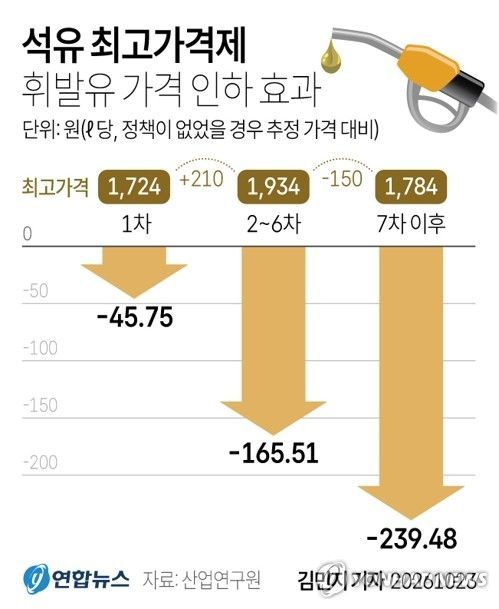
Our government's response to oil prices, however, may be failing to keep pace with global changes in energy supply and demand. The oil price cap is a case in point. It has helped stabilize domestic energy prices amid the war in the Middle East. The problem is that, more than seven months after it was introduced, no end date is in sight. The cap is merely a stopgap policy to put out an immediate fire. It has held down soaring prices but has done nothing to address the underlying factors driving them up. Meanwhile, the fiscal burden continues to grow. Several trillion won in public funds will have to be spent to compensate refiners for their losses. What is more, there is no way to know how long further public funding will be needed.
Of course, in a crisis like this, injecting public funds in a timely way to achieve results may be unavoidable. The problem is that the longer such temporary fixes remain in place, the more severely they distort the market's price structure. Prices should adjust rationally in response to market supply and demand, but government intervention is now driving the market order. Conditions being discussed for lifting the oil price cap include an end to the war, the resumption of normal shipping through the Strait of Hormuz, and oil prices stabilizing in the $90s. If these conditions are not met, the country may have to keep relying on the cap. Conversely, lifting it all at once at some point could also deliver a major shock to the market. That is why a realistic exit strategy for the oil price cap needs to be drawn up now.
This is also an opportunity to take another look at the policy shift needed for long-term energy supply planning. South Korea aims for a supply system that prioritizes importing inexpensive energy. As a result, about 70% of its imported oil passes through maritime chokepoints in the Middle East. The current crisis has shown how vulnerable an approach focused on securing cheap supplies can be. This war has demonstrated that no matter how much inexpensive oil can be supplied, it cannot be brought into the country if chokepoints such as the Strait of Hormuz or the Red Sea are blocked. The Overseas Economic Research Institute of the Export-Import Bank of Korea has recommended shifting the focus of the country's energy policy from price-centered supply-and-demand responses to building supply-chain resilience, as risks to oil and gas supply chains have become a constant concern.
In fact, major economies such as the United States, the European Union and Japan are increasingly choosing secure supplies, even if that means giving up some economic efficiency. There is a clear trend toward treating energy not merely as a matter for market forces but as a core national security issue.
Energy supply will become an even more important policy issue as it becomes increasingly intertwined with investment in artificial intelligence (AI). The time has passed when energy policy could be formulated solely on the basis of economic efficiency. Energy supply plans must take a long-term view, with national security and stable energy supplies in mind. Proactively establishing a robust energy supply-chain plan will help reduce reliance on short-term stopgaps such as the oil price cap.