Financial regulators to unveil plan to improve financial firms’ governance as early as November ... emerge from ‘policy lull’
- Input
- 2026-10-26 20:20:59
- Updated
- 2026-10-26 20:20:59
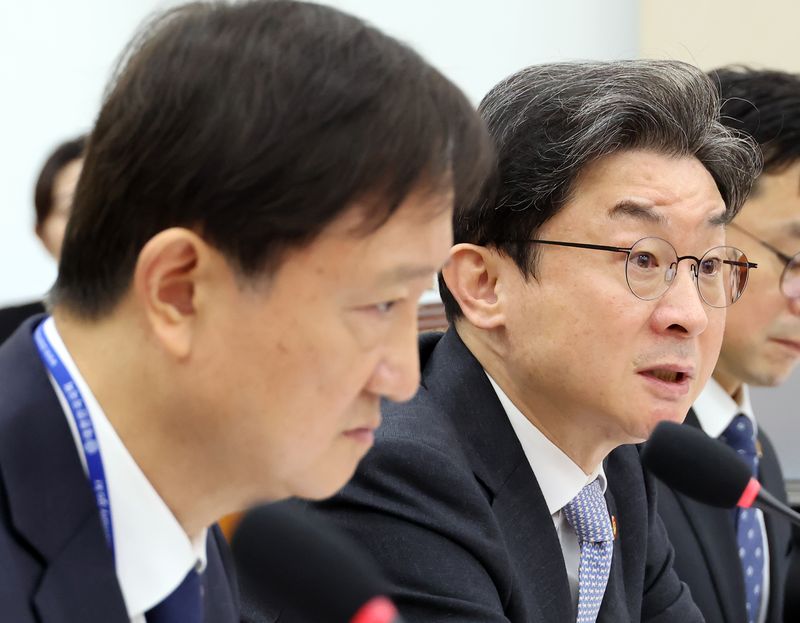
[Financial News] Financial regulators will begin government-ruling party consultations early next month on a plan to improve financial firms’ governance. Accordingly, the plan, which includes restrictions on financial holding company chairmen serving a third consecutive term, is expected to be announced in November. With 54 CEO changes scheduled at the five major financial groups alone by year-end, regulators say they can no longer put it off. The Financial Services Commission is seen as emerging from a ‘policy lull.’
According to financial regulators on the 26th, the Financial Services Commission plans to begin consultations with the ruling Democratic Party of Korea in early November to finalize a plan to improve financial companies’ governance that has been stalled for months. The commission’s goal is to present a plan to advance financial firms’ governance as early as November and by the end of the year at the latest. Voices within and outside the ruling party say it would be more reasonable to reform the process, for example by requiring a special resolution at a shareholders’ meeting, than to impose a blanket legal ban on financial holding company chairmen serving a third consecutive term. A financial regulator said, “We will announce a plan to advance financial firms’ governance through government-ruling party consultations, and resume the consultations in early November.” A ‘verbal warning’ from Financial Supervisory Service Governor Lee Chan-jin regarding appointment procedures in the financial sector is also expected to follow. Lee, who has criticized financial holding company chairmen for “entrenching themselves,” plans to hold a meeting on the 28th with the board chairs of the eight bank holding companies to stress transparency and fairness in the selection of bank CEOs. The plan to advance financial firms’ governance took shape in earnest last December, when President Lee Jae-myung publicly criticized the process for selecting financial holding company chairmen and bank CEOs as a “corrupt inner circle.” The plan was intended to coincide with the chair reappointment and selection season at Shinhan Financial Group, Woori Financial Group, BNK Financial Group and KB Financial Group. But after the government’s proposal was pushed back from March, as originally planned, to July, the effort lost momentum and stalled. The delay was largely due to controversy even within the ruling party over whether the reappointment of private financial holding company chairmen should be mandated by law, as well as the resignation of the Blue House policy chief and the resulting personnel vacuum, and single-stock leveraged exchange-traded funds (ETFs) and a sharp market downturn.
The Financial Services Commission is also expected to decide as early as its regular meeting in early November on final fines related to the mis-selling of Hong Kong H Index (Hang Seng China Enterprises Index)-linked equity-linked securities (ELS), which has drawn controversy over so-called ‘rubber-band fines.’ The fines apply to KB Kookmin Bank, Shinhan Bank, Hana Bank, NH Nonghyup Bank and SC First Bank. The total amount was initially calculated at 4 trillion won, then set at 2 trillion won during the preliminary notification process, and later approved at 1.4 trillion won by the Sanctions Review Committee. However, after the commission ordered a review in June, a proposal to reduce the amount to 600 billion won was reported again. Only the commission’s final decision remains, but it has struggled to reach a conclusion given that this would be the first large-scale fine imposed since the Financial Consumer Protection Act took effect and that the banks have signaled plans for extensive litigation.[email protected] Jo Eun-hyo Reporter