“So Many People Earn 100 Million Won a Year?” ... Is My Rank 1,650,000th? [Atongjin]
- Input
- 2026-11-14 06:00:00
- Updated
- 2026-11-14 06:00:05

An annual salary of 100 million won. Enviable. The weight of that figure may vary with age, but it sounds like a certificate of success. On a blind date, if someone says, “I earn about 100 million won a year,” the other person might set down their glass of water and listen a little more seriously.
100,000,000 won. The impression made by that figure is powerful. At work, it is someone’s goal; in salary negotiations for a new job, it is a barrier they want to break through. Only 1 million won has been added to 99 million, yet the salary is now labeled as being in the “100-million-won bracket.” Income has not increased much, but it feels as if one’s “status” has risen. With 100 million won, the heart reacts before the calculator does.
Divide a pre-tax annual salary of 100 million won by 12 months, and it comes to about 8.33 million won a month. Looking at the figure alone, it seems like money to spare would steadily pile up in the bank account each month. But the household budget tells a somewhat different story. Taxes and social insurance contributions are deducted, while mortgage principal and interest payments or rent await. If there are children, education costs add up; in households helping their parents, there is another expense to cover.
That is not to say 100 million won is a small amount. It is clearly a lot of money. But more expenses than you might expect lie between an annual salary of 100 million won and “a life without worries about money.” It may look as though you have arrived when you see your payslip, but there is still a way to go in the household budget.
So where does 100 million won rank in the statistics? Is it really the peak of salaried workers, reached by only a tiny few?
7.3% earn 100 million won or more a year... 7 in 100
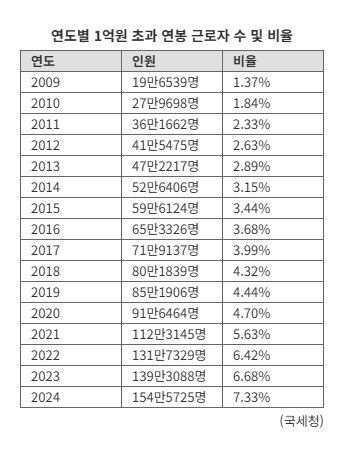
According to the National Tax Service’s year-end tax settlement statistics for employment income attributable to 2024, there were 21,078,535 filers in total. Of these, 1,545,725 reported gross pay exceeding 100 million won, about 7.3% of the total. Around 7 out of every 100 filers fell into this bracket.
That is not a large share, but it is not so rare as to count on one hand, either. The proportion is just over 7%, but in headcount it exceeds 1.54 million. It is no surprise to hear both “I haven’t seen many people like that around me” and “They’re common in my circle.” After all, each person’s circle is not a scaled-down version of all filers. As of 2026, the number of people earning 100 million won or more a year has likely increased.
But who is included in this 7.3%? The denominator is neither the entire population of Korea nor all employed people. It is the number of people who filed year-end tax returns for employment income. The figure does not also count people with only business income as if they were in the same group. And because it includes people who worked for only a few months, it is not the same as a ranking comparing only people who worked the entire year.
In baseball terms, it is like comparing the hit totals of players who played only half a season with those who played a full season. The basis for comparison differs from that of the so-called “full-year workers’ league,” which looks only at people who worked the entire year. Even with the same 100 million won, a person’s position in the statistics can change depending on whom they are ranked alongside.
But a high salary does not necessarily mean great wealth. Even people earning the same salary can have different living circumstances, depending on how much they own in property and savings and how much debt they have to repay.
The “title” of earning 100 million won a year has been confirmed. Now it is time to see whether there is also a certificate for being “rich.”
If you earn 100 million won a year, are you rich too?
A salary is not the only way to earn money. People can make money from a business or earn interest on savings and bonds. They may receive stock dividends or earn income by renting out property. Widen the lens beyond employment income, and another set of statistics comes into view.
An analysis by Rep. Yong Hye-in’s office of the “2023 Integrated Income Percentile Data” obtained from the National Tax Service found that average integrated income per person in the top 10% group was 153.17 million won. The average was 476.19 million won for the top 1% and 1.73681 billion won for the top 0.1%.
Integrated income is calculated by combining employment income and comprehensive income, then removing any employment income counted twice. Comprehensive income includes interest, dividends, business income, employment income, pension income and other income. It is a figure that looks at multiple sources of income, not just salaries.
The fact that average income in the top 10% is 153.17 million won does not mean you have to earn that much to be in the top 10%. The group includes people who earn more and people who earn less.
Nor can the difference from an annual salary of 100 million won be regarded as “money earned outside of one’s salary.” That is because these figures do not compare one person’s salary with their total income.
Ultimately, a salary alone does not reveal a person’s full financial circumstances. They may have money coming in separately from interest or dividends, and the assets they have saved or the debt they need to repay also differ from person to person. That is why people with the same salary can have different living circumstances.
The next question after how much you earn... how much is left, and what have you built up?
That changes the original question, “If you earn 100 million won a year, are you rich?”
Even with the same annual salary of 100 million won, the household budgets of someone who already owns a home and someone who needs to buy one now are different. So are those of someone with no loan and someone making monthly principal and interest payments, or someone living alone and someone responsible for the living costs of a family of four. The top line of their payslips may be the same, but the amount left at the end is not necessarily equal.
The reverse can also be true.
Even if a person’s salary is relatively low, receiving interest and dividends from financial assets they have already accumulated—or having rental and business income—changes how much money they have available to spend. Of course, such income is not always steady or guaranteed. Having multiple sources of income alone does not ensure financial security.
An annual salary is like the rate at which money comes in. Assets are what has been accumulated so far, and debt is what remains to be repaid. Living expenses flow out each month in between. To understand someone’s financial breathing room, you have to look at the whole household budget, not just one line.
An annual salary of 100 million won may be the result of years of effort and recognition within an organization. It is certainly a figure worth celebrating. On a blind date, that one remark might even change the other person’s expression a little.
But life’s household budget asks the next question: After how much comes in, how much is left? And what have you built up so far?
An annual salary of 100 million won is a badge of high standing that signals a high income. But it is no certificate guaranteeing a life free of money worries.
“Atongjin” is short for “the truth about statistics that are good for pretending to know what you’re talking about.” We explain in simple terms the differences hidden by averages and the stories statistics have yet to tell.
[email protected] Kim Ki-seok Reporter