[Exclusive] Four major insurance contributions deducted, workers left in limbo...Reports to NHIS and labor office bring no relief in sight
- Input
- 2026-10-26 08:00:00
- Updated
- 2026-10-26 08:00:00
[Financial News] Workers at a small and medium-sized company in Seoul have reportedly been unable to obtain relief for two years, despite repeatedly reporting the company to the relevant authorities, while it has accumulated at least 180 million won in unpaid contributions to the four major social insurance programs. The problems of unpaid premiums and missing wage and income records remain unresolved despite payment demands from the National Health Insurance Service, fines imposed by the labor office, and calls from the tax office to submit documents. Concerns are growing that workers are suffering prolonged harm as administrative measures by the relevant authorities have failed to lead to meaningful relief.
Questions over the effectiveness of NHIS’s compulsory collection
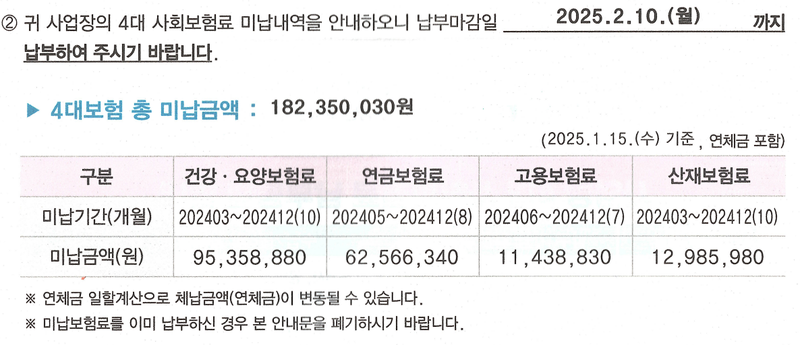
According to Financial News’ reporting on the 26th, the arrears listed in a notice of unpaid premiums for the four major social insurance programs that the National Health Insurance Service sent to Seoul-based Company A in January last year totaled 182,350,030 won. The breakdown was 95,358,880 won for health and long-term care insurance, 62,566,340 won for national pension, 11,438,830 won for employment insurance, and 12,985,980 won for industrial accident compensation insurance.Company A’s premium arrears began in 2024. The NHIS pressed the company to pay through February last year, but some employees’ premiums remain unpaid to this day.
According to documents issued by the NHIS to whistleblower Lee Sang-don, who worked at Company A, as of the 9th, his health and long-term care insurance premiums remained unpaid for 12 months, from April 2024 through March of last year, while his national pension premiums were unpaid for 9 months, from July 2024 through March of last year.
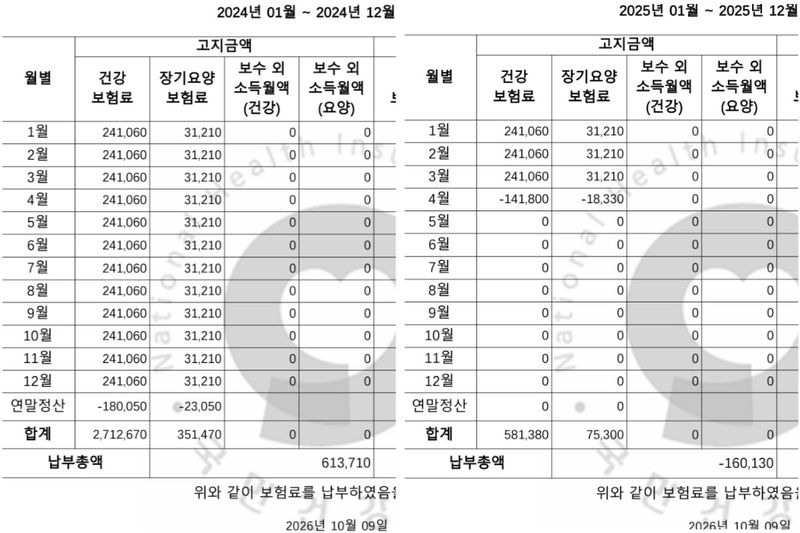
If an employer deducts national pension premiums from an employee’s wages but does not pay them, that period is not counted toward the employee’s contribution period, potentially reducing future pension benefits. A remedy is available under which employees can pay the premiums themselves to have the period recognized, but critics say workers may end up shouldering the burden caused by their employer’s arrears.
Company A’s representative told Financial News by phone, “The company is effectively out of business, so we couldn’t pay the premiums,” adding, “If the company recovers and has cash to spare, we might be able to pay, but realistically that would be difficult.”
The NHIS maintains that the obligation to pay premiums remains regardless of whether a company has ceased operations. An NHIS official explained, “A corporate business remains obligated to pay through the corporation even after it closes,” adding, “For businesses in arrears, we issue payment demands and preliminary notices of seizure, then proceed with compulsory collection measures such as seizing assets.” However, it has not been confirmed whether Company A’s assets were actually seized or whether any premiums were collected.
No change despite fines and calls to submit documents
The failure to provide wage statements also remains unresolved alongside the unpaid premiums. Company A was sent to trial on suspicion of wage arrears, received a deferred sentence, and was also fined for failing to provide wage statements. Lee, however, said he still had not received a wage statement and could not verify his wages or the premiums deducted from them.An official at the Seoul Regional Employment and Labor Office explained, “When a complaint is filed over failure to provide a wage statement, we either set a deadline for correction or determine whether the law has been violated and impose a fine.” The fine for a first violation is 300,000 won per employee, and the statutory maximum is 5 million won. Lee said that even after the fine was imposed, he had still not received a wage statement and was having difficulty accurately reconciling his wages.
The tax office’s calls for the company to submit documents also failed to produce a meaningful resolution. In response to Lee’s complaint about the failure to submit an earned income payment statement, the Seocho Tax Office said, “We will urge the company to submit the statement as soon as possible.” Lee claimed, however, that he was still unable to obtain the relevant documents afterward.
An official at the National Tax Service explained, “There is no specific manual for urging the submission of payment statements,” adding, “We can urge submission by official letter or phone, but failure to submit alone does not immediately lead to compulsory measures such as a tax audit.”
The harm to workers remains unremedied despite payment demands from the NHIS, fines imposed by the labor office, and calls from the tax office to submit documents. Lee stressed, “I have filed complaints several times with the labor office, the NHIS, and the tax office, but the unpaid premium issue has still not been resolved after two years, and I still can’t verify my wage records,” adding, “There needs to be meaningful recovery for workers, beyond simply imposing penalties on employers.”
[email protected] Lee Dong-hyuk Reporter