Jang Dong-hyuk Endures 425 Days... What's Next After the 'Longest-Serving' Title?
- Input
- 2026-10-25 14:43:56
- Updated
- 2026-10-25 14:43:56
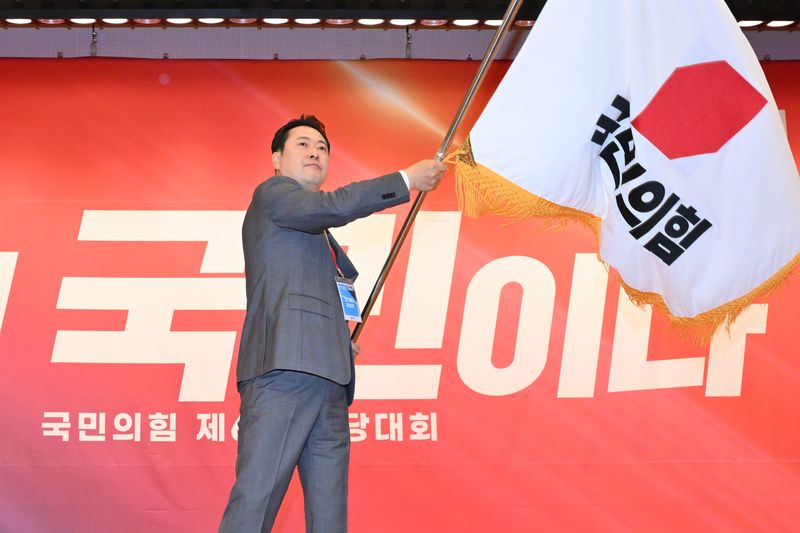
[Financial News] People Power Party leader Jang Dong-hyuk has set a record as the party's longest-serving leader. As of the 25th, he had been in office for 425 days, surpassing the 424-day tenure of former leader Lee Jun-seok. From shortly after taking office, he faced calls to resign over internal divisions, including disputes over apologizing for the December 3 Martial Law and expelling independent lawmaker Han Dong-hoon, as well as the party's defeat in the June 3 local elections. In the end, however, he managed to hold on.
With Jang having relied on support from Yoon Again before the local elections and from the Olympic Park faction afterward, observers say he needs to change course to win reelection as party leader and secure victory in the 2028 general election. His term runs until August next year, but some figures opposed to his leadership argue that the party needs a change of leadership to someone with greater appeal to centrist voters.
According to opposition parties on the 25th, Jang set a record that day as the longest-serving party leader since the party changed its name in 2020. Lee Jun-seok, the party's first leader, served for 424 days; its second leader, former leader Kim Gi-hyeon, served for 280 days; and its third leader, former leader Han Dong-hoon, served for 146 days. Even if the scope is widened to include the Saenuri Party, the Liberty Korea Party and the United Future Party, former leader Kim Moo-sung, who resigned in 2016, held the position the longest, for 640 days.
Jang's 425 days in office were a continuous series of trials. Shortly after taking office on August 26 last year, he faced the task of uniting the pro-impeachment camp, which supported impeaching former President Yoon Suk Yeol, and the anti-impeachment camp, which opposed impeachment, after they clashed during the party convention. Around the first anniversary of the December 3 Martial Law declaration, he faced controversy over whether to apologize for martial law. Each time, Jang tried to push through the crisis head-on, repeatedly rejecting both reconciliation with the anti-impeachment camp and an apology for martial law. The high point came in January this year, when he pushed ahead with expelling former leader Han Dong-hoon. Hardline supporters cheered, but the prevailing assessment was that he had lost the support of centrist and conservative voters. Even amid these crises, he sought a way out through a '24-hour filibuster (unlimited debate)' and a hunger strike, managing to sidestep them.
Calls by figures outside Jang's faction for him to clarify his future were strongest around the June 3 local elections. Their argument was that the party could never win the elections under Jang's leadership. At the time, Seoul mayoral candidate Oh Se-hoon personally stepped forward to call for Jang's resignation, and candidates began distancing themselves from the party leadership as if it were a trend. Opposition to Jang intensified further when he traveled to the United States during the election campaign. In the end, the party won only four races for heads of metropolitan governments, amounting in effect to a 'crushing defeat,' and calls for Jang to resign were even made to his face.
Even after the local-election defeat, Jang had a way out: the shortage of ballots in the National Election Commission incident. His faction countered that 'we cannot afford to fall into internal disarray while calls for a parliamentary investigation and a special prosecutor into the NEC incident are mounting.' Later, analysts said Jang's leadership was also stabilizing and benefiting indirectly as approval ratings for President Lee Jae Myung and the Democratic Party of Korea began to decline.
Though he has claimed the title of 'longest-serving party leader,' Jang's leadership is by no means secure. There is considerable criticism among lawmakers and party figures, including comments such as 'What does being the longest-serving even mean?' and 'The Democratic Party's approval rating is falling, but the People Power Party's is unchanged—whose fault is that?' One alternative proposal is to 'bring in everyone, including lawmakers Han Dong-hoon and Lee Jun-seok, and let them compete.'
Many observers, however, believe Jang is likely to win reelection. Their reasons include the fact that, as government and ruling-party missteps continue, lawmakers are not yet making strong formal demands for an immediate change in direction by the People Power Party leadership, and that Jang, backed by hardline party members, has an advantage at the party convention because members account for 80% of the vote.
Observers say that, to go beyond completing his term and winning reelection and emerge as a leader of the conservative opposition, Jang must present the image of a 'party ready to govern' rather than a 'party of struggle.' He must first address divisions in the opposition and deliver tangible results as leader of the main opposition party. One political insider said, 'Jang needs to show conservative voters that “without me, we can't win the general election,”' adding, 'Then shouldn't he also be able to convince centrist voters that “I'm better than the Democratic Party”?'.
[email protected] Lee Hae-ram Reporter