55% of Young People Say They'd Work at SMEs Outside the Capital Region If Pay and Benefits Are Right
- Input
- 2026-10-25 13:35:39
- Updated
- 2026-10-25 13:35:39
Six in 10 young people with experience working at small and medium-sized enterprises (SMEs) had spent less than a year working at SMEs in total. Fewer than half of young people currently employed at SMEs said they intended to stay. The analysis suggests that improving working conditions and supporting long-term retention are just as important as securing young talent for SMEs.
On the 25th, according to the “Survey on Young People’s Perceptions of Jobs at SMEs,” conducted by the Korea Federation of SMEs among 1,000 people aged 19–39, 58.7% of the 191 young respondents with past SME work experience had worked at SMEs for less than a year in total.
The most commonly cited reason for leaving was low pay (41.4%). Poor working conditions and excessive workloads or long working hours followed, each at 37.2%. Among young people currently employed at SMEs, 46.7% said they intended to stay. The share of other young people, including those who were unemployed, who intended to take a job at an SME was 30.6%.
Notably, young people value practical working conditions, such as pay and the work environment, more than company size itself. Overall, 56.5% of respondents said they prioritized pay, the work environment and growth prospects over company size. The figure among young people employed at SMEs was 64.5%, 8.0 percentage points higher than the overall average.
Pay (64.7%) was cited as the most important factor when choosing a job. Working hours (51.9%) and job security (50.9%) were also cited by more than half of respondents.
By contrast, the most commonly cited reason for avoiding jobs at SMEs was poor working conditions and organizational culture (52.3%). Other reasons included low pay (49.8%), uncertainty about career and growth prospects (36.4%), and concerns about job security (36.3%). In other words, the conditions young people prioritize when choosing a job largely overlap with the reasons they are reluctant to work at SMEs.
Young people expressed conditional interest in working at SMEs outside the Seoul metropolitan area. A total of 55.3% said they would consider taking a job at an SME outside the region if conditions such as pay, benefits and job duties met their expectations.
Housing support (55.2%) was the most commonly cited important condition when considering work in a regional area. Competitive pay compared with the Seoul metropolitan area (47.5%) and transportation or commuting support (43.9%) followed. Reasons for not considering jobs at SMEs outside the Seoul metropolitan area included the burden of living far from family and acquaintances (61.3%) and transportation or accessibility problems (44.4%).
Young people also had a pessimistic outlook on the job market. The share who said job-seeking and hiring opportunities had decreased this year compared with last year was 46.6%, far above the 7.0% who said they had increased. More young people expected such opportunities to decrease next year (40.3%) than to increase (9.4%).
The main difficulties cited in the job search process were entry-level positions requiring job-specific or practical experience (52.0%) and the expansion of rolling recruitment focused on experienced candidates (48.7%).
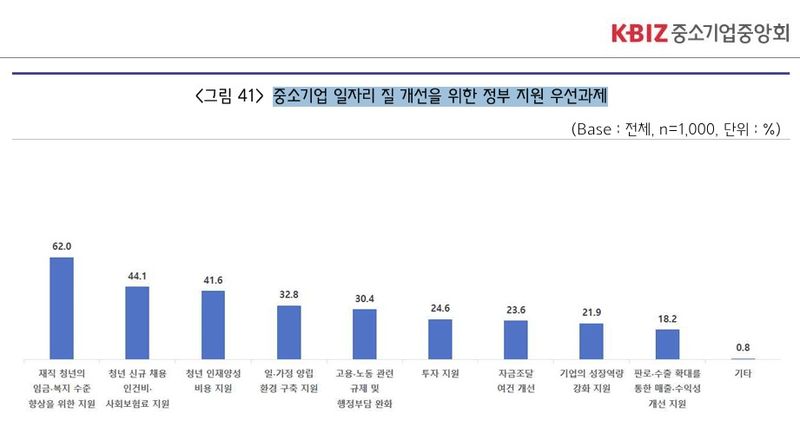
Among the government support measures cited to improve job quality at SMEs, support for raising pay and benefit levels for young people already employed at SMEs ranked highest (62.0%). This was followed by support for labor costs and social insurance premiums for newly hired young workers (44.1%), and support for talent development costs, including job training and on-the-job training (41.6%).
Yang Ok-seok, head of the Human Resources Policy Headquarters at the Korea Federation of SMEs, said, “To encourage young people to take jobs at SMEs and stay long term, it is important to narrow the pay and benefits gap with large companies and improve working conditions and organizational culture. We will also strengthen support for long-term retention and work to ease labor shortages at regional SMEs by improving living conditions, including housing and transportation.”
[email protected] Kim Hyun-chul Reporter