Kolon Industries and HS Hyosung Advanced Materials advance EV tire materials
- Input
- 2026-10-30 18:35:18
- Updated
- 2026-10-30 18:35:18
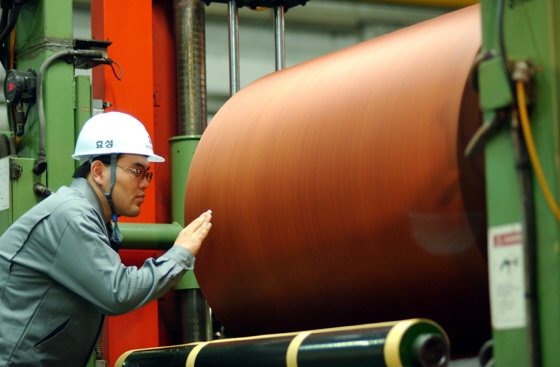
[Financial News] Kolon Industries and HS Hyosung Advanced Materials are stepping up efforts to target the market for high-performance tire materials for electric vehicles. Their strategy is to strengthen high-value-added products, including hybrid tire cords with greater strength and modulus of elasticity than conventional nylon, to meet EVs’ high weight and driving force. However, short-term earnings are expected to weaken due to the stronger won, rising raw material prices and oversupply from China.
According to industry sources on the 30th, HS Hyosung Advanced Materials holds the top spot in the global polyester (PET) tire-cord market, with a share of about 50%. Kolon Industries, the country’s leading producer by aramid production capacity, supplies tire cords, aramid and petroleum resins for tires, among other products.
The product both companies are focusing on is hybrid tire cord, which combines aramid and nylon. Tire cord is a reinforcing material that maintains a tire’s shape and supports its load. Electric vehicles are heavier because they carry batteries and have high initial driving force, making tire durability and load-bearing capacity important.
Hybrid tire cord is considered better suited to preventing deformation of the belt inside a tire at high speeds because it has greater strength and modulus of elasticity than conventional nylon products. HS Hyosung Advanced Materials’ hybrid tire cord also sells for about five times the price of its conventional nylon products. It is currently used in premium EV tires and other products, and increased supply is expected to improve profitability.
However, expanding high-value-added products is unlikely to improve earnings immediately. Shinhan Securities estimated Kolon Industries’ operating profit for the third quarter of this year at 44.4 billion won, down 55% from the previous quarter. Operating profit in the industrial materials division was forecast to fall 47% to 11.9 billion won. Key reasons include weaker export profitability due to the stronger won, widening losses in aramid and declining profitability in tire cord.
For the same period, HS Hyosung Advanced Materials’ operating profit was also forecast to fall 32% from the previous quarter to 52.6 billion won. Operating profit in its core tire reinforcement materials business was estimated to decline 29% to 45.7 billion won, affected by higher raw material prices and lower selling prices. The super-fiber division, including carbon fiber and aramid, is expected to remain in the red, but its operating loss is projected to narrow from 13 billion won in the previous quarter to 5.8 billion won.
Both companies are also expanding into new businesses beyond tire materials. Kolon Industries recently started operations at its second modified polyphenylene oxide (mPPO) plant in Gimcheon, North Gyeongsang Province, raising annual production capacity, in equivalent sales value, from 80 billion won to 200 billion won. mPPO is used in copper-clad laminates (CCL) for artificial intelligence (AI) servers, and the company is undergoing quality certification with customers in South Korea and abroad. Its transparent polyimide (CPI) business is also responding to growing demand for foldable phones.
HS Hyosung Advanced Materials is seeking new sources of demand, including defense and drones, based on its carbon-fiber production base in Vietnam and its aramid business. However, profitability remains under pressure from oversupply originating in China and a downturn in the carbon-fiber market.
An industry official said, “We expect demand for hybrid tire cord to increase as tires for electric vehicles become higher-performance,” adding, “However, actual improvements in profitability depend on expanding supply to customers and utilization rates at production facilities.”
[email protected] Kim Mi-hee Reporter